
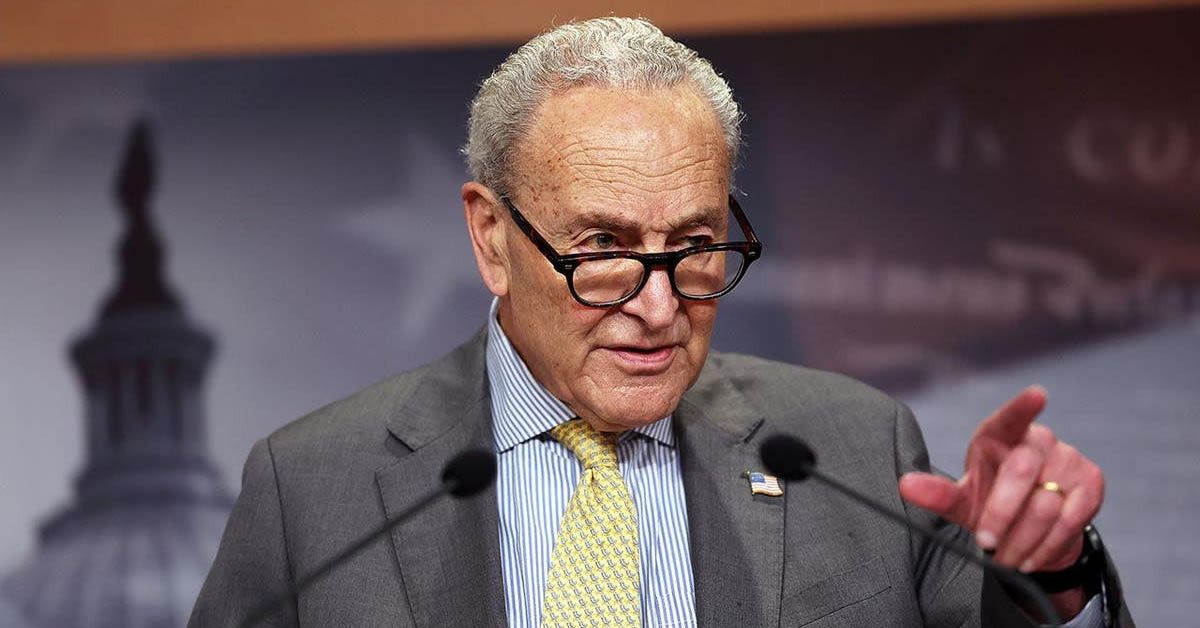
Senate Minority Leader Chuck Schumer is sounding the alarm to his fellow Democrats, warning that an enormous Republican financial edge could determine who controls the upper chamber after the midterm elections.
In a Dear Colleague letter circulated, Schumer cautioned that the fight for the Senate may hinge on whether Democrats can withstand what he called an unprecedented tsunami of Republican money pouring into key races in the final stretch. According to Western Journal, he framed the contest as a clash between strong Democratic candidates and a GOP war chest that threatens to overwhelm them in the closing weeks.
We have strong candidates, a clear message, and a political climate that offers real opportunities. But Republicans have one enormous advantage of their own. Money, the New York Democrat wrote, underscoring his partys concern that messaging alone may not be enough to blunt the Republican surge. He highlighted that President Donald Trump could deploy between $400 million and $500 million through his super PAC, MAGA Inc., a staggering sum that would supercharge Republican efforts to flip or defend critical seats.
Schumer also pointed to the growing role of high-profile conservative donors in bolstering GOP prospects. Elon Musk, he noted, has added $300 million to help Republicans win midterm races, further widening the financial gap between the parties. Thats the enormous force bearing down on this election. And its a challenge none of us can afford to underestimate, Schumer exhorted, urging Democrats to recognize the scale of the Republican advantage.
The disparity is already visible in the advertising battlefield that often shapes late-breaking voter sentiment. Further, CNBC reported, Going into the closing weeks, Republicans and their allies have about $888 million in advertising planned through Election Day, compared with roughly $666 million for Democrats and their allies, according to AdImpact. That nearly quarter-billion-dollar edge in planned ad spending gives Republicans a powerful megaphone to hammer home their message on inflation, crime, and the Biden administrations failures.
Despite this, Schumer insisted Democrats retain a political advantage rooted in public dissatisfaction with Trump and economic pain under his watch, a claim that conveniently sidesteps the inflation and cost-of-living crisis under President Joe Biden. Schumer argued that Trumps unpopularity, combined with voter frustration over high prices, can be leveraged against Senate Republicans. Over the last two years, our caucus has worked every day to make sure the American people understand that Senate Republicans are responsible for the costs they are paying and the pain they are feeling, he wrote, attempting to shift blame away from Democratic policies that have fueled record inflation.
Polling, however, suggests a far more competitive landscape than Democrats would like to admit. Fox News reported on Tuesday that its latest projections show Republicans and Democrats each with 47 likely Senate seats, leaving six races categorized as toss-ups. Those pivotal contests include Alaska, Iowa, Maine, Michigan, Ohio, and Texas, states where Republican candidates are generally running on platforms of fiscal restraint, energy independence, and tougher border security.
The Cook Political Report, a closely watched election handicapper, adds Kansas to the list of toss-up states, further expanding the map of competitive races. That assessment indicates that Democrats are on defense even in traditionally right-leaning states where they had hoped demographic changes and heavy spending might give them an opening. For conservatives, these ratings underscore that a disciplined message on inflation, crime, and cultural overreach can keep the Senate within Republican hands despite the Democrats media and institutional advantages.
Data analysts are also signaling that the polling environment may be underestimating Republican strength, as has happened in recent cycles. CNN chief data analyst Harry Enten argued Monday that Republicans have a solid chance of maintaining their Senate majority, especially if the polls are again skewed toward Democrats. Lets just say we have the 2026 Senate polls, but if the polls are underestimating the Republicans by 3.5 points, which you know is really possible, because weve seen it through the history, right? You go back to 2020, thats basically what happened, he declared, referencing the consistent pattern of GOP overperformance relative to pre-election surveys.
Enten went further, mapping out how a modest polling error could translate into a comfortable Republican majority. How about Michigan? How about up there in Maine, how about in Alaska, how about in Iowa, how about in Kansas which has been getting a lot of press lately all of these go red. All these go red, and the Republicans dont just hold the United States Senate; they hold it easily with 52 seats to the Democrats 48 seats. That scenario would represent a clear rebuke of the Biden-Schumer agenda and a mandate for a more conservative course on spending, regulation, and cultural issues.
Schumers increasingly urgent tone reflects his awareness that the numbers are not moving in his partys favor, despite massive Democratic spending and a friendly media environment. Schumer clearly sees these polling numbers and realizes that the November elections may keep his party in the minority position, especially if Republican voters remain energized and conservative donors continue to fuel the GOPs late-game advertising blitz.
Login