
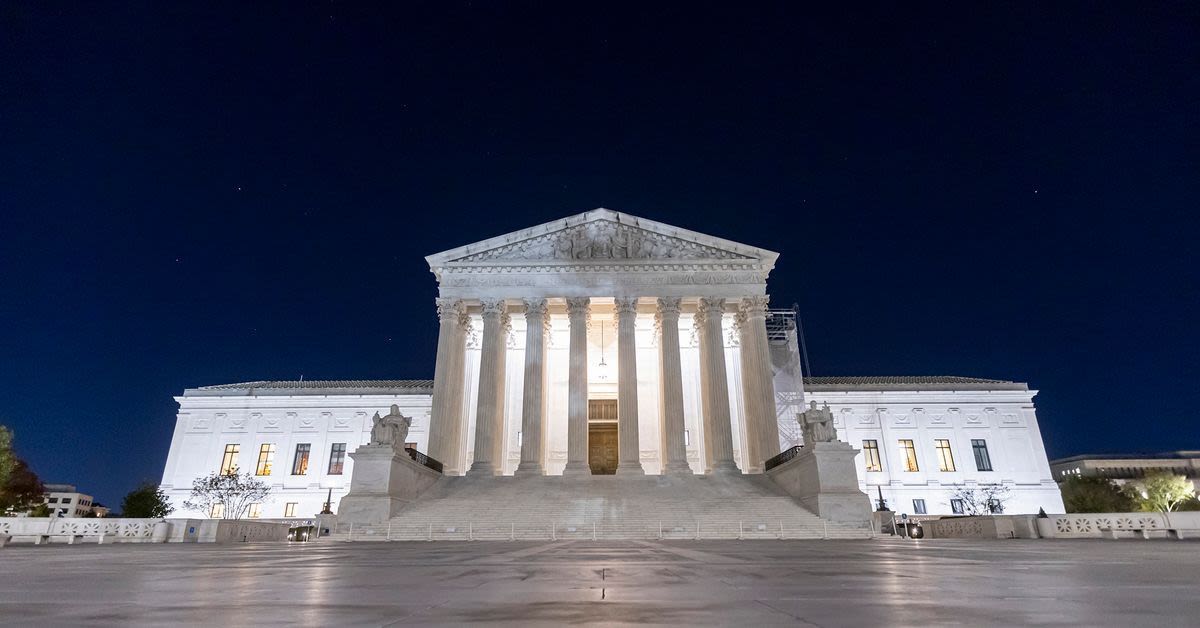
The Supreme Court is preparing to decide whether a man who cooked thousands of meals for an armed terrorist organization should be allowed to claim asylum in the United States.
At the center of the case, Blanche v. Ozurumba, is Izuchukwu Ozurumba, a Nigerian national who crossed the U.S. border illegally in July 2023 after working for roughly six months in 2022 as a cook for a militant faction known as the Unknown Gunmen. According to Gateway Pundit, court filings show that U.S. officials have classified the Unknown Gunmen as a Tier III terrorist organization, and the dispute now before the high court will test how far activist courts can stretch immigration law to benefit foreign nationals with direct ties to extremist groups.
Court records indicate that Ozurumba prepared three meals a day for between 15 and 17 leaders of the group at a remote camp outside Lagos, meaning he likely produced thousands of meals over that period. U.S. immigration authorities concluded that this activity amounted to material support for terrorism under the Immigration and Nationality Act, a finding that made him ineligible for asylum and led to his removal back to Nigeria.
Ozurumba insists that he was lured to the camp by a job tip, only discovering its true nature after arrival, and claims he continued cooking under threat, sometimes without pay, before escaping during a grocery run and eventually fleeing through Venezuela to the United States. The Board of Immigration Appeals, however, has consistently held that the statute contains no duress exception for providing support to terrorist organizations, reflecting Congresss clear intent to draw a bright line against any assistance to extremists.
In September 2025, a divided panel of the Fourth Circuit Court of Appeals overturned the immigration courts rulings and sided with Ozurumba. Judge Andrew Wynn, an Obama appointee, concluded that Ozurumbas cookingusing food and supplies furnished by the group itselfwas not material because it did not provide anything the organization could use or readily divert to plan or carry out its terrorist activities, and the majority went so far as to describe him as a captive laborer.
Judge Julius Richardson dissented sharply, arguing that feeding the leaders of a terrorist organization for months is both quantitatively and functionally material support, noting that an army marches on its stomach and that the meals effectively freed up resources for the groups operations. His view reflects a more traditional understanding of national security law: that logistical and logistical-style supportwhether food, fuel, or shelterenables terrorism just as surely as weapons or cash.
The Trump administration, represented by Attorney General Todd Blanche and Solicitor General D. John Sauer, has asked the Supreme Court to reverse the Fourth Circuit and restore the tougher standard. The government contends that the appellate ruling effectively guts the material-support bar, conflicts with decisions from other circuits, and would substantially increase the burden on the government in excluding aliens with links to terrorism.
As the Justice Department bluntly stated, Providing meals to a terrorist organizations members is no less a material form of support than providing gasoline for its vehicles, adding that the law does not distinguish between guns and butter. That position underscores a core conservative principle: national security and border integrity require clear, enforceable rules that do not reward those who knowingly embed themselves within terrorist networks and then seek refuge in the United States.
The Supreme Court granted certiorari on Tuesday, setting the stage for arguments later in the term and a decision expected by the end of June 2027. The justices will address a narrow but consequential question: whether material support under 8 U.S.C. 1182(a)(3)(B)(iv)(VI) requires that the support directly advance the organizations actual commission of terrorism, or whether sustained logistical assistance to its leadership is enough.
The Department of Justice has warned the Court that if the Fourth Circuits precedent is allowed to stand, it will substantially increase the burden on the government in excluding aliens with links to terrorism, inviting more litigation from individuals who aided extremists but now claim victimhood. If preparing food for terrorists does not qualify as material support, critics ask what will be excused nextWashing the blood off their uniforms? Driving the getaway vans? Managing their payroll?
Login