
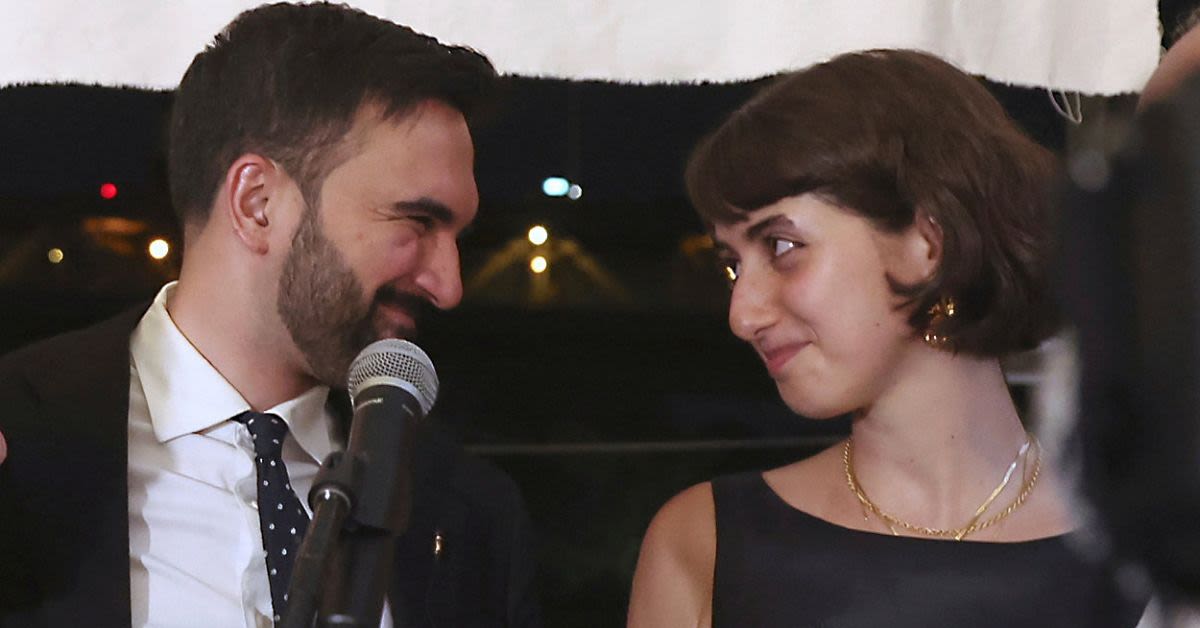
New York Citys first lady, Rama Duwaji, has chosen as her self-professed artistic "inspiration" a Palestinian propagandist who glorified Hamas leaders as "great heroes," cheered the Oct. 7 massacre, and promoted the lie that The Diary of Anne Frank is a Jewish fabrication
According to the Washington Free Beacon, the artist in question, Sliman Mansour, was not merely a painter but a committed advocate of violent "resistance" whose work and public statements consistently exalted terrorism against Israel. Mansour, who died in August, spent decades producing images and commentary that romanticized armed struggle, lionized jihadist leaders, and trafficked in crude antisemitic conspiracy theories. Yet this is the man whom Duwaji, the Syrian-born wife of New York City comptroller and left-wing politician Zohran Mamdani, publicly credits as a central influence on her own creative work.
Mansours connection to Hamass most notorious figures is not abstract or incidental. He was reportedly pleased when a militant reinterpretation of one of his paintings was used as the backdrop for a fiery press conference by Yahya Sinwar, the Hamas commander who would go on to mastermind the Oct. 7 atrocities, during which Sinwar thanked Iran for bankrolling the terror group. Before Mansours death, Duwaji had already animated a portrait of him and explicitly declared that he "inspired the work that I do," signaling a deep ideological affinity rather than a casual artistic admiration.
"Hi, I'm Rama, a Syrian illustrator and animator based in Brooklyn, and today I'm going to be animating a portrait of Sliman Mansour, who is a painter and sculptor that's inspired the work that I do. Sliman is an artist of the Intifada," Duwaji said in a video first posted online in April 2024, identifying herself as Houston-born and now living in New York. The second intifada in the early 2000s was not a vague political protest but a bloody terror campaign that included suicide bombings on buses and in cafes, leaving more than a thousand Israelis dead, the vast majority of them civilians.
In the same video, Duwaji elaborated on what she finds so compelling in Mansours oeuvre. Mansours work "is about the Palestinian experience under occupation, and growing up seeing his paintings, I was always really inspired by the emotion behind his portraits," she continued, framing his imagery as a formative part of her own worldview. The setting of the video underscores the political message: she works in a Palestinian-themed studio beneath a large banner proclaiming "Artists Against Apartheid: Palestine Will Be Free," a slogan widely recognized as an antisemitic call for the elimination of the Jewish state rather than a plea for coexistence.
Her visual cues are equally pointed. She wears a keffiyeh-patterned headband, a symbol long associated with Palestinian militancy, and even lights a candle using matches from a Brooklyn Palestinian restaurant, turning a simple artistic process into a ritualized political statement. "Sliman has been jailed twice since the start of his career," Duwaji says proudly, presenting his imprisonment not as a stain but as a badge of honor. "And since then, he's inspired many artists after him, including myself."
A review of Mansours work, writings, social media posts, and public associations reveals a consistent pattern of incitement and endorsement of violence rather than any serious commitment to peace or coexistence. On Oct. 8, in the immediate aftermath of Hamass slaughter of more than 1,200 Israelis, Mansour posted on Facebook an image of his war-themed painting "Rising," which prominently features a Palestinian fighter gripping a gun. The comments beneath the post were filled with jubilation, including one admirer who gushed, "So timely and amazingly beautiful," treating mass murder as an occasion for aesthetic celebration.
On Oct. 17, Mansour went further, posting an image of Ghassan Kanafani, a founder of the Popular Front for the Liberation of Palestine, a U.S.-designated terrorist organization responsible for hijackings and bombings. The accompanying message was a call to arms for his followersone of whom is Duwaji. "You might have heard the news through the imperialist propaganda system that the Palestinian people are currently exhausted, that they have given up the struggle, and that they are defeated by the reactionary Israel. Comrades, do not believe them. There is no end to our struggle," the post read, rejecting any notion of compromise or peace.
"The struggle has no end," Sliman added, making clear that his vision is one of perpetual conflict rather than reconciliation. His admiration for Hamass leadership was explicit and longstanding. In a November 2017 Facebook post, Mansour hailed Hamas founders Ahmed Yassin and Abdul Aziz Al-Rantasi as "great leaders," even though both men orchestrated terror attacks that deliberately targeted civilians and were killed in Israeli airstrikes in 2004.
Mansours art was not merely background noise to the regions violence; it was actively incorporated into Hamas propaganda. In 2021, Sinwar held a press conference in Gaza to boast about a wave of violence he had unleashed that left more than a dozen Israelis dead, an event broadcast live by Al Jazeera and still available on YouTube. "Our political ideology is clear and well-known. We are for the demise of Israel and through Jihad and armed struggle. This is our ideology," Sinwar thundered, leaving no doubt about Hamass genocidal aims.
"All thanks and gratitude to the Islamic Republic of Iran, which has not been stingy with us over the past years nor with other Palestinian resistance factions regarding money, weapons, expertise, and support in all fields," he said later, openly acknowledging Tehrans role in arming and financing the terror campaign. As Sinwar ranted, the backdrop behind him displayed a large banner depicting a Palestinian fighter carrying the city of Jerusalem on his back, a powerful image designed to sanctify violence as heroic sacrifice. That image was a direct reinterpretation of Mansours painting The Camel of Bearings, and Mansour himself expressed satisfaction that his work had been appropriated for such a purpose.
"They didn't put the face of a politician, but rather the face of a young resistance fighter who has become the future in the eyes of Palestinians, the resistance fighter who carries Jerusalem on his back," he told Al Jazeera in the days after the press conference, endorsing the symbolism. "Using icons in different expressions is legitimate," Mansour reflected, adding that it "didn't bother him at all," a revealing comment from a man whose art was being used to glorify jihad and the destruction of Israel.
Duwajis description of Mansour as an artist of the "intifada" was not a mischaracterization; it was an accurate reflection of how he saw himself. In a fawning NPR interview published after his death, Mansour openly boasted about his role in the violent uprising. "I participated in the first intifada," he said, recalling that he had been throwing stones "and whatever" during deadly clashes, a casual phrase that glosses over the lethal nature of the confrontations.
In 2025, he asserted that Palestinians had a right to pursue "armed resistance" against Israel, a euphemism that in practice has meant suicide bombings, rocket attacks, and the deliberate targeting of civilians. His record of direct involvement with terrorist-linked organizations stretches back decades. In 1981, Mansour was arrested for taking photographs in a military area, according to a clipping from the Palestine Liberation Organization newspaper Al Fajr, which also noted that he worked as a cartoonist for the publication.
The PLO, another U.S.-designated terrorist organization, made extensive use of Mansours talents to advance its agenda. His 1980 Communist-inspired poster "Workers' Arms Defend the Revolution and the Masses" was first published by the Palestine Martyrs Works Society, also known as SAMED, according to the Palestinian Poster Project Archives. SAMED oversaw PLO payments to the families of Palestinians killed while carrying out terrorist attacks against Jews, effectively institutionalizing financial rewards for violence.
Mansours social media activity in recent years shows that his glorification of terror never abated. On July 31, 2024, the day Hamas leader Ismail Haniyeh was killed by Israel at his hideout in Iran, Mansour posted an image of his painting "Abu Jihad" to Instagram, named for an earlier terrorist leader eliminated by Israel. On September 28, 2024, the day after Israel killed Hezbollah chief Hassan Nasrallah, he posted an image of his painting "The Martyr" to his Instagram account, again celebrating figures whose legacies are soaked in blood.
His admiration extended to individual terrorists as well. After Palestinian terrorist Walid Daqqa died in an Israeli prison in April 2024, where he was serving a life sentence for murdering an Israeli soldier, Mansour met Daqqas widow and daughter a few months later, as documented on his Instagram. Far from being marginalized, Mansour was embraced by the broader anti-Israel ecosystem: he was honored by former PLO leader Yasser Arafat, and his work was recently displayed at the Tehran Museum of Contemporary Art, a fitting venue given the Iranian regimes sponsorship of terrorism.
In March 2025, Mansour received the Necip Faz?l Award in Istanbul and was singled out for praise by Turkish president Recep Tayyip Erdo?an. The awards namesake, Necip Faz?l K?sakrek, was a notorious antisemite who produced the Turkish translation of the Protocols of the Elders of Zion and called for the eradication of Jews in Turkey, underscoring the ideological company Mansour kept. Mansours Facebook page, largely in Arabic, reveals a long history of deranged and frequently antisemitic ranting, often amplifying conspiracy theories that would not be out of place in 1930s Europe.
He often shared bizarre and hateful claims about Jews. "The diaries 'I am Frank' that they made the world famous finally turned out to be the invention of an American Jewish writer," Mansour said in a February 2016 post, linking to a widely debunked hoax about Anne Franks diary. One of the top comments, which Mansour liked, read: "Look at how the Jewish mind works: setting up, cheating, making profits, and the strange thing is that the world believes the lies and considers them a truthful history, while in reality, it is a forgery, a fantasy, and a deception in order to achieve the goal: material, more money, and control," a textbook example of antisemitic stereotyping.
In September 2015, Mansour shared a painting by Adolf Hitler and, in a follow-up comment, described the Nazi dictator as a "technically proficient artist." Another commenter, whose post Mansour liked, wrote, "May God have mercy on you oh Muhammad Hitler you were a natural Muslim Daesh," equating Hitler with ISIS and praising him as a kind of proto-Islamist extremist. In November 2016, Mansour accused Hillary Clinton of donating money to ISIS, further illustrating his penchant for conspiratorial, extremist rhetoric.
For Duwaji, whose public persona appears overwhelmingly consumed by the Palestinian cause, her embrace of Mansour is only one episode in a broader pattern of associations with individuals and organizations committed to the violent destruction of Israel and the demonization of Jews. This behavior has not ceased since she moved into Gracie Mansion. She has a long record of social media posts celebrating Palestinian terrorism, and on and after Oct. 7 she "liked" multiple posts that framed the massacre as legitimate resistance, as well as a post that dismissed reports of Hamas sexual violence on Oct. 7 as "a mass rape hoax."
Her judgment in other areas has also raised eyebrows. She has used the N-word onlinethe only remark for which she has ever publicly apologizedsuggesting that her professed concern for justice and equality is highly selective. While she is rarely seen at public events with her husband, who describes her as a "private person," a smiling Duwaji was photographed inside Gracie Mansion serving food to Mahmoud Khalil, the notorious organizer of the anti-Israel protests at Columbia University, indicating that her activism continues behind closed doors.
Her professional endeavors likewise reflect a consistent ideological through-line. Last week, the Free Beacon reported on Duwajis work for an olive oil company dedicated to promoting Palestinian terrorism, whose farmers boast that their olive groves are watered in "martyrs' blood." Last month, New Yorks first lady also served as the artist in residence at a luxury Islamic womens retreat in Portugal that has called for the destruction of Israel and for the countrys Jewish "oppressors" to be "cleansed" from the land, a chilling echo of the rhetoric that has historically preceded ethnic cleansing and genocide.
For a city that prides itself on diversity, tolerance, and the rule of law, the spectacle of its first lady venerating a man who praised Hamas founders as "great leaders," endorsed "armed resistance," and spread lies about Anne Franks diary should prompt serious questions about the moral compass of those in and around power. When the spouse of a prominent elected official openly aligns herself with figures who celebrate terrorism and traffic in antisemitic conspiracy theories, it is not merely an aesthetic choice about art; it is a political statement that normalizes extremism and undermines the values of individual liberty, human dignity, and the sanctity of innocent life that conservatives argue must remain at the core of any civilized society.
Login