
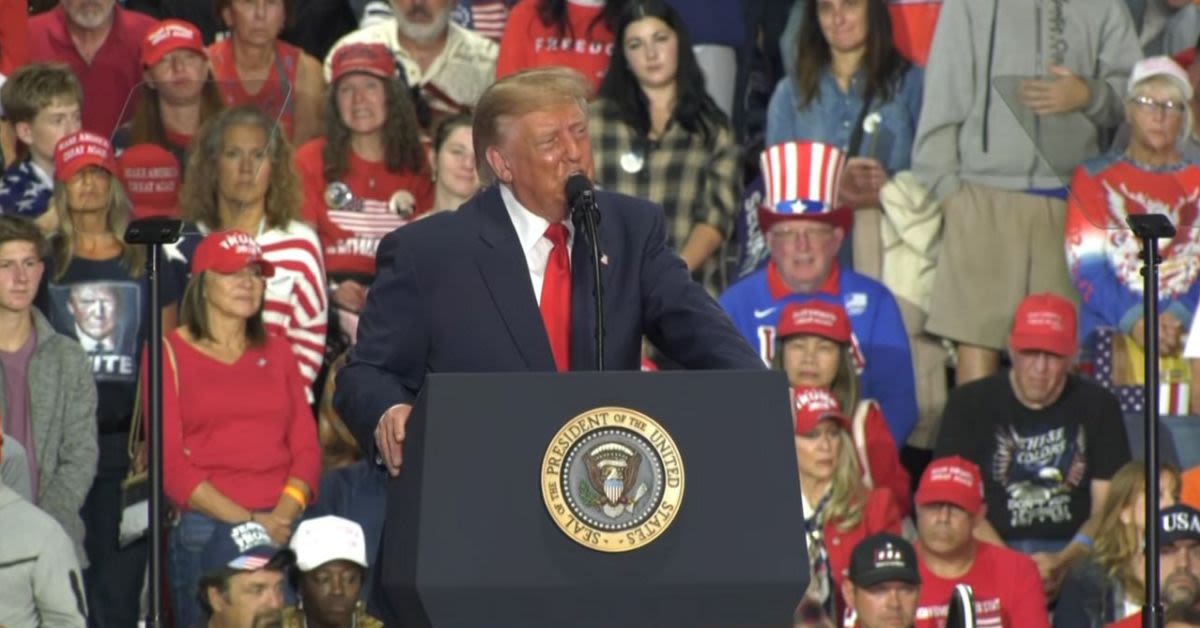
President Donald Trump drew a boisterous crowd in Syracuse, New York, on Friday night, pressing voters to install Republican Bruce Blakeman in the governors mansion and to keep Congress in GOP hands in Novembers midterm elections.
Speaking inside a packed Oncenter in downtown Syracuse, Trump framed the race as a referendum on Democratic Gov. Kathy Hochuls record on immigration, crime, and progressive social policy, arguing that New Yorkers have endured nearly two decades of one-party rule in Albany. According to Newsmax, the president cast the states political status quo as a symptom of entrenched liberal governance that has eroded public safety, economic confidence, and traditional values.
Trump did not mince words as he urged voters to break the Democratic hold on state government and send a message to Albanys political class. The people of New York need to clean house in Albany on November 3, starting with Kathy Hochul, he told supporters, before driving the point home with a sharper rebuke: New York needs to throw out this radical left lunatic and elect Bruce Blakeman, he added, promising to work closely with the Nassau County executive if elected.
Blakeman, standing alongside Trump, echoed that indictment of Hochuls tenure and portrayed the state as weary of progressive governance that has failed to deliver security or prosperity. I've traveled to every part of this state, every nook and cranny of the state of New York and everywhere I go it's the same story: people are miserable under Kathy Hochul, Blakeman said, arguing that frustration with rising costs and public disorder is uniting voters across traditional partisan lines.
The president also seized on Albanys social-policy agenda, ridiculing legislation that rewrites family-related terminology in state law to align with gender-neutral and surrogacy-focused language. He highlighted provisions that replace mother and father in certain sections with gestating parent and non-gestating parent, holding the measure up as an emblem of what conservatives see as the lefts ideological overreach into everyday life.
Trump turned the issue into a moment of cultural commentary that resonated with the crowds skepticism toward progressive identity politics. You can no longer say 'mother, hi mom!' It's 'hi gestating,' Trump joked, drawing laughter from the audience and underscoring his argument that Democrats are more interested in social engineering than in tackling crime, taxes, or the cost of living.
Yet even as Trumps endorsement electrified the arena, Blakeman confronts a political landscape that has long favored Democrats in statewide contests. An Emerson College Polling/PIX11 survey conducted Oct. 3-5 showed Hochul leading 52% to 40%, while a Marist poll taken Oct. 1-4 found the Democratic incumbent ahead 53% to 42%, reflecting the structural advantage Democrats enjoy in New York.
That advantage has been decades in the making, as Republicans have not captured the governors office since George Pataki secured a third term in 2002. Pataki, who first defeated Democratic incumbent Mario Cuomo in 1994, governed from 1995 through 2006, after which Democrats consolidated their hold on the executive branch, buoyed by a large voter-registration edge and overwhelming margins in New York City.
The GOP has come close only once in recent years, when former Rep. Lee Zeldin mounted a strong challenge in 2022 and lost to Hochul by roughly six percentage points. Zeldins performance, particularly his gains in traditionally Democratic suburbs and parts of the city, offered Republicans a blueprint for competing on crime, education, and economic anxiety, but it also underscored how steep the climb remains in a state where Democrats outnumber Republicans by about two to one among enrolled voters.
Blakeman now faces an even more daunting arithmetic, with Democrats still dominating the rolls and progressive groups well-funded and deeply entrenched in urban strongholds. Republican strategists hope that discontent over inflation, public safety, and cultural radicalism can narrow the gap, but they acknowledge that any GOP victory would require unusually high turnout in conservative and swing regions, coupled with significant defections from moderate Democrats and independents.
Beyond the governors race, Trump used the Syracuse rally to energize Republicans in several competitive House contests that could determine control of Congress. He singled out New Yorks 22nd District, where Republican Kailee Buller is challenging Democratic Rep. John Mannion, as a key battleground in the fight to halt what conservatives view as the Biden-Hochul agenda of higher taxes, lax border enforcement, and expansive federal regulation.
Trump urged attendees to treat the midterms as a personal referendum on his leadership and agenda, even though his name is not on the ballot. Just pretend I'm on the ballot, he told the crowd, adding a pointed warning about GOP complacency: Here's the deal: when I'm on the ballot we win everything, when I'm not on the ballot 48% of you don't vote. Please pretend I'm on the freaking ballot.
The president also defended his administrations economic record, contrasting it with the current climate of elevated prices and global instability. He blamed high energy costs on the war with Iran and the broader geopolitical turmoil that has roiled oil markets, while predicting a sharp reversal once the conflict subsides.
As soon as the war is over, oil is tumbling down like you've never seen, Trump said, arguing that a more assertive and America-first foreign policy, coupled with robust domestic energy production, would shield U.S. consumers from the volatility driven by overseas crises. His remarks fit squarely within a conservative critique that Democrats have undermined American energy independence through regulation and ideological hostility to fossil fuels.
The rally itself carried the trappings of a full-scale campaign event, with a roster of prominent Trump allies taking the stage to reinforce the message on border security, law enforcement, and regulatory rollback. Former heavyweight boxing champion Mike Tyson, border czar Tom Homan, and Environmental Protection Agency Administrator Lee Zeldin were among those who appeared, signaling the breadth of support Trump continues to command within conservative political and cultural circles.
Outside the arena, opposition to the president was visible but contained, as approximately 2,500 demonstrators assembled in nearby Clinton Square to protest his visit and his administrations policies. Authorities reported no arrests or major violence, a notable contrast to the unrest that has accompanied some high-profile political events in recent years, and a sign that even sharp ideological divides can be managed peacefully when local officials maintain order.
With Election Day approaching on Nov. 3, Trumps appearance in Syracuse underscored the Republican Partys determination to compete aggressively in a state that has reliably backed Democrats in statewide races for nearly twenty years. For conservatives, the stakes extend beyond a single governors race, touching on whether New York will continue down a path of expansive government, progressive social experimentation, and soft-on-crime policies, or whether voters will embrace a course correction toward law and order, economic freedom, and respect for traditional institutions.
The question now is whether the energy inside the Oncenter can translate into votes across a state where Republican victories have become rare but not impossible. Trumps messagethat New Yorkers are miserable under Kathy Hochul, that cultural radicalism has gone too far, and that when I'm on the ballot we win everythingaims to awaken a dormant coalition of conservatives, independents, and disillusioned Democrats who may yet decide that two decades of one-party rule is long enough.
Login