
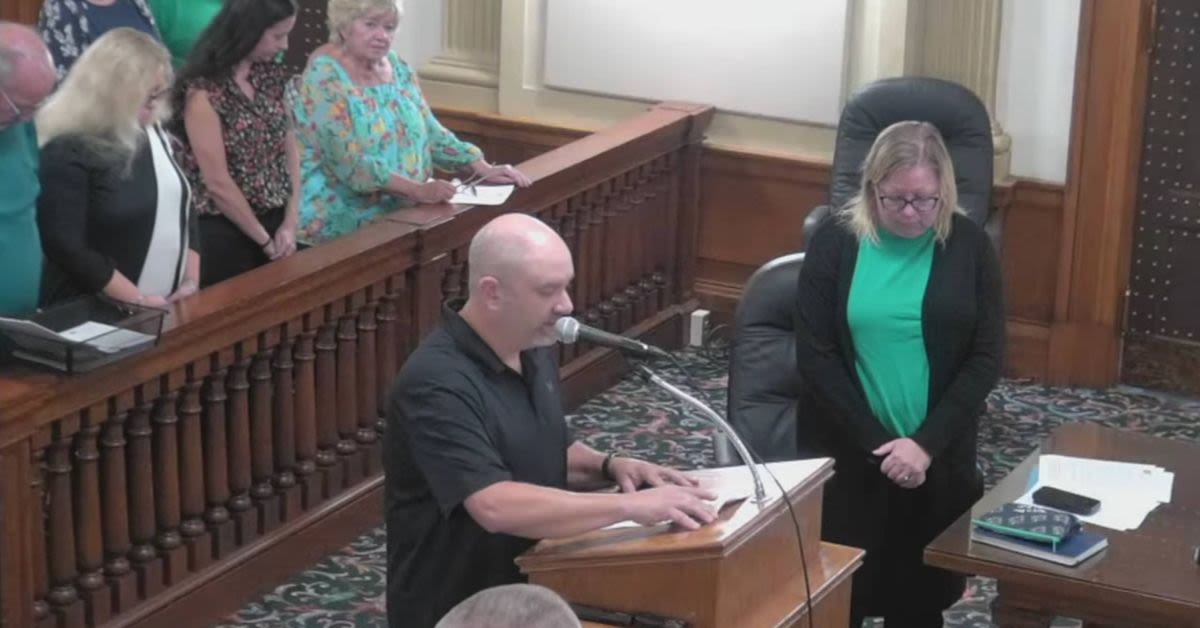
One small-town council meeting in Iowa became an unexpected battleground over faith, public life and the limits of tolerance when a local Satanist delivered an invocation and a Christian pastor immediately rose to challenge what he saw as a spiritual assault on his community.
According to Western Journal, the controversy unfolded at an Ottumwa City Council meeting on Tuesday, when resident and former council member Matt Dalbey, dressed entirely in black, was permitted to open the session with a satanic prayer. Standing before the council, Dalbey intoned, Dear Dark Father, let us stand now, unbowed and unfettered by arcane doctrines born of fearful minds and darkened times. Let us embrace the Luciferian impulse to eat of the tree of knowledge and dissipate our blissful and comforting delusions of old. He pressed on with his invocation, adding, Let us demand that individuals be judged for their concrete actions, not their fealty to arbitrary social norms and illusory categorizations.
Dalbey then closed his remarks with a stark declaration that left many in the room stunned. It is done. Hail Satan, he concluded, a line that appeared deliberately crafted to parody Christs final words from the cross, It is finished. For Christians, those words from Jesus signify that his sacrificial death fully paid the penalty for humanitys sin and decisively defeated death, hell and the devil. Dalbeys invocation, by contrast, celebrated rebellion against arcane doctrines and openly hailed the adversary of the Christian faith.
The irony of what followed was difficult to miss. Immediately after Dalbeys satanic prayer, the council moved to the next item on its agenda: placing hands over hearts and reciting the Pledge of Allegiance, which ends with the affirmation, one nation, under God, indivisible, with liberty and justice for all. The juxtaposition was stark a public body that had just permitted a Hail Satan invocation now collectively pledged allegiance to a nation explicitly described as being under God.
Those two words, under God, are not incidental or accidental. As explained in the book We Hold These Truths: The Two Beliefs That Still Hold the Power to Transform the Nation and the World, the phrase was added to the pledge in 1954 after President Dwight Eisenhower attended a sermon at the historic Washington, D.C., church once attended by Abraham Lincoln during the Civil War. In that sermon, a Presbyterian minister underscored the significance of the phrase under God in Lincolns Gettysburg Address, especially as the United States confronted the rise of atheistic communism in the 1950s.
Eisenhower was deeply moved by the message. After the service, he told the preacher, I agree entirely. Shortly thereafter, Congress added under God to the Pledge of Allegiance, and Eisenhower signed the measure into law. The president later observed that millions of American schoolchildren would now daily proclaim the dedication of our nation and our people to the Almighty and be reminded of the countrys true meaning. He further emphasized that in this way we are reaffirming the transcendence of religious faith in Americas heritage and future; in this way we shall constantly strengthen those spiritual weapons which forever will be our countrys most powerful resource, in peace or in war.
Against that historical backdrop, the events in Ottumwa take on even greater significance. After the council finished reciting the pledge on Tuesday, local resident and pastor Rick Bick of New Life Center rose from his seat and addressed the council and the mayor, refusing to let Dalbeys words stand unchallenged. Lets just reverse that curse that was just put on our city, that ending with Hail [Satan] and hail dark god. Thats not welcome here, Bick declared, making clear that he viewed the satanic invocation not as harmless speech but as a spiritual attack on the community.
His intervention immediately drew procedural objections from council member Cara Galloway, who insisted that Bick was speaking out of order because public comments are typically reserved for the end of the meeting. Bick, however, refused to be silenced or delayed. It needs to be done now, he fired back. I appreciate what Ms. Galloway is saying, but that was a curse put on the city Most of you know that, and we need to just stop and reverse it.
Faced with the tension in the room, Mayor Benjamin Foote sought a middle ground. He announced that a 30-second moment of silence would be appropriate to reflect on whatever it is we need to reflect on at this time, offering a way for those present to respond in their own hearts to what had just occurred. Galloway again objected, insisting, It was time to move forward, but this time the mayor overruled her, and the chamber observed a brief period of silence.
The next day, city administrator Philip Rath appeared on KBIZs Dialogue program to address the uproar and explain how a satanic invocation had been allowed in the first place. Rath noted that Ottumwa, a city located about 85 miles southeast of Des Moines, had adopted a new policy in January that opened the meeting invocation to participants from faiths other than Christianity, as reported by the Ottumwa Courier. I dont know whats on Mr. Dalbeys heart, but thats part of what happens when you have an open policy like this, Rath said. You have to be open to allow people to express their different beliefs.
Rath acknowledged that the policy could be revisited in light of the controversy. However, he cautioned that tightening the rules might expose the city to litigation from groups eager to challenge any perceived preference for Christianity or traditional religious expressions. That legal concern is not theoretical; activist organizations have long used the courts to pressure local governments into either secularizing public life or granting equal platform to fringe or anti-religious movements under the banner of inclusion.
Yet the Supreme Court has already provided a clear framework for such disputes. In the 2014 case Town of Greece v. Galloway, the Court held that a town council did not violate the First Amendment by opening its meetings with prayer that comports with our tradition and does not coerce participation by nonadherents. The justices recognized that legislative prayer is deeply rooted in the nations history and that such invocations need not be stripped of their religious character to satisfy constitutional standards.
Crucially, that tradition is overwhelmingly Christian, not satanic. From the Continental Congress to modern state legislatures, public prayer in America has almost always invoked the God of the Bible, not the Dark Father celebrated in Dalbeys remarks. Ottumwas leaders therefore have both a legal and cultural basis to revise their policy in a way that honors the nations heritage without opening the door to every anti-religious or explicitly anti-Christian ideology that demands equal time.
A prudent course would be to draw directly from the Supreme Courts language, specifying that invocations must comport with our tradition and avoid coercion, while recognizing the historic role of Judeo-Christian faith in American public life. Such an approach would not compel anyone to participate in prayer, nor would it establish a state church, but it would prevent the city from being used as a stage for those who openly mock the faith that shaped the nation and its institutions. In that light, Ottumwas experience serves as a warning to other communities: when officials abandon discernment in the name of radical inclusivity, they risk not only confusion and offense, but also a slow erosion of the very moral foundations that phrases like one nation, under God were meant to preserve.
For many residents, Pastor Bicks decision to stand up immediately and call for reversing what he described as a curse was not an act of intolerance, but an act of spiritual leadership. At a time when public officials often shrink from defending faith in the public square, his willingness to speak plainly and the mayors choice to allow a moment of silent reflection offered a reminder that religious conviction still has a place in American civic life. The question now is whether Ottumwas leaders will align their policies with the nations constitutional and cultural traditions, or continue down a path that treats a Hail Satan invocation as morally equivalent to a prayer offered under God.
Login