
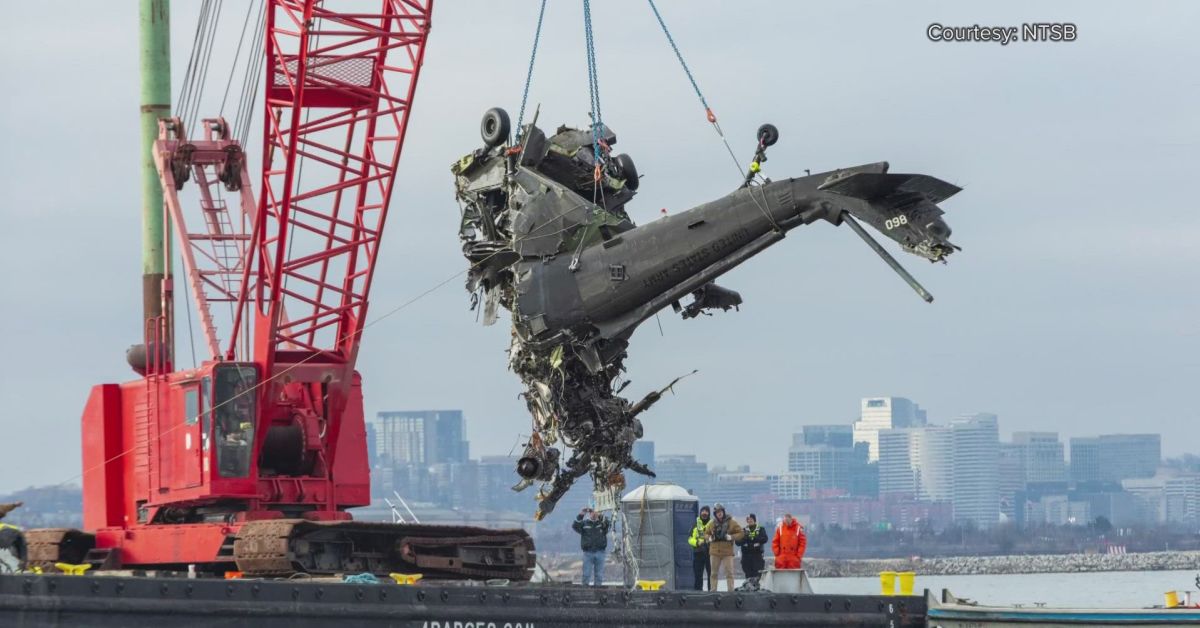
Family members of those killed when an Army Black Hawk helicopter collided with a civilian airliner over the Potomac River in January 2025 are denouncing a newly released Army report that, in their view, shields senior leaders from accountability.
According to Western Journal, the midair collision between the aging Army helicopter and American Airlines Flight 5342 claimed 67 lives and scattered wreckage into the icy Potomac. The Armys long-awaited investigative report, released in heavily redacted form, catalogues a series of systemic failures but is conspicuously silent on whether any commanders or officials have faced discipline, as reported by The Washington Post.
Relatives of the dead, already frustrated by months of delay, were allowed to preview the document only to find page after page of blacked-out text. For families who lost loved ones on Flight 5342, the redactions reinforced a familiar Washington pattern: bureaucratic self-protection taking precedence over transparency and responsibility.
An Army summary acknowledged multiple long-standing safety issues that contributed to the disaster, including known problems with the Black Hawks instruments. Yet the report stops short of naming specific individuals whose decisions or lack of action allowed those hazards to persist, leaving families to wonder whether anyone in uniform or in the Pentagons civilian leadership will ever be held to account.
The Army owes the families and the American public a full accounting of how these risks were allowed to persist, who was responsible for the decisions that allowed them to persist and what will be done to make sure this never happens again, said Tim Lilley, a former Black Hawk pilot and commercial airline captain whose son, Sam, served as first officer on the doomed American Airlines jet. For Lilley and others, the absence of clear consequences for those in charge is not just an insult to the dead but a warning sign that the same institutional complacency could lead to another tragedy.
A coalition of grieving relatives has been pressing for an outside review, arguing that the Army cannot credibly investigate itself on matters that implicate its own leadership and culture. We again call for the Army Inspector General to perform the independent audit formally requested by 24 U.S. Senators well over a year ago: its time to do your job, the group representing families of the passengers who were killed said.
The Washington Post reported that the Armys own findings are damning on their face, even in redacted form. The report cites the Army for not resolving flaws in instruments that were known to give inaccurate altitude readings on older Black Hawk models including the helicopter involved in the collision or ensuring that pilots were aware of the problem.
Investigators also faulted the service for failing to systematically track near-miss incidents or to provide adequate training for operating in the congested and highly regulated airspace around the nations capital. In a region where military and civilian aircraft share tight corridors, that omission reflects a troubling disregard for the realities of modern air traffic and the lives at stake.
The report notes that in some instances, military helicopters and commercial jets in the D.C. area have passed within as little as 75 feet of one another. In an era of advanced avionics and collision-avoidance systems, such razor-thin margins underscore how fragile safety becomes when known equipment flaws and inadequate procedures are allowed to linger.
That risk is magnified by the specific shortcomings of older Black Hawk helicopters, which rely on barometric altimeters that can be off by as much as 140 feet. The report further indicates that readings can be distorted when helicopters carry external fuel tanks, as did the Black Hawk that went down last January, compounding the danger in already crowded skies.
On Jan. 29, 2025, the altimeter in the ill-fated helicopter indicated it was flying 200 feet above the Potomac River. In reality, it was at 278 feet a discrepancy that, in a tightly controlled airspace shared with commercial traffic, can mean the difference between a safe pass and a catastrophic collision.
A crash investigator who reviewed the material criticized the Armys decision to redact its own analysis of the altimeters performance. Air traffic controllers need to know that these crews may be seeing different variations than what they expect, the investigator said, arguing that withholding such information undermines the ability of civilian authorities to manage risk.
The Army report also concludes that the helicopter crew was likely flying with night-vision goggles that were unable to discern the aircraft lighting of the American Airlines jet from lights on the ground. Under those conditions, pilots can easily misinterpret what they are seeing, especially when their instruments are unreliable and their training for that specific airspace is insufficient.
According to the report, the night-vision equipment may have distorted distances, potentially causing the crew to fixate on the wrong aircraft instead of the one they ultimately struck. That combination of faulty instruments, degraded visual cues and inadequate situational awareness created a perfect storm that ended with dozens of Americans dead in the freezing river below.
Families of the victims, speaking through the Families of Flight 5342 group, have urged policymakers to move beyond expressions of sympathy and enact concrete safety reforms, according to an Associated Press account carried by KTVN-TV. They argue that proven technology already exists to prevent such tragedies, but that Washingtons political class has lacked the will to insist on its deployment across both military and civilian fleets.
Its a simple concept anyone can understand: aircraft should be able to see each other in the sky. The technology is proven. All thats required is the political will to do the right thing, the Families of Flight 5342 group said, pointing to collision-avoidance systems that are standard in much of the commercial sector but not uniformly integrated into military operations. Their message is a rebuke to a federal establishment that often finds billions for new weapons systems while dragging its feet on basic safety upgrades.
The families stressed that they have been patient with the investigative process, but that patience has now run out. We have waited long enough. We waited for the NTSB. We waited for the Army. Both investigations are complete, and both make clear that collision-avoidance technology must be part of the solution. There is nothing left for Congress to wait for, they said.
Their demand highlights a broader concern about a federal bureaucracy that too often appears more focused on shielding itself than on serving the citizens who fund it and the service members who risk their lives. From a conservative perspective, the episode is a stark reminder of why concentrated power and unaccountable agencies are dangerous, and why robust congressional oversight not deference to the Pentagon or to career officials is essential.
The unanswered question now is whether lawmakers will act, or whether the deaths over the Potomac will be quietly folded into the long list of tragedies met with reports, redactions and little real reform. For the families of Flight 5342, the path forward is clear: name those responsible, fix the known failures, and ensure that the men and women who fly in Americas skies are protected by the best technology and the most rigorous standards a free nation can provide.
Login