
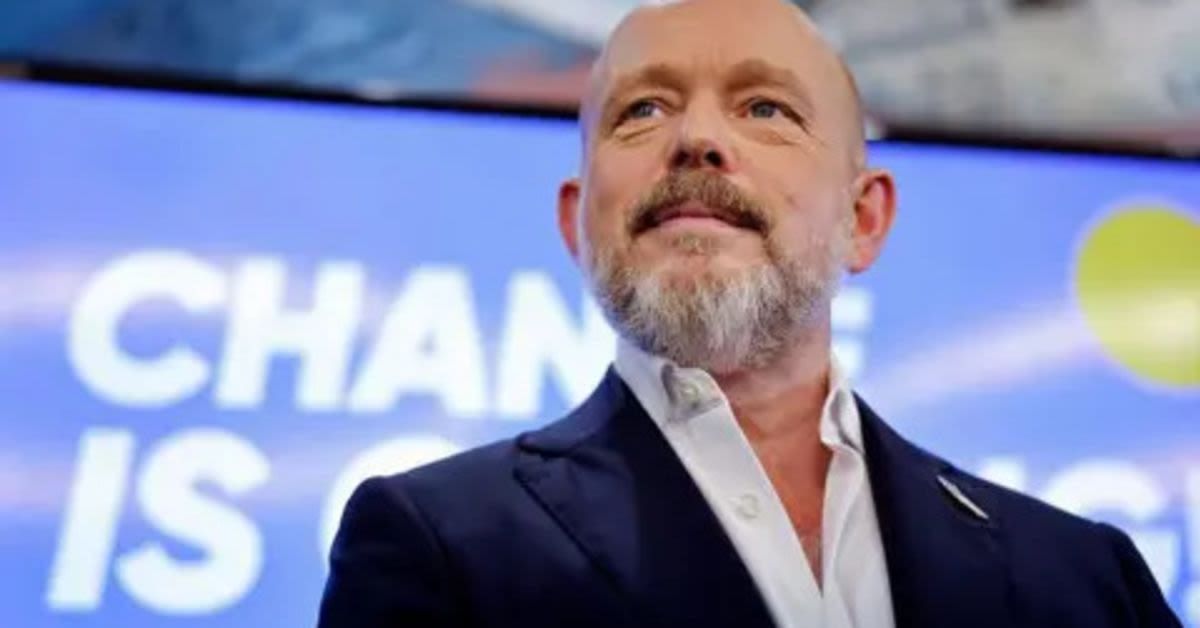
Calling for a sweeping rollback of Californias tax burden and a decisive break with one-party rule, Republican gubernatorial candidate Steve Hilton is urging voters to end the states long-running experiment with Democratic dominance in Sacramento.
During a campaign forum Tuesday evening, Hilton argued that Californias entrenched political monopoly has failed to deliver prosperity or opportunity. It's 16 years now that we've had one party running everything, and if you look at history ... when you have one-party rule, in the end, it doesn't deliver the results that we want, the former Fox News commentator told the audience, warning that the states current trajectory is unsustainable. As reported by Just The News, Hilton underscored his point with a stark statistic: We are ranked 50th out of 50 states for opportunity by U.S. News & World Report. That is a crime," he said.
The forum, co-hosted by the Los Angeles Times and Pasadena-based NPR affiliate LAist, subjected Hilton to more than 50 minutes of pointed questioning from a panel of journalists. According to the events organizers, an invitation for Democratic rival Xavier Becerra to appear alongside Hilton went unanswered, leaving the Republican alone on stage to defend his agenda and critique the status quo.
Central to that agenda is Hiltons proposed Working Class Tax Cut, a plan that would make the first $150,000 of income tax-free for Californians. Panelists pressed him on how he intends to pay for such a dramatic tax reduction and how he would simultaneously drive gas prices down to $3 a gallon less than half the current statewide average of $6.36 without detonating the state budget.
Hilton responded by pointing to what he described as runaway government expansion and fiscal mismanagement in Sacramento. He noted that the state budget has more than doubled in the last 10 years, even as California has experienced a significant population exodus of roughly 2 million residents fleeing high costs and heavy regulation.
So we're spending twice as much for a big reduction in population and worse results," Hilton said, framing the situation as a textbook example of big government failure. From his perspective, the solution is not more bureaucracy or new programs, but a disciplined rollback of wasteful spending and a renewed focus on taxpayers who feel squeezed by Sacramentos priorities.
The Republican contender then detailed the spending cuts he believes would offset the cost of his tax relief package. Number one is high-speed rail. I've said I'd cut that, Hilton declared, taking aim at the states long-troubled bullet train project, which conservatives have long criticized as a boondoggle. Secondly, just today, we've made an announcement: We call it Operation Zero Waste, finding ways to cut out the waste in the budget."
Hilton argued that one of the richest veins of potential savings lies in Californias Medi-Cal program, the states Medicaid system. Hilton said, "There are massive amounts of fraud reported in Medi-Cal," estimating the scale of that fraud at $5 billion and suggesting that serious enforcement and oversight could reclaim substantial sums for taxpayers.
Beyond targeted cuts and anti-fraud efforts, Hilton proposed a broad-based efficiency mandate across state government. "The next part of the plan is a 5% reduction in all budgets in the state government," he said, contending that Sacramento has rarely, if ever, been forced to tighten its belt. "It's been a long time, if ever, that the government's been asked to save a bit of money and be more efficient."
According to Hilton, these three pillars canceling high-speed rail, rooting out Medi-Cal fraud, and imposing a 5% across-the-board budget reduction would more than cover the estimated $25 billion annual cost of making the first $150,000 of income tax-free. He cast the proposal as a way to restore competitiveness, keep families from leaving the state, and reward work rather than punishing it with some of the highest tax rates in the nation.
When the conversation shifted to Californias affordability crisis, Hilton again placed the blame squarely on government policy rather than market forces. The panel raised issues including soaring home prices, restrictive zoning, a 10% rent increase cap, and obstacles to water infrastructure, prompting Hilton to defend his ambitious plan to build 10 entirely new cities outward from existing urban centers.
Hilton contended that Sacramentos regulatory regime is artificially constraining housing supply and driving up costs. He argued that government fees and regulations add an average of $200,000 to the price of a new home in California, a burden he wants to slash by imposing a strict $50,000 legislative cap on cumulative administrative and regulatory charges, effectively stripping away three-quarters of that bureaucratic overhead.
Later in the evening, journalists pressed Hilton on his hard-line stance toward homelessness, particularly his ultimatum giving mayors one year to clear street encampments with the support of the California Highway Patrol. They also questioned how he would finance a major expansion of mental health services, which he has identified as a key component of addressing the crisis.
Hilton leaned into the moral dimension of the issue, arguing that the current situation on Californias streets is both inhumane and a failure of leadership. "We would never allow someone we love to continue to live in those conditions, so I don't know why we think it's OK for people we don't know," he said, insisting that compassion requires action rather than endless studies and half-measures.
The immediate priority, Hilton maintained, must be to move people off the streets and out of dangerous encampments, even as the state works on longer-term treatment and recovery strategies. He suggested that a combination of law enforcement support, expanded treatment capacity, and accountability for local officials would be necessary to reverse years of permissive policies that have allowed encampments to proliferate.
The panel also confronted Hilton with questions about his alignment with Republican President Donald Trump in a state where the president remains deeply unpopular with a majority of voters. Trump has endorsed Hilton, a fact that Becerra, a former state attorney general, has repeatedly highlighted on the campaign trail, and reporters asked how Hilton would stand up to Washington if elected.
Hilton responded by casting himself as an independent advocate for California rather than a rubber stamp for any national figure. "My job is to stand up for the interests of Californians, and where that conflicts with the attitude of the federal government or the president, I will say so strongly," he said, adding that he fundamentally "resists centralization of power, central bureaucratic control."
As the evening drew to a close, Hilton was asked to reconcile his past reputation as a green conservative in the United Kingdom with his current skepticism toward Californias environmental regulations, fossil fuel restrictions, and climate mandates. Hilton, who served as director of strategy for former British Prime Minister David Cameron, has previously described offshore wind as an absolute abomination, a stance that puts him at odds with progressive climate orthodoxy.
Hilton told the panel that his understanding of environmentalism is broader and more balanced than the carbon-centric approach favored by the left. "Environmentalism includes beautiful parks and public spaces, keeping our coastline pristine and the quality of the environment all around us," Hilton said. "It's not just carbon emissions and climate change."
The Center Square reported that outreach to Becerra a former congressman who later served as President Joe Bidens secretary of health and human services went unanswered as of publication time. The outlet also contacted both the California Democratic Party and the state Republican Party, but neither responded before deadline, leaving Hiltons proposals and critiques largely uncontested on the record.
Roxanne Hoge, chair of the Los Angeles County Republican Party (LAGOP), praised Hiltons performance and contrasted his willingness to engage with Becerras absence. This is a perfect illustration of the choice Californians face for governor someone who shows up and understands policy, or someone who runs and hides, Hoge told The Center Square in an email about the forum, attended by Hilton, but not Becerra. We deserve good governance up and down the ballot, which is why we recommend VoteDifferentLA.com as your guide when voting.
Hoge added that LAGOP is proud to have the indefatigable Steve Hilton at the top of the ticket, framing his candidacy as a test of whether California voters are ready to challenge the entrenched progressive model that has dominated the state for more than a decade. For conservatives, Hiltons platform of tax relief, spending restraint, regulatory rollback, and a tougher stance on homelessness and crime offers a stark alternative to the high-tax, high-regulation, one-party governance that critics say has eroded opportunity and driven families and businesses out of the Golden State.
Login