
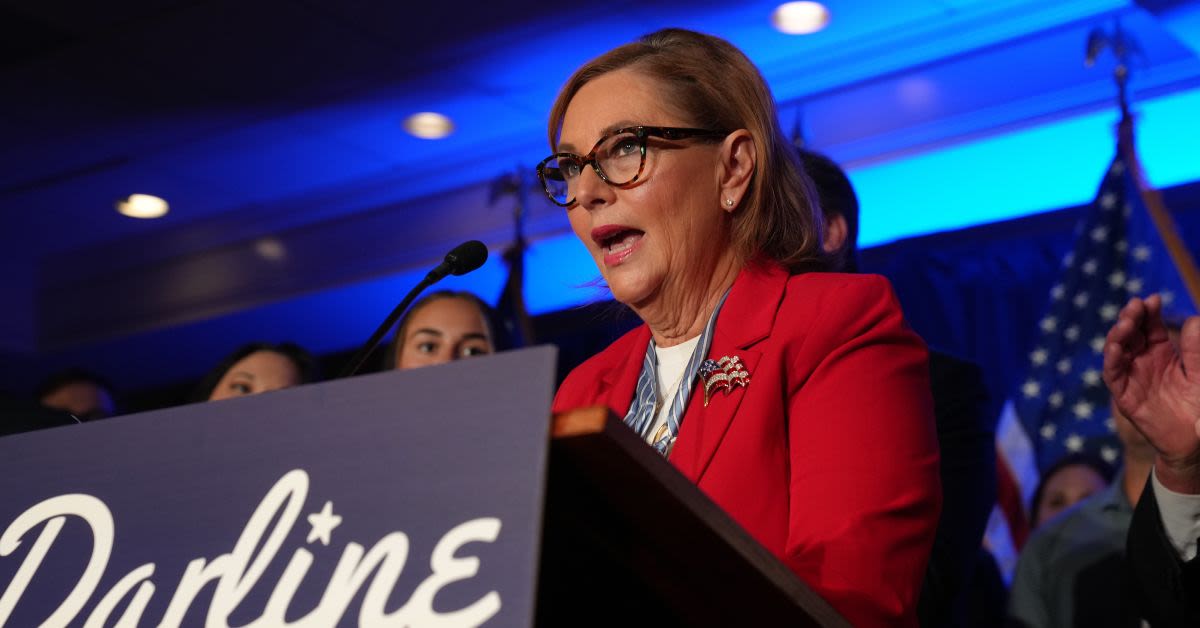
The Senate Leadership Fund is preparing to inject $5 million into South Carolinas Senate race to bolster Republican Sen. Darline Graham in what has unexpectedly become a highly competitive contest.
The late infusion of cash underscores growing anxiety within GOP leadership that a seat long considered safely Republican could be at risk, as reported by the Daily Caller. According to the Daily Caller, a source familiar with the decision described the expenditure by the Senate Leadership Fund, the primary super PAC backing Senate Republicans, as an insurance policy ahead of the Nov. 3 election after Axios first disclosed the planned spending.
Until now, the Senate Leadership Fund had not committed any resources to Grahams race, a sign that national Republicans initially viewed her position as secure. The decision to reverse course suggests that Grahams narrow 2.4-point lead over Democratic nominee Annie Andrews has raised alarms about the possibility of an avoidable loss in a conservative stronghold.
Financial disclosures highlight the scale of the challenge Graham faces in the money race. Andrews has outraised the incumbent by roughly $10.45 million, pulling in over $10.8 million by June, while Graham reported only about $347,000 in contributions, according to Federal Election Commission records.
Much of Andrews financial advantage is driven by national progressive infrastructure eager to flip a red seat. The 314 Action Fund, a pro-STEM political action committee that backs Democratic candidates with scientific or technical backgrounds, has pumped $3.6 million into Andrews campaign, with the group touting her credentials as a licensed pediatrician, according to Axios.
Grahams campaign did not immediately respond to the Daily Caller News Foundations request for comment, leaving unanswered how her team plans to counter the Democrats financial onslaught. The silence comes as Republicans increasingly worry that well-funded left-wing groups are targeting red states that once required minimal defensive spending.
Polling paints a picture of a race that is uncomfortably close for Republicans in a state that has not sent a Democrat to the U.S. Senate since 2005. The Trafalgar Group, a conservative-leaning pollster based in Atlanta, found Graham leading Andrews 43.4% to 42.3% in a September survey, while an InsiderAdvantage poll on Sept. 10 showed Graham ahead 45.1% to 43.2%, and an Impact Research poll in mid-August had the race deadlocked at 41%, with RealClearPolling placing Grahams edge at just 2.4 points.
Grahams path to the nomination was itself unusual and controversial within South Carolina Republican circles. She defeated Republican Rep. Ralph Norman in the Aug. 25 primary runoff after securing the endorsement of President Donald Trump, and she had earlier been appointed by Republican Gov. Henry McMaster to fill the seat of her late brother, Sen. Lindsey Graham, who died on July 11.
The late Sen. Graham was a fixture of hawkish foreign policy in Washington, often aligning with the interventionist wing of the GOP. He supported a ground takeover of Kharg Island by U.S. troops, urged billions of dollars be sent to fund Ukraines war against Russia, repeatedly supported the war in Iraq and Afghanistan and maintained a strong relationship with Israeli leadership, and in March 2022 he even called on Russian President Vladimir Putin to be assassinated.
Darline Graham, by contrast, has struggled to project command of complex national security issues, a vulnerability Democrats are eager to exploit. During an Aug. 19 primary debate, she faltered when Newsmax host Greta Van Susteren pressed her on a basic foreign policy question, asking, Senator, are Taiwan and the South China Sea national security issues for the United States? If so, why?
Grahams response raised eyebrows among conservatives who expect their senators to be well-versed in global threats. Im just going to be honest here. Im not that informed on national security, she admitted, adding, So But I do support the military.
Her candid admission fed into existing unease among grassroots Republicans who were already skeptical of her sudden rise. Many South Carolina Republicans were caught off guard when Graham entered the race, and South Carolina Freedom Conference Chairman Jordan Pace told the Daily Caller on Aug. 11 that the party did not support her serving a full term.
Despite these internal tensions, the broader political environment in South Carolina still favors the GOP. Republicans hold commanding majorities in the state Legislature, with an 8935 advantage in the state House and a 3412 margin in the state Senate, and the state has not elected a Democratic senator since Fritz Hollings left office in 2005.
The decision by the Senate Leadership Fund to reallocate resources into South Carolina fits a broader pattern of Republicans being forced to defend territory that should be secure. The top GOP super PAC has paused spending in North Carolina and launched a seven-figure ad blitz in Kansas, another traditionally red state where Republican Sen. Roger Marshall is facing an unexpectedly strong challenge from Democratic nominee Adam Hamilton, even though Kansas has not elected a Democratic senator since the 1930s.
Trump-aligned super PACs have also been compelled to pour money into deep-red areas, spending 40% of their funds in states and districts that President Trump carried by double digits in 2024. In Texas, Republicans anticipated spending between $150 million and $200 million to protect Republican Attorney General Ken Paxton from Democratic Texas Senate nominee James Talarico, who held a 2.8-point lead in RealClearPolling, underscoring how Democrats national fundraising machine is forcing conservatives to fight costly defensive battles even on reliably red turf.
Login