
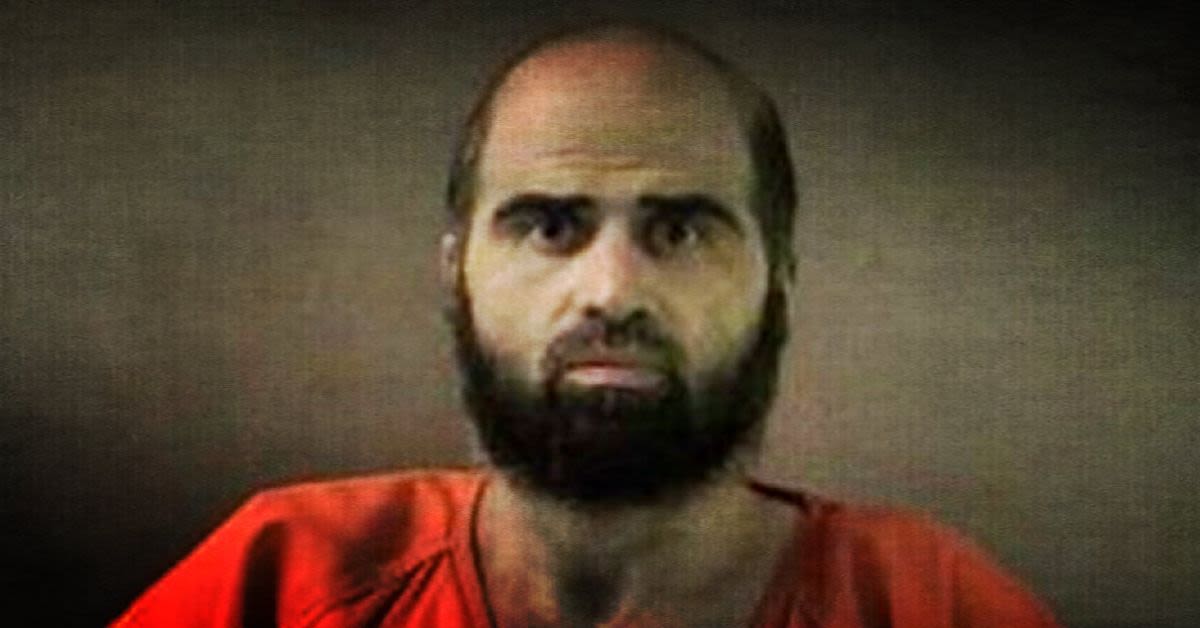
President Donald Trump has authorized the first U.S. military execution in more than six decades, approving death by firing squad for convicted Fort Hood terrorist Nidal Malik Hasan at the recommendation of Secretary of War Pete Hegseth.
The move marks a historic and hard-line shift in military justice, as reported by RedState, reviving a punishment the armed forces have not carried out since 1961. It also underscores a broader conservative insistence on accountability for jihadist violence and a rejection of the leniency and euphemism that too often characterized the Obama-era handling of the Fort Hood massacre.
Hasan, a former Army major and self-proclaimed jihadist, was convicted of murdering 13 people and attempting to murder 32 others during the Nov. 5, 2009, attack at what was then Fort Hood, Texas, now Fort Cavazos. He opened fire at the Soldier Readiness Processing Center, targeting unarmed American soldiers and civilians in one of the deadliest acts of Islamist terrorism on U.S. soil since 9/11.
The Army has been quietly preparing for months to resume executions, which have effectively been on hold since Army Pvt. John A. Bennett was hanged on April 13, 1961, after being convicted of rape and attempted murder. Earlier this year, military officials developed an internal plan, Operation Resolute Justice, to cover potential executions for the four inmates currently on military death row: Hasan, Ronald Gray, Hasan Akbar and Timothy Hennis.
Those preparations included detailed procedures for transferring condemned prisoners from the U.S. Disciplinary Barracks at Fort Leavenworth, Kansas, coordinating with federal prison authorities, and arranging for official witnesses. Yet despite the logistical groundwork, one constitutional barrier remained beyond the Armys control: the presidents signature.
Under Article 71 of the Uniform Code of Military Justice, no military death sentence can be carried out without explicit presidential approval. As recently as June, an Army spokeswoman confirmed that no such order had been received, even as the service conducted exercises and refined its plans for possible executions.
That legal and political obstacle has now been cleared in Hasans case. Chief Pentagon spokesman Sean Parnell announced Sunday evening that Hegseth had formally recommended Hasans execution and that Trump had approved it.
"Secretary of War Pete Hegseth has recommended and President Donald J. Trump has approved death by U.S. Army firing squad for convicted terrorist Nidal Malik Hasan, the jihadist who opened fire on unarmed American soldiers at Fort Hood in 2009," Parnell said. "He killed 13 people and wounded 32 others while shouting 'Allahu Akbar' during the attack. The Secretary of the Army will set the time and place of the execution. Judgement day for Hasan has finally come."
Hegseth, a combat veteran and longtime critic of the political correctness that surrounded the Fort Hood case, offered a blunt one-word reaction: "JUSTICE." For families who have waited nearly 15 years, that sentiment reflects a long-delayed reckoning with an act of open jihad carried out inside a U.S. military installation.
A military jury in 2013 convicted Hasan of 13 counts of premeditated murder and 32 counts of attempted premeditated murder. He was sentenced to death and has since been held at Fort Leavenworth, where he has lived under far more humane conditions than those he afforded his victims.
Hegseth had already signaled last year that he intended to see the sentence enforced rather than allowed to languish indefinitely in legal limbo. In September 2025, he stated he was "100 percent committed" to carrying out Hasans death sentence, even as Pentagon lawyers worked through the process of securing the presidential authorization required by military law.
That final authorization has now been granted, according to the Pentagon announcement. Parnell emphasized that Trump specifically approved "death by U.S. Army firing squad," leaving the Secretary of the Army to determine the exact time and place of the execution.
The Hasan case has always carried weight beyond the horrific casualty count because of what it revealed about the governments handling of Islamist radicalization within the ranks. Witnesses testified that Hasan shouted "Allahu Akbar" as he began firing, and during his court-martial he represented himself and chillingly told the panel in his opening statement that "the evidence will clearly show that I am the shooter."
Earlier Sunday, before news of Trumps decision became public, Reed D. Rubinstein, who represented Fort Hood victims and their families in litigation against the Army and FBI, argued in the New York Post that Washington had never fully confronted its failures. "Fort Hood was not an unexpected 'tragedy,'" Rubinstein wrote. "It was a preventable act of jihad."
Even with presidential approval, legal maneuvering is likely to continue, as military death-penalty cases have historically generated lengthy appellate and collateral challenges. Defense attorneys and activist groups can be expected to contest both the method and the broader legitimacy of the sentence, despite the overwhelming evidence and Hasans own admissions.
The choice of firing squad also stands in stark contrast to a recent civilian execution in Tennessee that turned into a medical debacle. Death-row inmate Christa Pike had specifically requested execution by firing squad rather than lethal injection, but Tennessee rejected that request and proceeded with lethal injection instead.
The Pike execution devolved into a prolonged medical crisis when the initial injection failed to kill her, forcing further intervention before she was removed from the chamber and transported for treatment. Pike herself had said shortly before the scheduled execution: "I am not afraid to die. Im only nervous about the process."
By contrast, the militarys decision to employ a firing squad for Hasan reflects a preference for a swift, decisive method that avoids the botched procedures and pharmacological controversies that have plagued lethal injection. For many conservatives, it also symbolizes moral clarity: a nation at war with jihadist terror must be willing to impose the ultimate penalty on those who wage that war from within its own ranks.
Hasans execution, once carried out, will close a chapter that began with bureaucratic denial and euphemisms about workplace violence and ends with an unambiguous acknowledgment of jihadist mass murder. We are unlikely to hear any complaints from Hasan after his execution, and unlike too many victims of terrorism and crime in recent years, he will actually be executed.
Login