
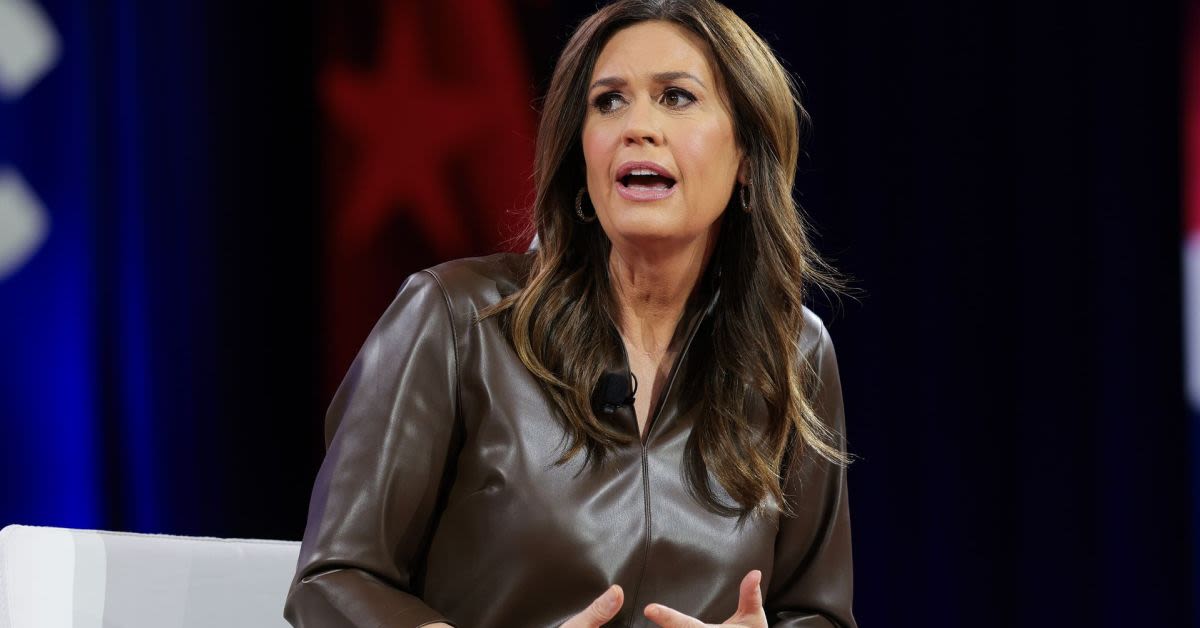
Arkansas Gov. Sarah Huckabee Sanders (R), once seen as cruising toward reelection, now finds herself defending not only her record but a controversial campaign ad that has managed to irritate precisely the voters she can least afford to alienate.
According to RedState, recent polling shows Sanders still leading Democratic State Senator Frederick Love, but with a noticeably slimmer margin than before. The latest Talk Business & PoliticsHendrix College survey places Sanders at 45 percent support among likely voters, compared with Loves 40 percent, while Libertarian candidate Colt Shelby has also ticked upward, mirroring a modest erosion in the governors numbers since 2022.
As KARK reported, The latest poll numbers show that while Gov. Sarah Huckabee Sanders still holds among a majority of Arkansas voters, her numbers are falling. The same Talk Business & PoliticsHendrix College Poll noted that Sanders stood at 51 percent in October 2022, just a month before the last general election, underscoring that her current standing is weaker than it was at the height of her initial gubernatorial run.
This softening comes despite an economic backdrop that should, on paper, be a political asset for any incumbent Republican governor. In July, the Arkansas Department of Commerce and several media outlets highlighted that the states unemployment rate had dropped to 4 percent, while nonfarm payroll employment had grown by 3 percent since 2025, a performance that would normally be touted relentlessly on the campaign trail.
The Department of Commerce, working with the Bureau of Labor Statistics, recently announced that Arkansas seasonally adjusted unemployment rate fell another tenth of a percentage point, from 4.2 percent in May to 4.1 percent in June. Nationally, the U.S. jobless rate also edged down by one-tenth of a point over the same period, from 4.3 percent to 4.2 percent, meaning Arkansas is at least keeping pace with, if not slightly outpacing, the broader labor market.
The FayettevilleSpringdaleRogers Metropolitan Statistical Area has been a particular bright spot, ranking as the third-fastest-growing MSA in the country for nonfarm payroll job growth over the year. That regions employment base has expanded by 2.9 percent since June 2025, a figure that should bolster the governors argument that conservative, pro-growth policies are working in Arkansas.
Under normal circumstances, such numbers would be a clear feather in Sanders' cap and the kind of economic narrative a disciplined campaign would ride straight through November. Instead, the governors team chose to roll out a jarring welfare-themed ad that has drawn fire from both the left and the right, raising questions about the political judgment behind it.
The short spot features a young white man, identified only as Brad, sprawled on a couch, immersed in a video game, surrounded by Cheese Balls and junk food, and seemingly uninterested in anything resembling gainful employment. The imagery is unmistakable: a caricature of a Gen Z layabout, content to live off the labor of others rather than contribute to society.
Over this footage, Sanders appears on screen, cutting between shots of herself and the slovenly Brad, to deliver a pointed message about welfare and work. Meet Brad. Brad has turned relaxing into a full-time profession. But you? You actually work hard. You pay taxes to cover welfare for guy's like Brad who simply choose not to work.
She continues by tying the caricature to her policy agenda, framing her welfare reforms as a defense of taxpayers and a push for personal responsibility. That's why I launched a Welfare-to-Work requirement. Now, more Arkansans are working than ever before. Even Brad.
The ad closes with a visual transformation: Brad, now cleaned up and dressed in a long-sleeved shirt and tie, appears ready to head to a job, as the words You Win flash on the screen. The campaign then amplified the message on social media, declaring, You pay taxes to cover welfare for people who just choose not to work. Thats why I launched a welfare-to-work requirement. If youre young, healthy, and get government assistance, you should work, go to school, or volunteer.
WATCH:
You pay taxes to cover welfare for people who just choose not to work. Thats why I launched a welfare-to-work requirement. If youre young, healthy, and get government assistance, you should work, go to school, or volunteer.
From a policy standpoint, conservatives have long championed work requirements as a way to restore dignity, reduce dependency, and ensure that safety-net programs do not become permanent lifestyles. Yet the execution of this particular ad has been widely panned as tone-deaf, needlessly insulting, and strategically misdirected at a demographic Republicans should be courting, not caricaturing.
Critics on the right argue that the spot feels out of left field, poorly timed, and aimed at the wrong audience, especially given Sanders need to energize younger male voters rather than lecture them. The Federalists Sean Davis captured the sentiment succinctly, writing, Great policy. Terrible ad that is so dishonest and insulting that it will entirely overshadow the genuinely great policy.
Great policy. Terrible ad that is so dishonest and insulting that it will entirely overshadow the genuinely great policy. Those words from Davis, hardly a liberal critic, underscore the frustration among many conservatives who support welfare reform but see no reason to alienate potential allies with a cartoonish portrayal of young men as freeloaders.
The data also complicate the ads implied narrative that the typical welfare recipient is a lazy white male lounging on a couch. White unemployment in Arkansas tracks the overall rate at roughly 4 percent, while Black unemployment stands at 8 percent and Hispanic unemployment at 5 percent, suggesting that minority communities bear a disproportionate share of joblessness.
Moreover, the states largest corporate players, including Walmart, have long relied on H-1B visa holders rather than drawing more aggressively from the in-state labor pool, a practice that undercuts the notion that Arkansans are simply unwilling to work. When major employers look abroad for talent instead of investing in local workers, it becomes harder to sustain the simplistic Brad narrative that joblessness is primarily a matter of laziness.
On the welfare side, Aspire Arkansas reports that 8 percent of white households receive SNAP benefits, compared with 10 percent of Hispanic households and 22 percent of Black households. Those figures suggest that if Sanders had chosen to depict a more statistically representative welfare recipient, the ad would likely have featured a minority Arkansan, a choice that would have triggered a different, and perhaps even more explosive, set of accusations.
Sanders consultants thus appear to have backed themselves into a lose-lose scenario: either risk charges of racial stereotyping by casting a Black or Hispanic actor, or invite backlash from young white men by turning them into the face of welfare abuse. Yet as the states chief executive and a seasoned political figure, Sanders is expected to rise above such crude binaries and insist on messaging that is both honest and strategically sound.
Instead, the governor has chosen to stand firmly by the ad, even as criticism has mounted from voters and commentators who otherwise share her conservative instincts on welfare reform. Rather than recalibrate, she has opted to mock her detractors, suggesting they are upset about trivialities rather than the substance of the message.
Some critics online don't like my welfare work requirement ad. Next thing you know theyll say I should have used cookies instead of cheese balls. If you are able-bodied you should not collect welfare simply because you choose not to work. Period. WATCH-> https://t.co/W9BAjVRkSA, Sanders posted, doubling down on the tone of the original spot. Her response, framed as a joke about snack food, sidesteps the core complaint: that the ad misrepresents who is on welfare and unfairly paints young men as parasites rather than potential partners in a conservative revival.
One online critic, writing under the handle Erchomenos, spelled out the problem in terms that many disillusioned conservatives would recognize. You are acting like your critics had a problem with your policy. Have you actually READ the criticism? Then you would know it is not the policy people had a problem with. It is certainly not an argument about cheese balls.
The same critic continued, warning that Sanders dismissive posture was eroding trust among her own base. Your reaction is insulting to your voters intelligence and shows either your ignorance or your deliberate misrepresentation of the argument. I was giving you the benefit of the doubt. That this was a consultant mistake. But now you own it. Get over your pride and do the right thing.
Erchomenos has, in effect, offered the governor a roadmap out of the mess: acknowledge the misstep, clarify the intent, and refocus attention on the merits of the welfare-to-work policy itself. With fewer than 40 days remaining before the November midterms, every day spent litigating the optics of a 30-second ad is a day not spent highlighting economic gains, educational reforms, or other conservative achievements.
Some defenders of the campaign argue that the controversy has at least made the ad go viral, ensuring that Sanders welfare reforms receive more attention than they otherwise might. Yet in a political climate where the Republican base is already disenchanted and disgusted with its electeds, as many grassroots activists openly admit, virality is not necessarily a virtue if it deepens cynicism and resentment among core voters.
One particularly pointed online comment captured the broader generational frustration that the ad has tapped into. The Republican Party is just a bunch of boomers and women lecturing and shaming young men about how lazy they are. Honestly, we need a new generation of intelligent young men to run for political office to replace these people because of how terrible they are.
That sentiment, while harsh, reflects a real and growing divide within the right: older, establishment-aligned figures who default to scolding rhetoric versus younger men who feel economically squeezed, culturally maligned, and politically taken for granted. When a Republican governor chooses to portray a young man as the face of welfare abuse, it risks confirming the suspicion that the partys leadership sees its own sons and grandsons as the problem rather than as the solution.
For Sanders, the political cost is not merely theoretical. Every point she loses among younger male voters, libertarian-leaning conservatives, or working-class Arkansans who resent being stereotyped, is a point that could narrow her margin in what should be a relatively safe reelection bid. With Love and Shelby both inching upward in the polls, the governor can ill afford self-inflicted wounds that distract from her record and hand her opponents an easy talking point.
If she had political capital to spare, this misjudged public-service-style message might have been a survivable blip, quickly forgotten amid a steady drumbeat of positive economic news. Instead, by clinging to the ad and dismissing substantive criticism as mere quibbling over cheese balls, Sanders has turned a tactical error into a test of her judgment and humility at a moment when conservatives are demanding more authenticity, not more consultant-crafted caricatures.
Login