
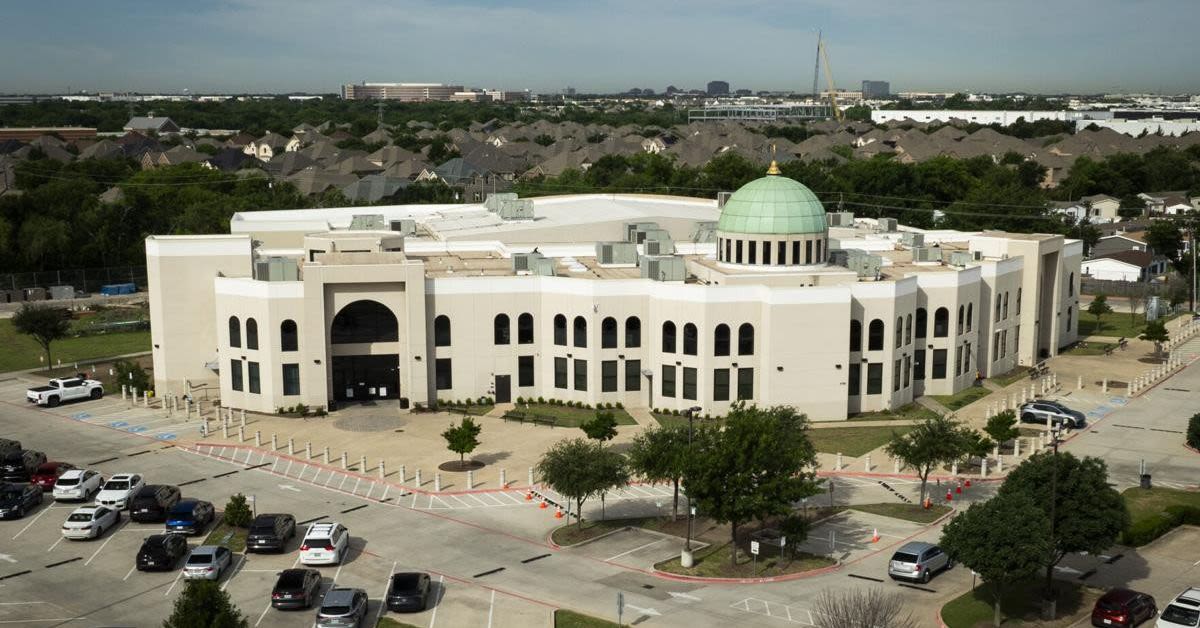
A proposed Islamic complex outside Plano, Texas, has ignited a fierce local backlash, drawing in state leaders and raising broader questions about religious freedom, cultural assimilation, and the future character of American communities.
According to Gateway Pundit, the project, backed by Authentic Ilm Mission (AIM), envisions a 40,000-square-foot Islamic school and community center near Plano, promoted during a livestreamed fundraiser at the Sufaraa Center in McKinney. The controversy intensified after critics highlighted promotional imagery that appears to depict a traditional Christian church morphing into a mosque, a visual that many residents see not as outreach, but as a symbolic act of religious displacement.
That imagery has struck a nerve in a country already wary of ideological movements that seek not merely to worship freely, but to reshape the culture and legal framework around them. When people already harbor concerns about Islam and conquest, a graphic showing a church effectively being replaced by a mosque does not reassure; it heightens fears that long-standing Christian institutions and values are being pushed aside.
The Federalist reported that Shaykh Uthman ibn Farooq used the McKinney event to articulate a sweeping ambition for the United States. We love this country, Farooq said. We want good for this country. And thats why we want Islam for this country, cause we think thats the best thing. And were not going to be ashamed of that.
Farooq further insisted that Muslims are entirely within their constitutional rights to live by Sharia principles. Were Muslims. Thats our identity, and theres nothing wrong with that. The Constitution of this country protects that. Thats our right to believe in the Sharia. Yes, I said it. Thats our right.
On its website, AIM claims to have raised $300,000 of the $800,000 target, with donations from 1,500 individuals across 50 countries, underscoring the projects international backing. The site features a video of a mosque displacing a beautiful church building with a steeple and classical brick architecture, along with an interactive graphic that lets users swipe to replace the church image at the listed address with the planned mosque.
For many Texans, especially in a state where faith and tradition remain central to civic life, such messaging does not read as peaceful coexistence but as cultural replacement. With the number of mosques in America already exceeding 3,000, residents in Plano argue they are justified in asking whether this project reflects simple religious exercise or a deliberate effort to normalize an Islamic America at the expense of the nations Christian heritage.
People in Plano have a right to be concerned, and the unease is not rooted in blind prejudice but in what they see and hear directly from the projects own advocates. The image of the church being transformed is unsettling, and when paired with open declarations of wanting Islam for this country, it raises serious questions about how far communities must go in accommodating movements that openly aspire to redefine the very culture that welcomed them.
Login