
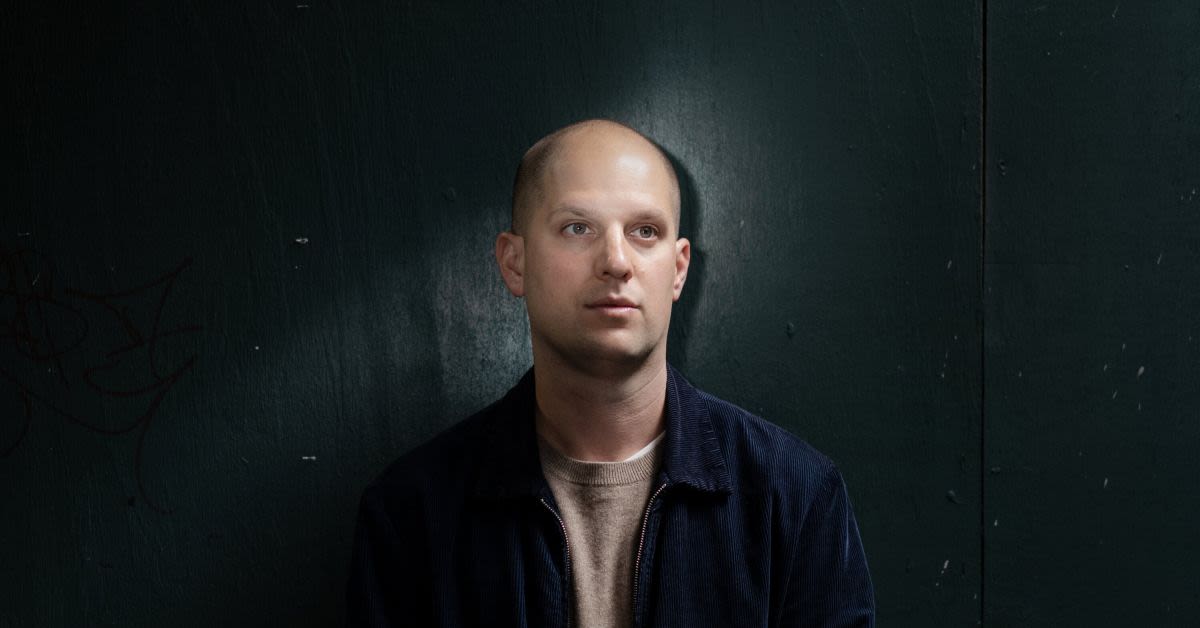
Wall Street Journal reporter Evan Gershkovich, freed this year after more than 16 months in a Russian prison, is now publicly recounting how a routine reporting trip turned into a calculated hostage operation by Vladimir Putins security state.
Appearing on "Fox & Friends" to discuss his new book, "This Cursed Beautiful Land," the 34-year-old journalist walked viewers through the moment his work in Russia collided with the Kremlins ruthless use of Westerners as bargaining chips, according to Fox News.
His account underscores not only the personal cost of his ordeal, but also the broader danger facing Americans abroad under adversarial regimes that see human lives as leverage rather than as citizens entitled to due process.
Gershkovich explained that he had been pursuing a straightforward economic and military story when the trap was sprung.
"I and a colleague of mine were reporting on basically how Russia was prepping to defend. They were changing their economy to a military footing, and I was meeting with a source of a colleague of mine who we thought was legitimate. We had been speaking to him for four years at that point, and it turned out it was a setup," Gershkovich told "Fox & Friends," describing how he ended up being wrongfully detained.
Host Brian Kilmeade highlighted a passage from the book in which Gershkovich realizes that the men surrounding him are not ordinary police but agents of the FSB, the successor to the Soviet KGB.
"At that moment, when you hear FSB, you understand that, as I write, it's not a misunderstanding," Gershkovich said.
He went on to describe the chilling precision of the operation, a reminder that this was not a bureaucratic mistake but a deliberate act by the Russian state.
"When it's the FSB, you understand it's a high-level planned operation. And I'm taken out in a hood to a van, asked who I work for, I say the Wall Street Journal, the hood comes back on, my midsection is pummeled by the security agents, hood comes back off, they ask who I work for, and that's when it dawns on me, that OK they're accusing me of espionage."
The intimidation was immediate and brutal, designed to break his resolve and force him into the role Moscow had scripted for him.
He said he was "obviously" scared at that point, and said, "When I get to the station, they just calmly hand me my charges, and they tell me I'm accused of espionage," Gershkovich said.
Even in those first hours, he could see that this was not just about him, but about a larger geopolitical game in which truth-telling journalists are treated as pawns.
"And there's also this moment that obviously the source, Pavel, stepping away out into the crowd. At that point, I realized, oh, this was a setup and this was a setup for a swap, clearly," he continued.
Gershkovich had been arrested on March 29, 2023, while reporting in the Ural Mountains city of Yekaterinburg, and the Kremlin quickly leveled espionage charges that both his employer and the U.S. government flatly rejected.
The Biden administration labeled him "wrongfully detained," and The Wall Street Journal and U.S. officials emphatically denied the accusations, which were widely seen as a thinly veiled hostage-taking operation rather than a legitimate national security case.
After more than a year of procedural stalling, a closed Russian court convicted him in 2024 of "gathering secret information" and sentenced him to 16 years in a penal colony, a punishment that bore all the hallmarks of Soviet-style show trials.
Wall Street Journal leaders condemned the "sham conviction" and pressed relentlessly for his release, while friends, family and fellow journalists worked to keep his name in the public eye and prevent Moscow from quietly burying his case.
Kilmeade asked Gershkovich to describe the moment in prison when his hope nearly collapsed, a question that cut to the emotional core of his captivity.
He responded by pointing to a period when he believed a complex three-way prisoner exchange involving the United States, Russia and Germany might finally bring him home.
"It's around the winter where a deal is starting to come together where Paul Whelan, who was also arrested on espionage charges in Russia, and myself are going to be traded for, or a deal would be put to the Russians for myself and Paul Whelan and the late opposition leader Alexei Navalny to be released from Russia, and Vadim Krasikov, the FSB assassin who had been arrested in Germany and was convicted to life in prison there, would be going back to Russia," Gershkovich said.
The arrangement, as he understood it, would have freed not only two Americans but also the most prominent domestic critic of Putins regime, in exchange for a convicted Russian assassin held in the West.
That fragile hope shattered in an instant when news of Navalnys death reached him through the prison radio, a stark reminder of how casually the Kremlin extinguishes lives to maintain power.
"I'm out on a walk, it's February. It's really cold. We usually get to listen to a news station called Relax FM. We listen to music. Suddenly the radio station changes. It switches to the news station and it's announced that Alexei Navalny has been killed. At that moment, it's really bleak for me. I think, 'Okay, there's no way I'm getting home now,'" he said.
Ultimately, Gershkovich and former U.S. Marine Paul Whelan were freed in August 2024 as part of a sweeping multinational prisoner swap, a deal that underscored both the value Moscow places on its operatives and the lengths to which Western governments must now go to retrieve their citizens.
His story, now captured in "This Cursed Beautiful Land," stands as a warning about the dangers of authoritarian regimes that weaponize their legal systems, and as a challenge to American leaders to take a firmer, more principled stand against state-sponsored hostage-taking that targets journalists and veterans alike.
Login