
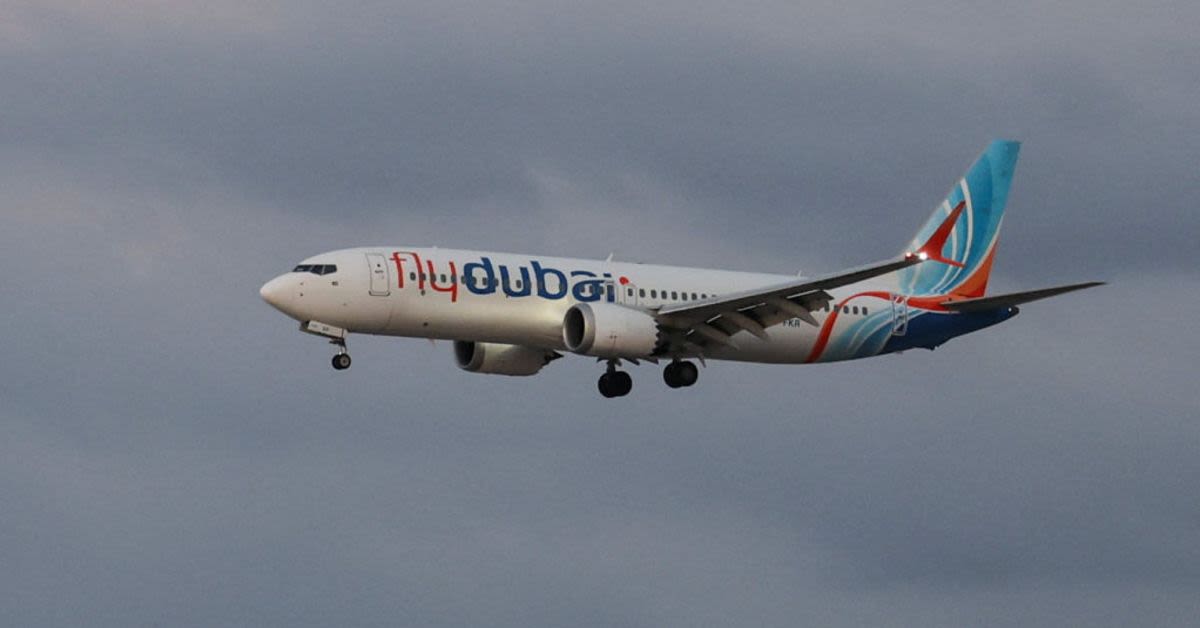
The terrifying midair battle for control of a passenger jet bound for Israel from Dubai on Wednesday has laid bare both the fragility of modern air travel and the extraordinary courage of those who refused to let 174 innocent people die.
According to Western Journal, the drama aboard FlyDubai Flight 1073 unfolded in a way that can be traced not only through eyewitness accounts, but also through the cold, clinical data of FlightRadar24, a Sweden-based service that tracks aircraft in real time.
The playback shows the Boeing 737 Max 8 cruising uneventfully for more than three hours at roughly 34,000 feet before suddenly dropping about 16,000 feet more than three miles in a matter of under two minutes as the aircraft reportedly hit speeds approaching 600 knots, well beyond its maximum rated 541 knots.
The crisis began when a man NBC News identified as the flights pilot allegedly stabbed the co-pilot in what appears to have been a deliberate attempt to crash the aircraft and kill everyone on board.
The co-pilot, Capt. Smit Machchhar, an Indian national, was grievously wounded but still managed to resist long enough to open the cockpit door, giving passengers the critical opportunity to storm the flight deck and overpower the attacker.
A post on X highlighted the alarming descent profile, noting the rapid loss of altitude and the extreme speed reached by the aircraft as it plunged toward the earth.
A photograph circulated on social media after the emergency landing at Tabuk Airport in Saudi Arabia appeared to show the jets rudder badly damaged, likely a consequence of the violent maneuvering during the struggle for control.
Machchhar is now being widely praised as the man whose actions prevented a mass-casualty disaster in the skies.
By forcing open the cockpit door despite his wounds, he enabled passengers and crew to subdue the would-be hijacker and stabilize the aircraft long enough for off-duty pilots on board to assume control and guide the plane safely to Saudi soil.
Israeli Prime Minister Benjamin Netanyahu publicly honored the injured co-pilot, underscoring the magnitude of what had been averted.
My salute to the Indian pilot Captain Smit Machchhar for his extraordinary bravery. Despite being stabbed and seriously injured, he fought back, resisted, opened the cockpit door, and enabled passengers and crew to overpower the attacker preventing a catastrophic mid-air disaster, Netanyahu posted on X.
Netanyahu continued his tribute by emphasizing the scale of the lives saved through Machchhars actions.
He saved the lives of 174 people, including Israeli citizens and other nationals. I wish Captain Machchhar a speedy and full recovery. He is a true hero.
The Jerusalem Post reported that 166 of the passengers on board were Israelis, underscoring the potential geopolitical and human toll had the attack succeeded.
In an era when Israel and its citizens are frequent targets of terror and political violence, the apparent attempt to bring down a commercial airliner will raise serious questions about vetting, cockpit security, and the broader threat environment.
Machchhars injuries were severe, with CNN reporting that he suffered massive blood loss during the attack.
Among the passengers was Dr. Shota Musaev, a dentist, who rushed to the co-pilots aid once the immediate danger had passed and the aircraft was under control.
I started helping the pilot because he had lost a lot of blood and was in bad shape. He was covered in cuts his head, his hands they were practically sliced open, almost severed in two, Musaev recounted, describing the gruesome scene.
His intervention, along with the rapid diversion to Tabuk, likely played a crucial role in keeping Machchhar alive long enough to receive hospital care.
According to Indias embassy in Riyadh, Machchhar is now in stable condition at a Saudi hospital, recovering from the ordeal that nearly cost him his life.
The would-be hijacker, meanwhile, is in custody in Saudi Arabia, NBC reported, where authorities will be under pressure to determine his motives and any possible connections to extremist networks or ideological causes.
For many observers, this incident will reinforce long-standing conservative concerns about aviation security, pilot screening, and the dangers of complacency in a world still plagued by terrorism and politically motivated violence.
The fact that a pilot a figure entrusted with the ultimate responsibility for passenger safety is alleged to have turned his aircraft into a potential weapon will intensify calls for stricter oversight, more rigorous psychological evaluations, and stronger safeguards that prioritize the lives of ordinary travelers over bureaucratic convenience or political correctness.
At the same time, the events aboard Flight 1073 highlight the enduring importance of individual courage and personal responsibility, values too often dismissed in a culture that leans on institutions and regulations to solve every problem.
From Machchhars refusal to surrender the cockpit, to the passengers who charged into a confined space to confront a violent attacker, to the off-duty pilots who calmly landed a damaged aircraft, the outcome was shaped not by government intervention, but by the character and resolve of private citizens acting in a moment of crisis.
As investigators sift through data, interview witnesses, and examine the damaged Boeing 737 Max 8, key questions remain about how such an attack could be attempted in the first place and what systemic failures, if any, enabled it.
What is already clear, however, is that 174 people are alive today because one wounded co-pilot chose to fight back, a cabin full of passengers refused to be passive victims, and a handful of trained professionals stepped forward when it mattered most.
Login