
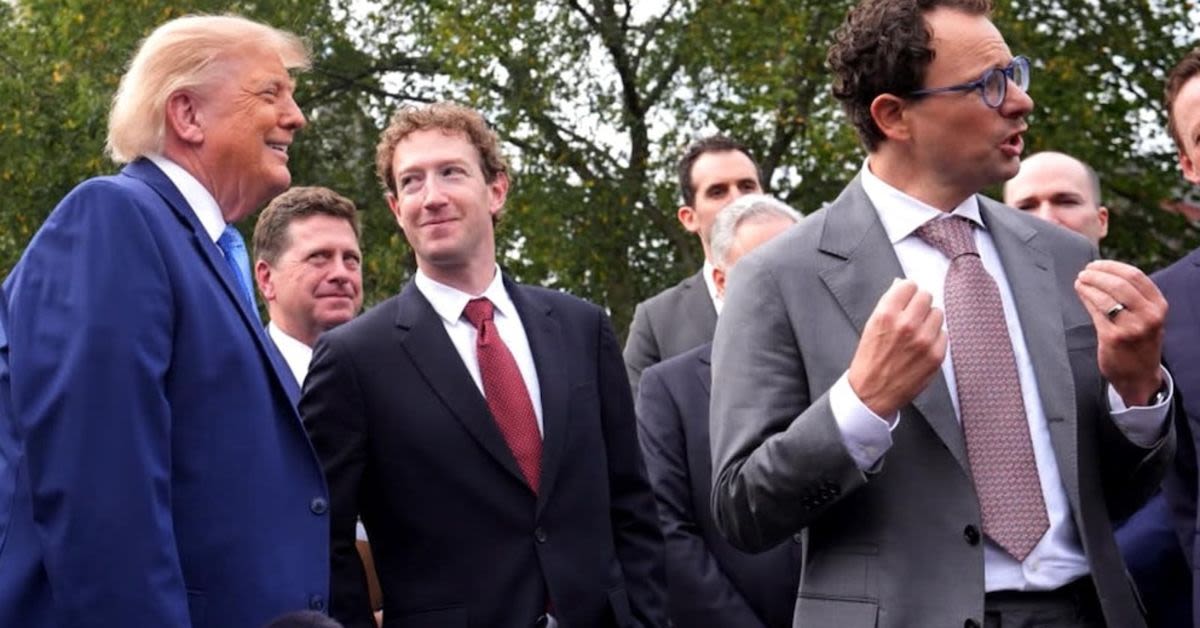
Top executives from Americas leading technology firms gathered at the White House on Tuesday to endorse a new framework for governing Super Intelligence, the term President Donald Trump has now formally adopted in place of Artificial Intelligence.
According to Breitbart, the event culminated in the signing of the White House Accord on Super Intelligence, a document House Speaker Mike Johnson said reflects the industrys pledge to implement robust internal controls and layers of internal and external review. Johnson outlined the accord during a press gaggle outside the West Wing, standing alongside xAIs Elon Musk, Metas Mark Zuckerberg, Anthropics Dario Amodei, Nvidias Jensen Huang, and other senior executives who have become central players in the race to dominate next-generation computing.
The public remarks followed a lengthy closed-door luncheon attended by Trump, Johnson, cabinet officials, and the assembled tech leaders. The gathering underscored the administrations strategy of engaging private-sector innovators while asserting a distinctly American, pro-growth framework for emerging technologies.
The super intelligence providers are committed to building trust as they help us build the future, and they can and will do that, and they are ready to put their names on the line to agree to that very commitment, Johnson told reporters, emphasizing the voluntary nature of the agreement. They expressed their desire to take accountability and ownership, and we have just formally signed a new document that youll all be seeing circulated today.
It is entitled the White House Accord on Super Intelligence, a Joint Commitment on Frontier SI Responsibilities. This is a statement of principles that youll see a statement of standards, commitments that are voluntary on behalf of the industry. It sets forth expectations. Its, in short summary, robust internal controls and layers of internal and external review. Thats important because you need people to be providing oversight and transparency, and thats what these leaders are going to do. In framing the accord this way, Johnson signaled a preference for industry-led responsibility and transparency over heavy-handed federal regulation that could stifle innovation and drive investment overseas.
Johnson added that Congress and the White House would continue to steer the sectors development in a safe manner. His comments reflected a conservative approach that seeks to balance national security and public safety with the need to preserve Americas competitive edge and avoid the bureaucratic overreach often favored by progressive policymakers.
Trump, who joined the gaggle after the luncheon, cast the accord in sweeping constitutional terms, underscoring its symbolic and practical importance. He likened the White House Accord on Super Intelligence to a constitution, suggesting it could serve as a foundational charter for how the technology is developed and deployed.
We had a great really a great great meeting. It was something very, very special, Trump said, describing the session as a rare alignment of political leadership and private-sector expertise. His remarks highlighted the administrations belief that cooperation with industry, rather than confrontation, is the most effective way to harness technological progress.
They love our country, they love the world, he said of the executives. And they came together, and they did something its almost like a constitution in a way and the biggest people in the world signed that, and I signed it as president, and it really is a form of protection. For conservatives wary of both Big Tech overreach and expansive federal control, Trumps framing suggested a middle path: binding public commitments without surrendering innovation to regulatory bureaucrats.
Zuckerberg, whose company has often been at the center of debates over content moderation and data privacy, endorsed the accords emphasis on layered oversight. He called the internal controls and reviews good steps and elaborated on the mechanisms the companies are pledging to adopt.
But I think what we can all agree on is that the American public and our customers want to know that what were building is working in the way that we all intend. So, we drafted a set of principles and commitments around building robust internal controls and detecting if there are any issues with the technology, coupled with multiple layers of of auditing and controls, starting with internal risk review, external auditors and evaluators, and agreeing that were going to have all of our boards of directors independently review the reports that come from the auditors. I think that these are good steps forward. The idea isnt that this is the only thing that we will ever do. It is that this is a start and an accord that the whole industry could come to. His comments underscored that, at least for now, the industry prefers self-governance anchored in corporate accountability rather than mandates drafted by unelected regulators.
Alongside the accord, Trump signed an executive order officially rebranding Artificial Intelligence as Super Intelligence, a move that reflects both the technologys accelerating capabilities and the administrations desire to define the terms of the debate. By pairing that rebranding with a voluntary, principle-based accord, the White House signaled that it intends to keep America at the forefront of technological leadership while resisting the sweeping regulatory schemes championed by the left, which risk entrenching bureaucracy at the expense of innovation, economic growth, and individual freedom.
Login