
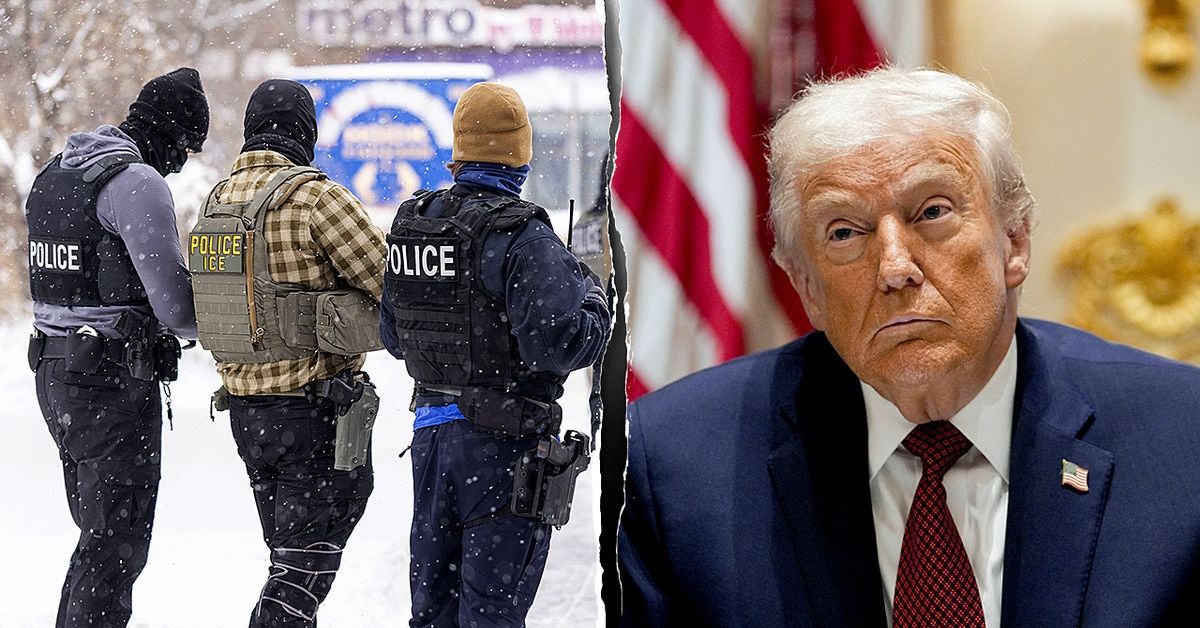
The Trump administration is pushing back hard against a viral report claiming that Immigration and Customs Enforcement has been ordered to stand down on deportations of illegal aliens who lack additional criminal charges.
According to RedState, the controversy erupted after the Daily Wires Jennie Taer published what she described as a major scoop, alleging that ICE officers nationwide had been instructed to stop arresting illegal immigrants who were not classified as criminals beyond their unlawful entry into the United States. Taer wrote on X that SCOOP: ICE officers across the country were told this weekend to stop arresting non-criminals, agency sources tell @realDailyWire, and further reported that Now, ICE may only arrest illegal immigrants with criminal convictions or charges for the time being, said the sources. The change also ends so-called collateral arrests, sources said, meaning officers who find a criminal target alongside others in the country illegally may detain only the target.
The Daily Wire based its report on unnamed ICE sources who insisted the guidance represented a sharp, sudden shift in enforcement. The outlet noted that several ICE officers expressed frustration with the seemingly sudden change, and one suggested it may be an attempt to gain public favor before the midterms, with one source bluntly stating, We believe it has something to do with the midterms coming up. Theyre trying to calm things down before the elections.
Another ICE source predicted that the impact would be measurable in the data, warning, Well see the arrest numbers go down. The implication from these officers was that political calculations, not public safety, were driving the alleged change in enforcement posture, a concern that resonates deeply with conservatives who have watched Democrats and the Left systematically undermine border security for years.
The Department of Homeland Security, however, responded with an unequivocal denial, publicly branding the report as inaccurate. DHS took to X to declare, This is false. No one is off the table. We will continue to arrest any and all illegal aliens that come into our path, and added, Anyone in our country illegally will be arrested and deported. In an effort to protect American citizens, ICE has initiated a nationwide public safety surge in sanctuary cities where our brave officers will be targeting criminal illegal aliensmany released from jails by sanctuary politiciansincluding murderers, rapists, child predators, and gang members.
That forceful statement from DHS was clearly intended to reassure both the public and the conservative base that the Trump administrations enforcement agenda remains intact. Yet almost immediately, conflicting accounts began to surface from within ICE itself, suggesting that some form of guidance had, in fact, been communicated to field offices.
Investigative reporter Katie Daviscourt of the Post Millennial publicly challenged DHSs denial, asking on X, Then why were multiple ICE offices across the nation given this information last night and this morning? Her question echoed the frustration of many on the Right who have grown wary of bureaucratic maneuvering inside DHS that appears to dilute or delay the presidents stated priorities on immigration enforcement.
Fox News correspondent Bill Melugin then stepped in with additional reporting that both confirmed and complicated the picture. Ive spoken on the phone with President Trump and nine ICE & DHS sources about this today, Melugin said, adding, Heres what Ive learned.
Melugin reported that Yes, this verbal guidance did go out to ICE offices across the country last night. Ive spoken with ICE agents who received it & were shocked & frustrated by it. Its unclear who it started with. However, Im told its erroneous, was some type of miscommunication during conversations about prioritizing worst first, and there is no change in immigration enforcement policy. In other words, according to his sources, some officials did convey instructions that sounded like a pullback, but those instructions were later characterized as a mistake rather than a formal policy shift.
Melugin further relayed President Trumps direct position on the matter, stating, President Trump tells me anyone in the country illegally remains on the table for ICE arrest & deportation. He added, Im also told new guidance went out to ICE field offices tonight to reaffirm this and that yes, arrests of illegal aliens and collaterals without additional criminal history will continue. ICE sources confirm to me they received the new guidance.
Summing up the confusion, Melugin concluded, Im not really sure what happened here - but everyone is on the same page, including President Trump, in telling me that his immigration enforcement agenda isnt scaling back. That admission underscores a deeper concern: even if the official line is that nothing has changed, the fact that such miscommunications can ripple through ICE suggests internal disarray or resistance that should trouble anyone who believes in strong, consistent enforcement of immigration law.
The timing of the controversy has fueled speculation among conservatives that the episode may have been part of a broader effortwhether by internal bureaucrats or outside actorsto demoralize Republican voters ahead of the midterm elections. While there is no hard proof that this was a deliberate op, the narrative that Trump was suddenly softening on deportations of non-criminal illegal aliens would, if believed, directly undercut one of his most popular and clearly articulated policy positions.
At the center of the storm is Homeland Security Secretary Markwayne Mullin, whose recent decisions have already drawn sharp criticism from immigration hawks and Trump-aligned conservatives. On Friday, Mullin announced that ICE would not be conducting worksite raids in Kansas, a move that immediately raised red flags among those who see workplace enforcement as a critical tool for deterring illegal immigration and protecting American workers.
ICE is not conducting worksite operations in Kansas, Mullin said in a public statement. He added that ICE law enforcement has conducted operations targeting heinous criminals including murderers, rapists, and drug traffickers and illegal aliens with final orders of removal, emphasizing a focus on the most serious offenders while leaving employers and unauthorized workers in Kansas effectively off-limits, at least for now.
For conservatives who believe that illegal employment undercuts wages, displaces American workers, and rewards lawbreaking, the decision to halt worksite operations in an entire state looks less like strategic prioritization and more like a retreat. It also fits a pattern that has led some on the Right to question whether Mullin is fully aligned with the presidents stated agenda or is instead bending to pressure from corporate interests and the permanent bureaucracy.
Mullin has already faced repeated questions about his stewardship of the administrations immigration crackdown, particularly from immigration hardliners who argue that he has been too quick to scale back aggressive enforcement tools. Those tensions escalated after the White House withdrew Lance Schroyer, Mullins preferred nominee to lead ICE, a move that, according to the New York Times, signaled internal disagreements over the direction of the agency.
An ICE source has also raised doubts about the chain of command and communication inside DHS, questioning whether President Trump was fully briefed before agency leadership moved to halt certain non-criminal arrests. That concern is not trivial: if senior DHS officials or career bureaucrats are making operational decisions that effectively soften enforcement without the presidents explicit approval, it raises serious questions about accountability and who truly controls immigration policy.
This is not the first time Trump and his DHS leadership have appeared out of sync on enforcement tactics. In July, Mullin temporarily restricted ICE vehicle stops following fatal encounters involving ICE officers in Houston and Biddeford, Maine, a move that critics saw as an overreaction that hampered frontline agents.
The restriction triggered immediate backlash from immigration hardliners and prominent Trump supporters, who argued that vehicle stops are a vital tool for apprehending illegal aliens and disrupting smuggling operations. Trump intervened swiftly, publicly ordering ICE to resume the stops and declaring that the agency could not abandon one of its most important and effective enforcement tools, a public rebuke that highlighted the growing rift between the White Houses rhetoric and DHSs operational decisions.
These episodes have fueled what some describe as a quiet revolt against Mullin among the administrations most committed immigration hawks. Critics such as Steve Bannon, Laura Loomer, Robby Starbuck, and former Border Patrol official Gregory Bovino have accused the secretary of adopting an overly conciliatory stance, particularly after he floated the idea of expanding certain employment-based visa programs to address labor shortages, a proposal that many conservatives see as a gift to big business at the expense of American workers.
In response to mounting criticism, Mullin has insisted that the administration is not backing away from its core promises on immigration enforcement. He has publicly vowed that there would be NO amnesty for illegal aliens and reiterated that individuals who are in the country unlawfully will be detained and deported, attempting to reassure skeptical conservatives that he remains committed to a tough line.
The White House, for its part, has rejected suggestions that Mullin has lost President Trumps confidence, pointing instead to sharply increased arrests, detentions, and deportations as proof that the enforcement agenda remains robust. DHS officials have likewise highlighted statistics showing stepped-up operations, particularly against criminal aliens, as evidence that the administration is delivering on its promises despite media narratives and internal disputes.
Yet the recurring clashes over guidance, vehicle stops, worksite raids, and now the alleged stand-down on non-criminal arrests have left a lingering question hanging over DHS: who is truly setting enforcement policy, and are key decisions being made with the presidents full knowledge and approval. As one ICE source bluntly put it after the latest controversy, I hope Trump finds out about this sh*t and puts an end to it, a sentiment that captures the unease among frontline officers and conservative activists who fear that bureaucratic drift and political caution could erode one of the signature achievements of the Trump erarestoring the rule of law at the border and in the interior of the United States.
Login