
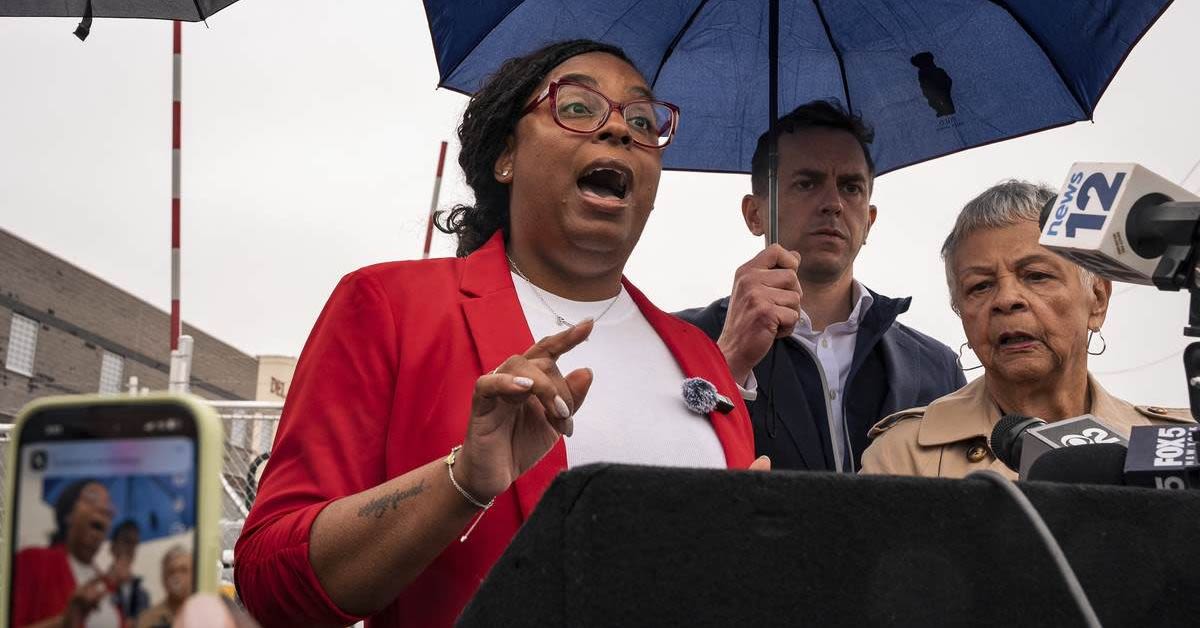
Democrat Rep. LaMonica McIver (NJ-10) is portraying herself as a political martyr as she faces serious federal charges stemming from a confrontation at an Immigration and Customs Enforcement detention facility in Newark, New Jersey.
The case traces back to a May 9, 2025, visit to Delaney Hall in Newark, where McIver joined Reps. Rob Menendez and Bonnie Watson Coleman for what was billed as an oversight tour of the ICE facility, according to RedState. While the three lawmakers waited to enter, federal agents moved to arrest Newark Mayor Ras Barakaalso on site that dayon a trespassing charge, and the situation quickly devolved into chaos.
Prosecutors allege that amid the disorder, McIver assaulted federal agents, transforming what Democrats framed as a routine visit into a criminal matter. While Barakas trespassing charge was swiftly dropped, McIver was indicted in June 2025 on two felony counts and one misdemeanor and now faces a theoretical maximum of 17 years in prison if convicted.
McIver has pleaded not guilty, and notably, the other members of Congress present that day were not charged. Seeking to avoid trial, she later moved to dismiss the case, arguing that her conduct was protected under the Constitutions speech or debate clause, which shields certain legislative acts from prosecution.
That argument largely failed. In August, the U.S. Court of Appeals for the Third Circuit rejected her constitutional claim as to two of the three counts and sent the remaining charge back to the trial court for further consideration, leaving most of the indictment intact.
Undeterred, McIver took to X on Thursday to cast herself as a victim of President Trumps immigration agenda and to rally support from the left. I am facing 17 years in federal prison for doing my job and standing up to Trumps merciless immigration enforcement campaign. I am finding the strength to keep standing up every single day, she wrote, repeating the same line in a separate post and framing the prosecution as political retaliation.
Her attempt at reframing the narrative was met with swift pushback online. Critics on X pointed out that the charges arise not from policy disagreements or legislative oversight, but from alleged physical conduct toward federal agentsbehavior that, if proven, falls well outside the bounds of protected congressional activity.
Many users also threw Democrats own rhetoric back at her, invoking the familiar refrain: No one is above the law. That standard, so often deployed against President Trump and his supporters, is now being cited by conservatives to argue that a Democrat lawmaker should not be exempt from accountability when accused of assaulting law enforcement.
McIvers complaint that she is being punished for opposing Trumps merciless immigration enforcement campaign also mischaracterizes the underlying policy dispute. The Presidents administration is enforcing immigration laws that Congress itself enacted, and if lawmakers like McIver object to those statutes, their constitutional remedy is to legislatenot to interfere with officers carrying out their lawful duties.
Her social media messaging appears designed to cast herself as stunning and brave, standing up to a supposedly cruel immigration system every single day, but most responses on X rejected the notion that she is a victim. Commenters instead emphasized personal responsibility and the rule of law, underscoring that disagreement with enforcement priorities does not grant license to obstruct or assault federal agents.
It is also worth noting that while 17 years is the statutory maximum, such an outcome is improbable in practice. Sentences for multiple counts arising from a single incident typically run concurrently, and absent a prior criminal record, it is unlikely a judge would impose the harshest possible term even in the event of conviction.
McIvers own post included an image indicating she was eight months pregnant, a detail that may be intended to elicit public sympathy as the case moves forward. For now, the legal process continues, and the central question remains whether a member of Congress will be held to the same standard her party so often demands for others when it comes to respecting law enforcement and the immigration laws of the United States.
Login