
Politicians across the country have seized on a convenient slogan for the exploding data center industry: welcome the servers, but insist they be 100% renewable."
According to Western Journal, Wisconsins Democratic gubernatorial hopeful David Crowley has already embedded that phrase in his campaign platform, and similar language is surfacing wherever tech giants scout locations for massive new campuses. The line sounds simple and virtuous, but it conceals a fundamental question that most voters and many politicians have not been encouraged to ask: what exactly does 100% renewable mean in practice.
There are, in reality, two very different definitions. In one version, the data centers servers are physically powered by wind and solar energy every hour of every day, even in the dead of winter nights. In the other, the facility simply pulls whatever electricity the grid happens to be generating coal, gas, nuclear, or renewable and then buys enough renewable contracts and credits over the course of a year to match its total consumption on paper.
The second model is essentially an accounting exercise, a way of balancing a corporate sustainability ledger without changing the physical reality of how electrons reach the servers. The first is a matter of physics, requiring that renewable generation and storage be available whenever the data center needs power, not just when the sun shines or the wind blows. Those two approaches do not carry remotely similar price tags, land footprints, or infrastructure demands.
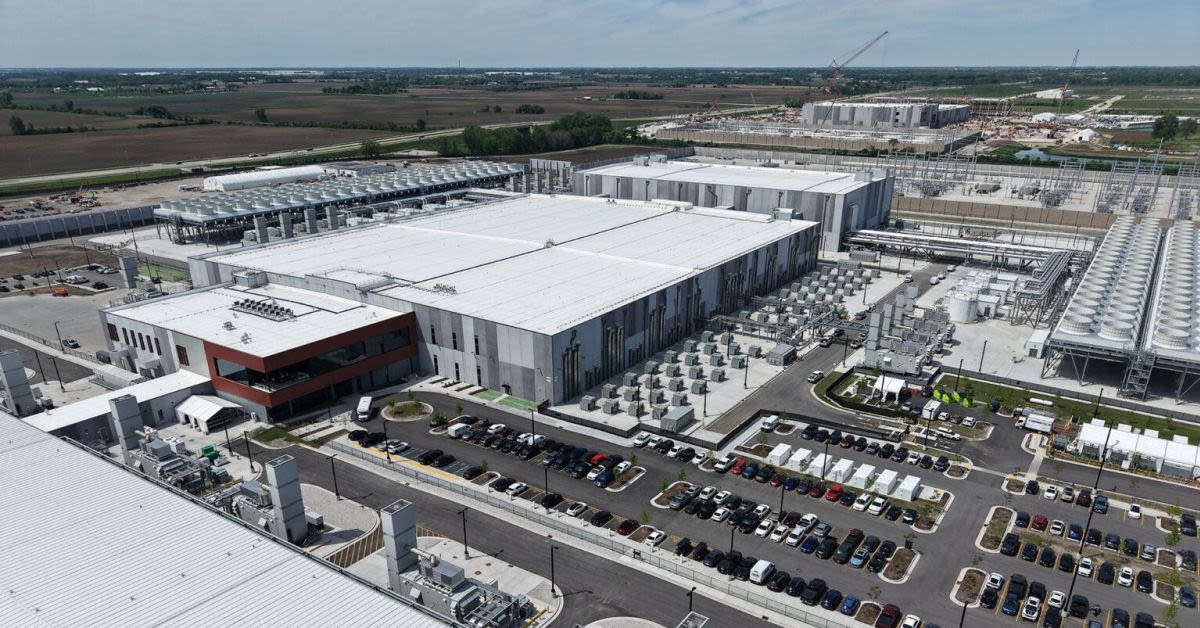
Wisconsin offers a revealing case study. The Paris Solar-Battery Park in Kenosha County, located near Microsofts Mount Pleasant data center campus, consists of roughly 500,000 solar panels spread across about 1,500 acres, delivering 200 megawatts of solar capacity and hosting the states first large-scale battery system rated at 110 megawatts for about four hours, or 440 megawatt-hours of storage. The total project cost was approximately $575 million, a substantial investment for a single solar-and-storage complex.
Microsoft has indicated that just the first phase of its Mount Pleasant operation will require around 450 megawatts of power on a continuous basis. That translates to roughly 3.9 million megawatt-hours of electricity every year, a staggering demand that dwarfs the consumption of many traditional industrial facilities.
Using the ledger definition of 100 percent renewable, the math quickly becomes daunting. In Wisconsins climate, solar installations typically produce about 18 percent of their rated capacity over a year, meaning the Paris project generates around 315,000 megawatt-hours annually. To match the electricity use of a single data hall on paper, Microsoft would need the equivalent of 12 to 13 Paris-scale projects: about 2,500 megawatts of solar, some 6.5 million panels, and roughly 19,000 acres close to 30 square miles of land.
Constructed as fully built-out Paris-style plants, that would amount to on the order of $7 billion in capital costs. Yet even after that enormous outlay, the servers would still be running on whatever mix the grid provides at night, with the 100% renewable claim satisfied only in the accounting books, not in the real-time flow of power.
The physics-based version of the promise is even more demanding. Pariss battery system can store 440 megawatt-hours, while the data center consumes about 450 megawatt-hours every single hour, meaning the entire battery would be drained in less than 60 minutes if it were the sole source of power. A mid-January night in Wisconsin can stretch to about 15 hours of darkness, requiring roughly 6,700 megawatt-hours of stored energy the equivalent of about 15 Paris-sized battery installations before even considering the impact of a cloudy day that limits solar output.
Extend that scenario to five consecutive gray winter days and the requirement balloons to around 54,000 megawatt-hours of storage, more than 120 Paris-scale battery systems. To keep those batteries charged through a typical northern winter, one would need to add a correspondingly massive solar fleet, bringing the total to something like 25 Paris plants, 12 million panels, and 60 square miles of land, with total costs in the tens of billions of dollars for a single data hall with firm, around-the-clock renewable power and that is before accounting for new transmission lines, charging losses, and eventual battery replacement.
By contrast, a modern combined-cycle natural gas plant of similar capacity can be built for roughly $1 billion. The planned restart of the Three Mile Island nuclear facility is budgeted at about $1.6 billion for 835 megawatts of reliable, carbon-free generation, and both gas and nuclear plants operate continuously, including at night and during winter storms.
The corporations driving the artificial intelligence revolution are acutely aware of these realities, even if political rhetoric often glosses over them. Microsoft has already announced that it has matched 100 percent of its electricity use with renewable energy on an annual basis, but its new goal for 2030 is to secure hourly carbon-free power, a far more stringent and technically meaningful standard.
The language shift is telling. Note the words: carbon-free, not renewable, the analysis observes, underscoring that carbon-free includes nuclear, which is why Microsoft signed a 20-year deal for Three Mile Island, Meta contracted for the Clinton plant in Illinois, and Amazon put money into new reactors. What actually keeps data centers and the broader grid running is firm power, the kind that is available on demand, regardless of weather or time of day.
This is not a case against solar energy itself. It is, rather, a warning against politicians and activists embracing a feel-good slogan before they have grappled with its technical meaning and financial implications, especially when those costs are many times the cost of natural gas.
Crowleys own platform implicitly acknowledges this tension. He supports nuclear power because reliable, carbon-free baseload power is essential to a grid that works for families and businesses, yet nuclear is carbon-free, not renewable, and his proposed data center rule appears to exclude the very resource he says the grid requires one that typically takes a decade or more to permit and construct, while data centers demand power almost immediately.
Complicating matters further, gas turbines the workhorses of modern backup and peaking power are already backlogged in the supply chain. Data centers, by contrast, can be built in roughly two years, creating a mismatch between political promises of 100% renewable facilities and the practical timelines for building the infrastructure that could even begin to approach that standard.
Candidates who insist on 100% renewable data centers are therefore making one of two very different commitments. If they mean the accounting version, they owe voters the honesty of saying so plainly; if they mean genuine, all-hours electricity from renewables alone, they should be prepared to show the public the vast tracts of land, the staggering number of batteries, and the multi-billion-dollar bill that such a system would entail.
The same hard questions apply to the broader grid that serves households and small businesses. When politicians and regulators talk about transforming the energy system, citizens deserve to see the full costs, not just the slogans.
On one key point, Crowley is correct: data centers should not be allowed to offload their grid costs onto ordinary ratepayers. Wisconsin regulators already require large industrial customers to pay for the generation capacity built specifically to serve them, reflecting a pay your own way principle that aligns with conservative views on fairness and fiscal responsibility.
Against that backdrop, the oft-repeated claim that Wind doesnt cost us. Sunlight doesnt cost us is exposed as little more than a marketing line. Fuel is free. Capacity in January is not, and it is capacity the ability to deliver power when it is needed most that determines whether families can heat their homes and businesses can keep their doors open.
Renewable energy certificates may be useful tools for balancing corporate sustainability ledgers. They cannot, however, balance the physical grid or keep the lights on during a prolonged cold snap when solar output is low and demand is high.
Artificial intelligence systems do not shut down on weekends, holidays, or frigid January nights. Energy policy must be designed to work under those same conditions, not just for data centers chasing green branding, but for every American family and business that depends on a reliable, affordable, and realistically planned power supply.
Login