
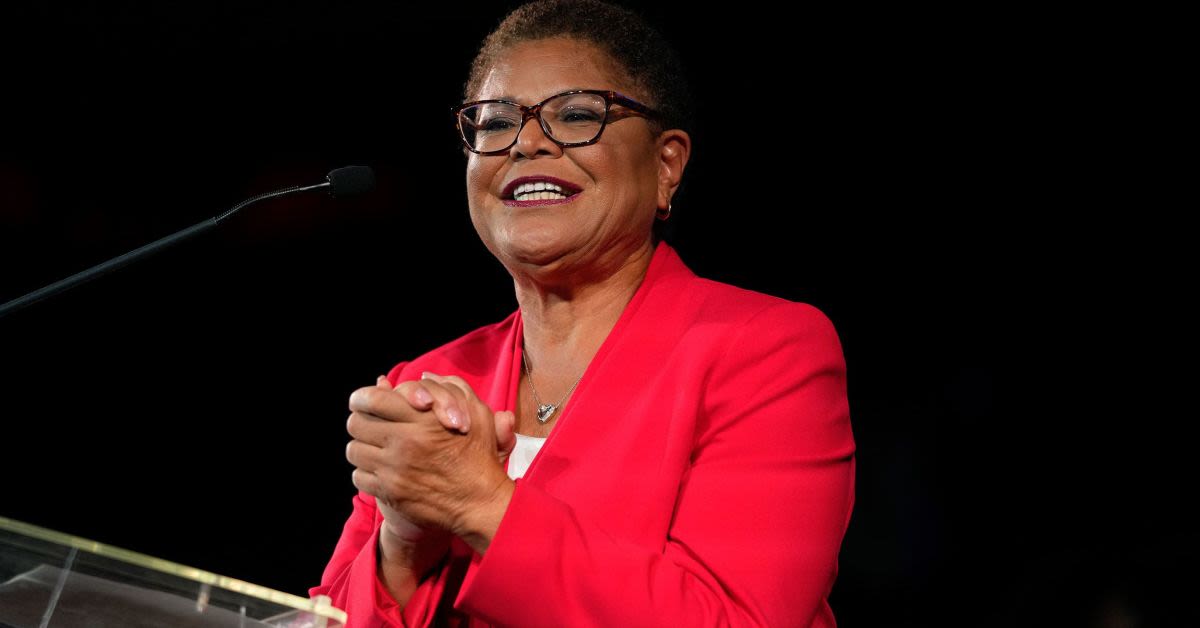
Los Angeles Mayor Karen Bass has quietly filed hundreds of state transparency reports meant to reveal who is bankrolling millions of dollars in donations she has solicited, yet dozens of those filings list the donor only as Anonymous.
.
According to Just The News, at least 23 of Basss state-mandated behested payment reports reviewed by The Center Square show her formally asking for money from Anonymous, a practice that may comply with narrow legal rules but plainly undermines the spirit of Californias transparency regime. The states behested payment system was designed so citizens could see which wealthy interests or corporations their elected officials are courting for cash, and what political or financial motivations might lurk behind those gifts.
Instead, the public is left with basic, unanswered questions that go to the heart of ethical government. Who actually wrote the checks, what business did they have before City Hall, what did Bass or her staff do to secure the money, and, if the funds flowed to a nonprofit, how were they ultimately spent?
Bass has not responded to multiple requests from The Center Square for comment. Her silence leaves a vacuum that watchdogs and taxpayers are increasingly filling with suspicion.
The filings show that the anonymous payments totaled $240,563 and were funneled through the Pledgeling Foundation over a mere 12-day stretch in January 2025. Bass directed that quarter-million dollars to the California Community Foundation (CCF), ostensibly to support fire relief and recovery efforts.
The Pledgeling Foundation, which brands itself as a 501(c)(3) donor-advised fund and charitable clearinghouse, serves as a kind of financial veil for donors who prefer to stay in the shadows. Companies and individuals can route money through such donor-advised funds to conceal their identities while often reaping generous tax deductions in the process.
Gregory Yorke, chief financial officer and vice president of business operations for Pledge, declined an interview but offered some possibilities in an email exchange. The City could be pulling donations that display as anonymous on sites like this one (set up by CCF), which just means that the donor did not want their name made public, Yorke wrote.
He further explained that anonymity is not an accident but a feature of the system. Some people will choose to donate via a donor-advised fund precisely to stay anonymous. They are not anonymous to us, but they can opt to be shown as anonymous to the organization we regrant to, like CCF.
Under California regulations, elected officials are not supposed to simply shrug and accept that opacity. They have a legal duty to identify the underlying donors of behested payments to the California Fair Political Practices Commission (FPPC) with as much specificity as they know or can determine by asking the sponsoring organization.
If the sponsoring organization refuses to reveal the donor, FPPC rules still allow the politician to disclose the payment without naming the person or company behind the money. That carve-out, however, is meant to be an exception, not a convenient excuse to avoid asking hard questions.
According to Pledge, Bass appears not to have pressed for those answers. I am not aware of any requests to share donor info with the Mayors office or ANY other 3rd party, whether related to CCF or any other charity and I am sure that any such ask would have been run by me, Yorke wrote in an email.
Yorke added that donor secrecy is not just tolerated but actively protected by the fund. We would never share donor info with any 3rd party, the Mayors office or whomever, unless we had the original donors permission.
California lawmakers tightened rules on donor-advised funds in 2021 precisely because of mounting concerns that anonymous giving was eroding transparency and accountability. Yet the Bass filings show how easily the system can still be gamed, especially when public officials show little appetite for piercing the veil.
When donors hide their identities, the public has no way to judge whether the money was ethically appropriate, transparency advocates warn. Citizens cannot check whether anonymous benefactors held city contracts, hired lobbyists, or had matters pending before Los Angeles officials at the time of the donations.
It speaks volumes, said Sean McMorris, who manages the transparency and ethics program for California Common Cause. The less they share, the more the public is going to assume... The public sees these things. They're not stupid. They can connect the dots.
McMorris has bluntly described the current framework as ripe for abuse. All of these accountability laws? Most of them have loopholes because money always finds a way, McMorris said.
He underscored that the system relies heavily on the honor of the very officials it is supposed to regulate. This entire system is based on trust without verification. It's inherently flawed... and policymakers are very apprehensive to amend laws that regulate themselves.
The California Community Foundation has emerged as one of the biggest beneficiaries of Basss behested fundraising. CCF has received more than $4.2 million from donors at the mayors request, even though Bass does not sit on its board.
The organization has nonetheless become a prominent partner working alongside Mayor Karen Bass on initiatives such as LA4LA, an affordable-housing partnership that dovetails with the citys progressive housing agenda. That close alignment raises obvious questions about whether philanthropic dollars are being used to advance policy priorities that should instead be debated and funded through the normal, accountable budget process.
Gilien Silsby, a spokeswoman for CCF, did not respond to a request for comment. The lack of transparency from both City Hall and its nonprofit partner only deepens public skepticism.
Most nonprofits must make their tax returns public, but those documents are blunt instruments. They show broad categories of revenue and expenses, not the granular, receipt-level detail that would allow taxpayers to track specific donations from donor to final use.
Federal law does not require nonprofits to disclose donors names or addresses, and their filings are a far cry from a government checkbook that would be subject to the California Public Records Act. When public officials steer large sums to private nonprofits, they effectively move money into a realm where accountability is weaker and scrutiny is harder.
Disclosure forms are supposed to mitigate that risk by stating the charitable purpose of each donation. Yet those descriptions are filled out by the politician or staffer requesting the money, not by the nonprofit that ultimately spends it.
Nonprofit recipients are not necessarily legally bound to adhere to the stated purpose on a behested payment form. That gap between stated intent and actual use is precisely where influence and favoritism can flourish out of public view.
The Mayors Office has offered no explanation for how Bass could solicit money from donors whose identities she apparently never sought to learn. That posture strains credulity, especially for a city that has seen its share of corruption scandals and pay-to-play allegations.
One possible explanation is that Bass herself rarely speaks with the donors whose generosity she later reports. The fundraising machinery may be operating at arms length, with staff and allied nonprofits doing the heavy lifting while the mayor reaps the political credit.
Bass has had minimal to no involvement in fundraising for the Mayors Fund for Los Angeles, according to the nonprofits president and chief executive officer, Conway Collis. He made that claim to local outlet L.A. Material in a story published earlier this month, even as he acknowledged that Bass reports all gifts to the Mayors Fund as behested payments via FPPC Form 803.
Those statements have triggered a new round of questions about whether Bass has been taking credit for donations in which she played little or no role. If a contribution truly had no connection to Bass or her staff, the law would not require it to be reported as a behested payment at all.
The Form 803 is not a casual press release or a political talking point. It is a formal filing with the FPPC, submitted under penalty of perjury.
By definition, a behested payment is one that is connected in some way to an elected officials request, suggestion or direction. According to the FPPC, politicians must disclose such payments precisely because of their role in the transaction, not despite it.
Bass serves as an advisor to the Mayors Fund but does not hold a board seat. Even so, her role has been described in markedly different terms depending on the audience and the moment.
Despite the CEOs claim that Bass has minimal to no involvement in fundraising, the Mayors Office has repeatedly credited her with helping to raise or secure philanthropic dollars. The Mayors Funds public-facing materials feature Bass writing letters to donors, thanking them and stressing that their support is critical.
Melanie Mendoza, a spokeswoman for the Mayors Fund, briefly spoke with The Center Square by telephone but ultimately declined to answer questions and stopped responding to follow-up inquiries. That pattern of partial engagement and quick retreat has become a hallmark of how the entities around Bass handle scrutiny.
The Center Square has not identified any anonymous donations to the Mayors Fund that were reported at Basss behest. That contrast with the CCF-related anonymous gifts suggests that different standards of transparency may be applied depending on which nonprofit is involved and how politically sensitive the funding stream might be.
Its the connecting of dots that's the problem. Just getting the dots can be difficult for most people, but linking them up, I think, is the hard part, said Richard Briffault, a Columbia University law professor and campaign finance expert.
These are not (money) trails. These are webs. Its like following the air molecules. Its the water in which the fish swims.
For conservatives who have long warned about the dangers of opaque publicprivate partnerships and the growth of unaccountable shadow governance through nonprofits, the Bass case is a textbook example of why robust transparency matters. When a big-city mayor can steer millions to favored organizations, rely on donor-advised funds to shield benefactors, and then file official reports that list Anonymous where a name should be, the publics ability to police conflicts of interest is badly compromised.
Californias transparency laws were meant to shine light on the nexus of money and power, not to provide a veneer of compliance while the real decisions happen behind closed doors. Until officials like Bass are willingor compelledto demand full disclosure from the intermediaries they use and to explain their own role in these fundraising operations, voters will be left to connect the dots on their own, with little more than partial filings and unanswered questions to guide them.
Login