
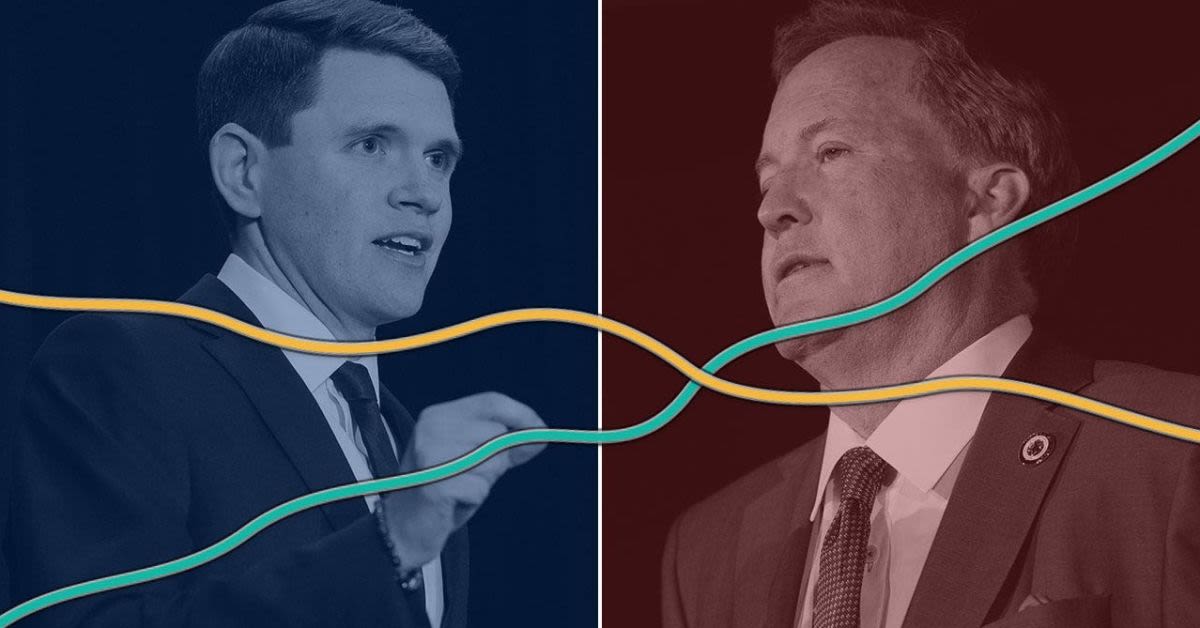
Democratic Senate hopeful James Talarico is being heralded by the polling class as the man poised to topple Republican Texas Attorney General Ken Paxton, but the numbers driving that narrative deserve far more scrutiny than they are getting.
According to Western Journal, a new Marist survey released Wednesday claims Talarico has opened up a significant lead over Paxton in the Lone Star States high-stakes Senate race.
The poll, conducted Sept. 17-20 among 1,139 registered voters with a margin of error of 4.4 percentage points, shows the Democrat ahead by 6 points and has already been seized upon by legacy media as proof that Texas is finally ready to abandon its conservative roots.
If this sounds familiar, it should. Dating back at least to 2016, the polling industry amplified by a compliant mainstream press has repeatedly promoted surveys that inflate Democratic prospects and, not coincidentally, risk discouraging Republican turnout.
Texas has seen this movie before, most notably with Beto ORourke, the media-anointed progressive savior who was supposedly destined to turn the state purple. Though he came within 3 percentage points of defeating GOP Sen. Ted Cruz in 2018, he failed miserably in his attempt to take out Republican Gov. Greg Abbott four years later, losing by 11 points.
The Marist poll at the center of the latest narrative relies on self?identified party affiliation, since Texas does not register voters by party. Its respondent pool was 33 percent Democratic-identifying, 39 percent Republican-identifying, and 25 percent identifying as independent, a breakdown that leaves ample room for misjudging who will actually show up on Election Day.
The survey also highlights Talaricos supposed strength with younger voters, reporting that 74 percent of voters 29 years old or younger favored the Democrat. Yet the question remains whether a surge of Gen Z enthusiasm a demographic that historically underperforms at the ballot box is enough to swing a statewide race in a state as large and complex as Texas.
Democrats and their media allies are eager to argue that Republican struggles with foreign policy, inflation, party infighting, and legislative gridlock have created the conditions for a sweeping blue wave.
But conservatives have every reason to ask whether this is genuine analysis or just another mirage crafted by liberal operatives and pundits to cast a cloud of despair over GOP voters and donors.
Looking at the polling record of the last decade, the pattern is hard to ignore.
Time and again, surveys and commentary have been deployed to boost deeply flawed and radical Democratic candidates who pose as moderates, hoping to conceal their far-left agendas behind carefully curated talking points.
The modern era of polling skepticism arguably began in 2016, when virtually every major outfit insisted Donald Trump had almost no chance of defeating Hillary Clinton.
Pollsters made it seem like she was running unopposed and that Trump was wasting his breath, and they even had the hubris to predict that he would wipe out the GOP congressional majorities when he lost.
That was a complete misfire and destroyed the industrys few remaining shreds of credibility.
It also exposed their deep liberal bias as fanatical and unwavering, revealing that many in the profession were less interested in measuring public opinion than in shaping it.
In 2018, the media spent months hyping a blue wave, with polls suggesting Republicans would be swept out of both chambers of Congress and lose a slate of key governorships.
Despite losing the House by a somewhat narrow margin, the GOP added two Senate seats and held its ground in several high-profile swing states throughout the country.
The 2020 cycle only deepened the doubts.
Politico published a piece during the aftermath of the election titled: Pollsters: Impossible to say why 2020 polls were wrong, citing how much closer the final tally was compared to previous predictions.
By 2022, the pendulum had supposedly swung the other way, with Newsweek noting that pollsters were forecasting a massive red wave fueled by President Joe Bidens unpopular policies.
The result was far more modest: A slim Republican majority in the House and a razor-thin Democratic edge in the Senate, once again exposing the professions inability to accurately capture the electorates mood.
In 2024, many pollsters and commentators finally conceded that the presidential race would be close, but few dared to predict that Trump would sweep all seven swing states and win the popular vote.
In fact, an infamous poll from Ann Seltzer and The Des Moines Register had Harris leading in the crucial state of Iowa by 3 percent, yet Trump won the state by over 13 points.
Enough said.
When misses of that magnitude are treated as mere footnotes rather than professional failures, it is hardly unreasonable for conservatives to question whether the errors are accidental or ideological.
This brings the conversation back to the upcoming midterm elections and the breathless coverage of Talaricos supposed surge.
Given this abysmal track record, why should we believe anything the polling industry says, and why should the public expect accuracy from a cabal of liberals who have disdain for conservative policies?
Democrats may indeed have a realistic shot at gains or at least holding ground in states such as North Carolina, Georgia, and Maine, even though Trump carried two of those states in 2024.
Yet we are now being told that Republicans should be sweating in places like Ohio, Alaska, and Texas, states that have consistently favored conservative candidates and policies.
The disconnect becomes even more glaring when Talaricos own record and rhetoric are examined.
Talarico is a fraud, and a majority of Texas voters support things like Second Amendment, tax cuts, immigration, barbecue, and Christianity, and they also withdraw in disgust at the thought of children being dressed up as drag queens or the idea that God is nonbinary.
Yet Talarico has been caught slamming Christianity and has a pastor who denies the resurrection of Christ.
Hes made insane proclamations that there are six genders, has claimed Jesus Christ was a radical feminist, said the southern border should be treated like a front porch and named his favorite drag queen without hesitation.
These are not fringe remarks in a private conversation; they are part of a public persona that aligns far more closely with the cultural left of coastal America than with the values of mainstream Texans.
Lest we forget the infamous photo op of him eating barbecue, in an effort to appear more likeable and down-to-earth, even Talarico had to admit hes been downright cringey and missed the mark.
Missed the mark?
Hes not even on the same page of the same book as the average Texan, and the notion that such a candidate is comfortably leading a conservative stalwart like Paxton strains credulity.
Does this sound like a man who will accurately represent the Lone Star State?
No, he sounds more like a California liberal, and were supposed to believe hes leading Paxton by 6 points? Give me a break.
What Talarico does have, however, are powerful allies in the establishment media, the polling business, and the political PAC ecosystem that funds and shapes modern campaigns.
They want him to win and will do whatever is necessary to make that happen, warping the narrative, contorting numbers, carrying his water, molding headlines and trying to depress turnout to make his win all but certain.
If he loses, the script is already written.
Theyll do what they did when Trump won: Act completely surprised, blame the data, and claim they underestimated rural turnout.
Then they rinse and repeat, preparing to do it all over again in two years. The cycle of error, excuse, and repetition has become so predictable that it is almost part of the campaign calendar.
Nor is Texas the only battlefield where this strategy is in play.
The polling and media industries have also targeted races like Ohios gubernatorial and Senate contests, in a state that is home to the sitting vice president and has not voted Democrat for president since Barack Obama carried it in 2012.
Ohio voters delivered a decisive victory for GOP Sen. Bernie Moreno just two years ago, opting to kick former Democratic Sen. Sherrod Brown out of office. By the way, Brown is running again this cycle and the race is being dubbed a dead heat, another supposedly shocking toss-up in a state that has been trending red for years.
This climate of polling panic has already had tangible consequences for Republican strategy. National Republican Senatorial Committee Chair Tim Scott has reportedly all but abandoned Georgia and North Carolinas Senate races, redirecting funding and attention to states where Trump won last cycle.
It is still anybodys game with several weeks remaining until Election Day, and no serious observer would claim that outcomes are locked in. But dont be fooled: This recent media polling blitz is coordinated, calculated, and controlled, designed as much to shape perceptions and resource allocation as to reflect voter sentiment.
Whether the data will ultimately match the end results is still an open question, especially given the industrys recent history of high-profile failures. What remains constant is that the real power still lies with the American electorate, who will ultimately have the final say, biased polling be damned.
Login