
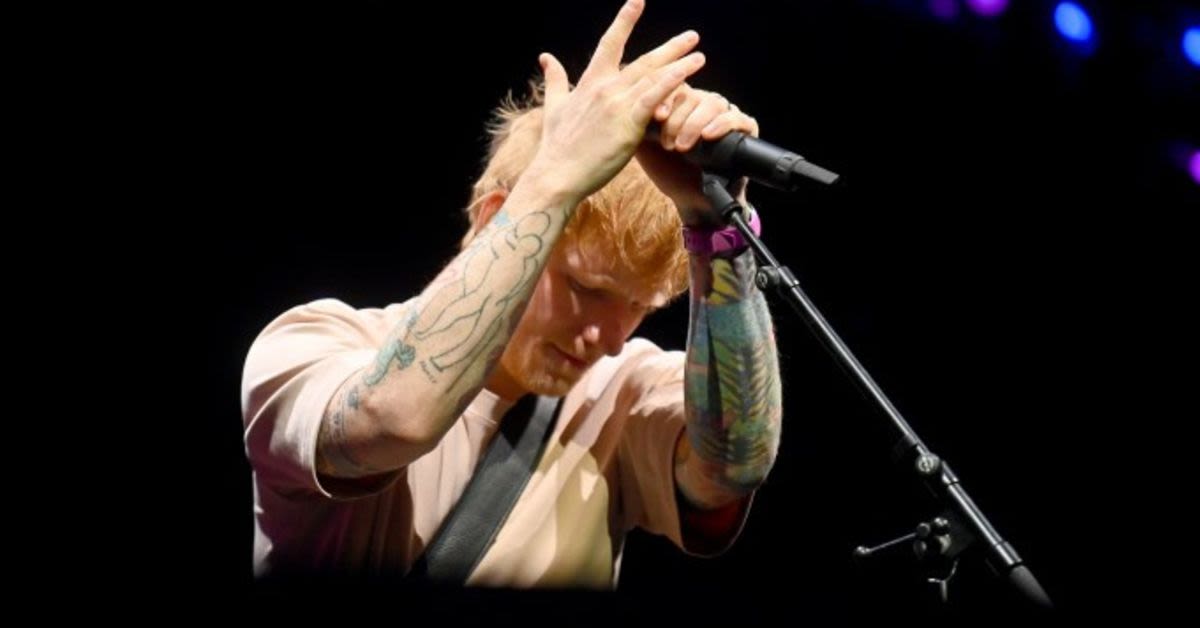
Ed Sheeran walked onto the stage at Lincoln Financial Field in Philadelphia on Saturday night alone with his guitar, carrying not only the weight of a stadium show but the political firestorm that has engulfed his Loop tour since the removal of rapper Macklemore.
The Philadelphia concert marked Sheerans first appearance on the tour since Macklemore was dropped by promoters Messina Touring Group, not by Sheeran himself, after the Seattle rapper defied requests not to perform his Free Palestine and Hinds Hall protest tracks. According to The Post Millennial, Macklemores dismissal prompted the remaining acts on the bill to walk away in solidarity, leaving Sheeran to face a furious pro-Palestinian backlash for his silence and to perform without any opening acts.
At the outset of the show, Sheeran addressed the controversy directly, acknowledging that the criticism he faced in the days after Macklemores removal was of a different order than the usual artistic scrutiny. He told the crowd that in the week following the decision, the criticism was about something much more important.
He admitted the strain of the moment and the difficulty of the choices he has been forced to make. "I've had to take and made difficult decisions," he said, "and I am making mistakes, and I'm so, so sorry."
Sheeran stressed that he has never seen himself as an activist performer, preferring to keep his shows focused on unity rather than ideological division. Yet he conceded that the Macklemore episode had thrust him into the middle of an important and passionate arguments about freedom of speech and the most complex political issue on the planet."
From there, he pivoted to a broader concern that resonates deeply with advocates of free expression and limited institutional control. He told the audience that he "deeply worries about the idea that venues should pre-approve content for performers. This happens in so many places that I perform around the world, but it should never happen in the free world."
Only then did Sheeran turn to the war itself, beginning with the atrocities that reignited the conflict last October when Hamas terrorists stormed into Israel, murdering 1,200 people, including young concertgoers at the Nova Music Festival. "I have tried in my career not to be a political commentator of any kind, because I want my music and shows to be about unity, not division, about humanity, not politics.
"But this is a humanitarian issue, and I cannot hide how I feel about it anymore. What happened in Israel and at the Nova Music Festival on October 7th was horrific and compounded centuries of Jewish Pain."
He then addressed the suffering on the Palestinian side, the cause Macklemore had been championing from the stage before his removal. "What is happening in Gaza is catastrophic and unjustifiable and disproportionate. My heart has been broken by the scale of devastation and loss of civilians' lives, of children's lives. And the systemic injustice we're seeing unfold in the West Bank cannot be overlooked."
Sheeran emphasized that his concerts are meant to be spaces where everyone is welcome, regardless of their politics, and that he is actively searching for a way to provide tangible help rather than empty rhetoric. He said he is trying "to work out how to make a contribution that helps victims of these terrible times."
The tension surrounding the tour was evident in the way he physically staged the show, revealing that he had removed a runway-style extension that would normally carry him into the middle of the crowd. "I didn't know what this audience would be like tonight," he said. "I didn't know if I would have things thrown at me, I didn't know if people would be angry at me."
Instead of hostility, the stadium responded with cheers, signaling that, whatever the online outrage, the people who bought tickets were prepared to hear him out. "Today is not the usual Loop show," he said, and it was not: Sheeran performed without his backing band, which had quit in support of Macklemore, and instead introduced a handful of new musicians, including violinist Alicia Enstrom.
He explained that some songs simply could not be recreated with his trademark loop pedal alone, forcing him to rethink the entire production in a matter of days. "There are certain songs that just dont work on the loop pedal," he told the crowd, "so when my friends dropped out of the show, I was thinking, How am I gonna keep the show the same, and how am I gonna get musicians to stand on stage with me in a week when no one wants to stand on stage with me?"
Sheeran praised those who did step forward, commending both their courage in standing beside him amid a political storm and their professionalism in learning the material so quickly. Their presence allowed him to preserve at least some of the musical richness of the original tour concept, even as the politics around it threatened to tear the production apart.
As the night drew to a close, Sheeran sat down on the edge of the stage and spoke to the audience with visible emotion, thanking them for showing up when so many around him were walking away. He choked up as he described wrestling with whether to continue the tour at all, saying that while he heard constant calls to cancel, what he actually saw was tens of thousands more people buying tickets, and he could not bring himself to abandon them.
"I have so many people telling me to cancel this tour and so many people falling out of my life that Ive known for years and years and years, people just kind of backing away," he said. "And then, you know, Im there, and everyones telling me to cancel, and Im feeling my friends and family, and people I know abandoned me."
His fans, however, have not abandoned him, and that loyalty has become his justification for pressing on despite the cultural pressure campaign. "If this tour ends," he said, "love doesn't win."
Login