
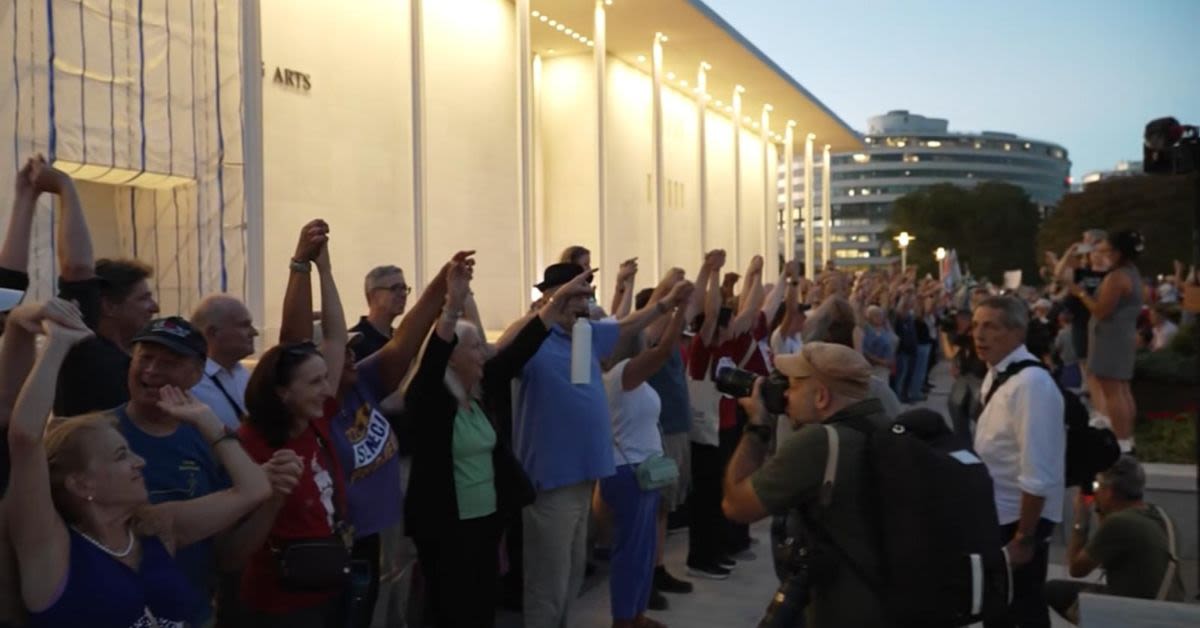
Hundreds of demonstrators encircled the John F.
Kennedy Center for the Performing Arts this week, chanting Hands off! to protest President Donald Trumps decision to temporarily shut down the iconic cultural venue.
The rally, organized by the advocacy group Hands Off the Arts, had been on the calendar for months but was delayed from July due to wildfire smoke. As reported by Breitbart, the rescheduled event unfolded during a week of heightened legal and political drama surrounding the Kennedy Center, amplifying tensions between the Biden-era arts establishment and a Trump administration determined to reassert executive authority over federally supported institutions.
On Tuesday, a judge for the second time blocked Trump from putting his name on the center, a move that would have symbolized a sharp break with the Kennedy-era liberal legacy that has long dominated the arts world. In response, Trump and the Kennedy Center board moved to close the facility, a step Executive Director Matt Floca later described as a one-week shutdown, while a separate ruling on Thursday required that any future changes to the center be disclosed to the court in writing 30 days in advance.
Hands Off the Arts was formed by Kennedy Center staff shortly after Trump took office in early 2025, reflecting a broader resistance within cultural institutions to conservative leadership. By Friday, organizers had anticipated a turnout of about 1,000, but by their own estimate the crowd swelled to several thousand, underscoring how the left-leaning arts community has mobilized against what it views as political interference.
The demonstration opposes the recent sudden closure of the facility, the installation of security fencing and political efforts to alter or demolish portions of the presidential memorial, the group declared on its website. Their framing cast Trumps actions as an assault on a national monument, even as conservatives argue that federally funded cultural centers have long been used to advance progressive narratives at taxpayer expense.
Actress Lynda Carter, best known for her role as Wonder Woman, appeared at the protest to lend celebrity weight to the cause. Music and the arts is how we actually survive, The Post reported she said, adding, It is how we learn. It is about vibration in the universe. It is about gravity; its about our souls.
Co-organizer Mallory Miller, speaking to The Washington Post before the event, argued that the Kennedy Center had lost its energy and needed to be reclaimed by its patrons. The center had more or less become like a mausoleum rather than a vibrant cultural center, she said, adding, But a lot of us have amazing memories of the center hustling and bustling with people. We wanted to kind of bring that feeling back.
Miller also rejected any suggestion that the center could be renamed or rebranded under Trump or any other political figure. The Kennedy Center cant be renamed for anyone else, she told ABC News. Its a memorial to John F. Kennedy. Its, like, silly to suggest otherwise. And its not just silly its insulting and its degrading and its un-American.
A former assistant manager of dance programming at the Kennedy Center, Miller lost her job in 2025 amid mass layoffs that followed years of bloated arts bureaucracy and heavy reliance on public funding. Artists are the risk takers in our society, Miller told ABC, insisting, We are the people who create the world that comes next, and that is what the Kennedy Center means to all of us. This is a building that belongs to the American people, not one person, and its our Kennedy Center. We are the Kennedy Center.
Organizers had hoped to form a continuous human chain around the building, but newly installed security fencing a direct result of the closure order made that impossible. Protesters improvised, linking hands where they could and symbolically completing the chain despite the barriers, a visual metaphor for their opposition to what they see as federal overreach into cultural life.
Former ticket salesperson Jasmine Small, among the first employees laid off last year, watched as the chain took shape and said she felt compelled to speak for colleagues who had been sidelined. Im showing up today, because no one showed up with my colleagues, Small said, adding, Im going to have a voice for them to say that we wont be forgotten.
As the legal fight over the Kennedy Centers future continues, the clash highlights a deeper struggle over who controls Americas cultural institutions elected leaders accountable to voters, or entrenched arts bureaucracies and activist groups that often lean left. For conservatives, the episode raises fundamental questions about political neutrality, taxpayer funding, and whether storied venues like the Kennedy Center should remain insulated from the kind of accountability that other public institutions routinely face.
Login