
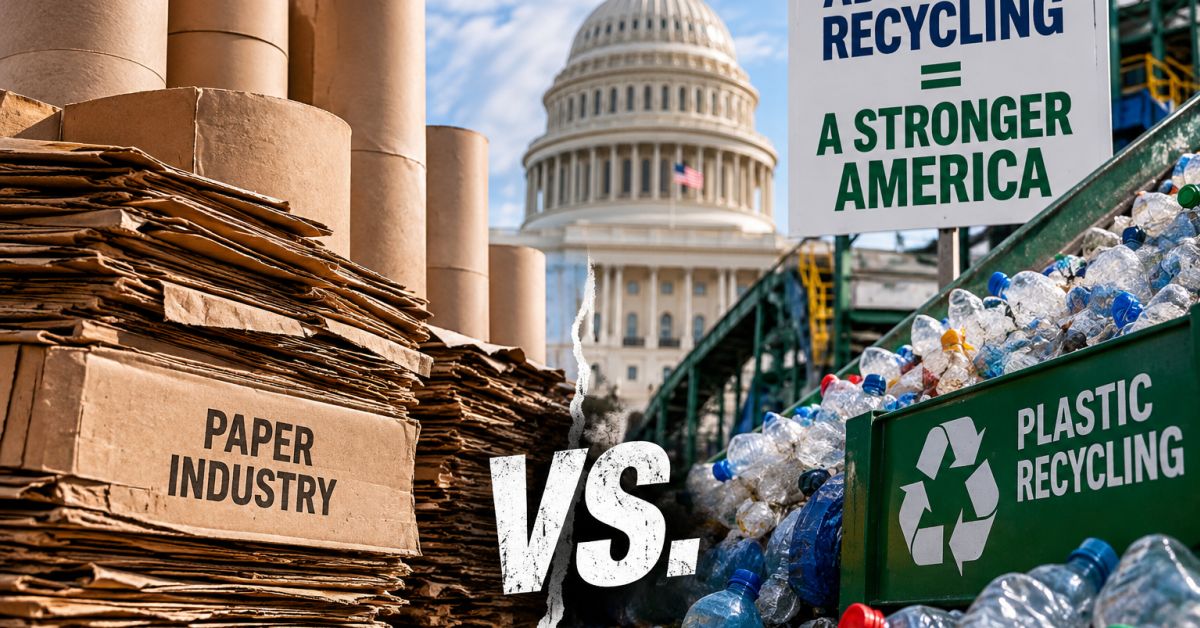
A conservative advocacy organization is challenging some of the worlds largest paper and consumer-goods companies over their role in blocking a Trump-aligned effort to expand advanced plastic recycling.
Consumer Action for a Strong Economy (CASE) has sent formal letters to six corporate heavyweightsInternational Paper, Pratt Industries, Kimberly-Clark, Packaging Corporation of America, Smurfit Westrock and Procter & Gambledemanding they rein in the American Forest & Paper Association (AF&PA), whose board they help lead. According to WND, CASE urged each company either to push AF&PA to stop lobbying against advanced recycling or to reconsider their membership in the powerful trade group, citing copies of the correspondence obtained by the Daily Caller News Foundation (DCNF).
You cannot credibly champion recycling while working to limit recycling innovation, CASE President Matt Kandrach wrote in each letter, accusing the companies of talking green while quietly undermining new technology. Kandrach argued that while recycled plastic may compete with paper in some markets, AF&PA should be promoting paper products on their merits rather than trying to kneecap rival forms of recycling that could reduce waste and support American manufacturing.
At the heart of the dispute is advanced recycling, a process that uses heat or chemicals to break down used plastic into its basic components so it can be turned into new products instead of being landfilled or burned. The House Energy and Commerce Committee voted 2819 on Wednesday to advance a bill to the House floor that would formally recognize advanced recycling as recycling under federal law, a move AF&PA opposes, spokesperson Lindsay Murphy told Politico.
Paper is proof of what a successful recycling system can look like, and this legislation builds on that success by giving other materials pathways to be recovered over sent to landfills, Republican New York Rep. Nick Langworthy, the bills sponsor, told the DCNF in a statement. Langworthy noted that while entrenched industries often resist change, the measure is designed to expand and modernize traditional recycling, not replace it, and to give consumers more options while reducing waste.
EPA Administrator Lee Zeldin wrote in an April op-ed that fewer than 10 advanced recycling plants are currently operating in the United States, while nearly 90 more are ready to be built but are stalled by regulatory uncertainty. Zeldin said the emerging industry could create more than 173,000 jobs, and the bill would establish a national standard for when a product can be labeled as made with recycled material, preempting a patchwork of state rules that complicate investment and innovation, Politico reported.
AF&PAs 2024 advocacy report lists Defeated advanced recycling legislation in Alabama among its key wins, underscoring how aggressively the group has worked to block the technology at the state level. In the same document, the association proclaims its vision is to be the most trusted voice for paper and wood products manufacturers in the circular economy, a model in which materials are kept in use as long as possible rather than discarded.
Executives from all six targeted companies sit on AF&PAs board, including International Paper Chairman and CEO Andrew Silvernail, who serves as second vice chair, according to the associations website. That leadership role, CASE suggests, gives these corporations both the responsibility and the leverage to stop AF&PA from undermining a recycling approach that could complement, rather than threaten, papers role in a more sustainable economy.
AF&PA argues the bill goes too far by allowing products with no physical recycled material to be marketed as recycled through a credit-based accounting system. Recycled content claims should reflect the material actually in the product, Murphy told Politico, framing the groups opposition as a consumer-protection stance rather than a bid to preserve market share.
AF&PA did not respond to two requests for comment from the DCNF on Tuesday or to a third on Friday, leaving its public rationale limited to statements made through Politico. That silence has only sharpened criticism from conservatives who see the association as aligning with environmentalist talking points when convenient, while quietly working to block pro-growth, pro-innovation reforms backed by the Trump camp and free-market advocates.
Pratt states on its website that its green mission is to use recycling as an important weapon against climate change, and International Paper calls circularity a key strategy in its 2023 sustainability report. Kandrach cited both corporate claims in his letters, arguing that opposing advanced recycling while touting climate credentials is precisely the kind of corporate greenwashing that has eroded public trust in large brands and trade associations.
Smurfit Westrock has nothing additional to contribute to this coverage, a company spokesman told the DCNF when asked about the dispute. International Paper, Pratt, Kimberly-Clark, Packaging Corporation of America and Procter & Gamble did not respond to media inquiries, and CASE itself did not answer three separate requests for comment, leaving the public debate to lawmakers and outside advocacy groups.
Langworthy introduced the bill in February with bipartisan cosponsors, according to Congress.gov, signaling at least some cross-party recognition that federal recycling rules are outdated. However, when the measure came up in committee on Wednesday, Texas Rep. Marc Veasey was the only Democrat to vote in favor, Politico reported, highlighting how far the Democratic Party has moved toward environmentalist orthodoxy that often resists market-based solutions.
Democratic Florida Rep. Kathy Castor argued during the markup that the bill would allow industry to pass off new plastic as recycled, according to the outlet, echoing talking points from green groups that have long opposed advanced recycling. Langworthy told the DCNF he remains optimistic that Veasey will help explain the bill to his Democratic colleagues, but with the vote occurring in the Houses final week in session before the November election and no Senate companion introduced, the legislative path remains uncertain, Politico reported.
Twelve conservative and taxpayer organizations, including Americans for Prosperity and the National Taxpayers Union, urged the committee in July to pass the bill, framing it as a pro-innovation, pro-consumer reform that would unleash private investment rather than expand federal bureaucracy. The U.S. Chamber of Commerce and the plastics industry also backed the measure, underscoring broad support from business and free-market advocates who see advanced recycling as a way to strengthen domestic manufacturing and reduce reliance on foreign materials.
The National Consumers League warned the committee in July that the bill would legitimize what it called a deceptive method of counting recycled content, while a coalition led by the Natural Resources Defense Council wrote on Aug. 31 that it would enable the plastics industry to make false claims. Those objections mirror a broader pattern in which progressive advocacy groups and their allies in Congress resist pragmatic, technology-driven solutions in favor of more regulation and restriction, even when those solutions promise environmental benefits, job creation and greater consumer choice.
Login