
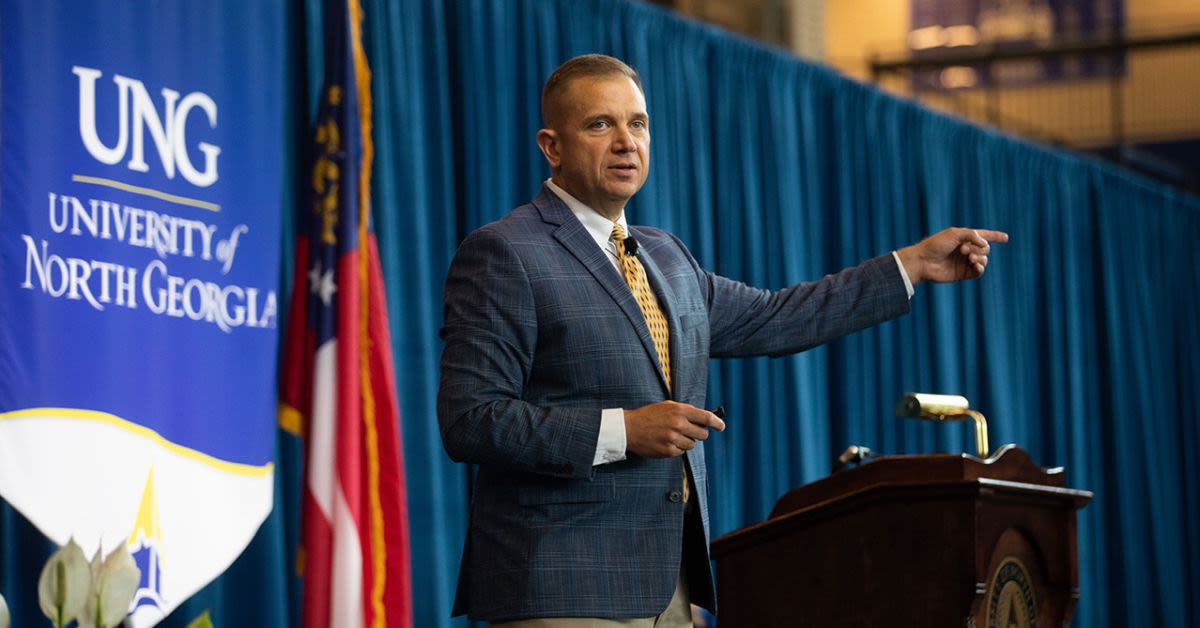
The University of North Floridas Board of Trustees has selected retired U.S. Army lieutenant colonel and current University of North Georgia President Mike Shannon as its next president, in a move that has drawn overwhelming support from board members but sharp ideological criticism from one dissenting trustee.
The Jacksonville-based institutions governing board voted 102 to advance Shannon, whose appointment must still be ratified by the Florida Board of Governors before it becomes official, according to the Gateway Pundit. While most trustees praised his credentials and leadership record, Trustee Allison Korman Shelton objected on explicitly political grounds, complaining that Shannon is too conservative for the universitys student body and campus culture.
Shannons rsum stands in stark contrast to the identity-politics litmus tests that increasingly dominate higher education. He served 20 years as a commissioned officer in the U.S. Army, retiring in 2015 as a lieutenant colonel after early operational assignments as an Infantry and Signal Corps officer with the 82nd Airborne Division, the 35th Signal Brigade (18th Airborne Corps), and the 2nd Infantry Division.
He was later selected as a U.S. Army nuclear and counterproliferation officer, spending more than a decade working on nuclear-technology issues for the Department of Defense and holding leadership roles at the Defense Threat Reduction Agency (DTRA). He also completed two tours at the U.S. Military Academy at West Point, first as an instructor and later as an assistant professor in the Department of Physics and Nuclear Engineering, giving him both operational and academic experience rarely matched in university leadership.
During his public interview with the UNF Board of Trustees, Shannon was asked to reflect on the formative experiences that prepared him for this moment. A trustee posed the question: And your military career, your academic career speaks for itself. Um, are there any other high points in your life or things in your life that you could point to that have gotten well, basically brought you to this point, prepared you to be sitting at this table?
Shannon responded with a candid and deeply personal account of how the Army shaped his character and philosophy of leadership. Wow, thats a good one. Thats pretty hard. Um, because now youre getting at the heart of Mike Shannon. I entered the United States Army. What did the United States Army do? It taught me how to lead. It taught me how to be a member of a team. And by the way, you dont always like the people you serve with in the Army. Its not about liking people. Theyre on your team. Doesnt matter what you feel about them. You got to serve. You got to work together.
He went on to describe how military service reinforced his belief in objective truth, national unity, and the equal dignity of every person. It taught me to stand on truth. I mentioned that earlier. It taught me about America and its diversity. It taught me about perspective, that were all created equal.
Shannon invoked the nations founding ideals to explain his sense of gratitude and duty. You know, on July 4th, 1776, right after they signed that piece of paper, they went into a room and they penned this: E pluribus unum, out of many, one. I have a stitching on my wall of an old US seal. Its an old, old stitching. And the reason I have it is every time I look at it, I remember that I am living in a place that provides that kind of an opportunity to a kid like Mike Shannon, a kid that never would have dreamed of going to college, a kid that was told by a high school counselor, youll never go to college, Mike. Youre just gonna go do whatever.
He emphasized that the Army forged resilience, discipline, and a willingness to embrace difficult challengestraits sorely needed in todays academic environment. The Army taught me about toughness. It taught me about resolve. It taught me that the best learning happens in the most extreme environments, about doing hard things. And if its not in the true extremes, then its just a method. Thats what I learned. It taught me about endurance. It taught me that I can be someone who can run in any race. Doesnt matter what the race is, I can run in it. But what I also know is that identity precedes purpose. And when you know who you are, then you can be all that you were created for. And thats what I learned in my experience in the United States Army.
For Shannon, leadership is not about power or theatrics but about self-knowledge and service. It wasnt its not about giving orders. Its not about shooting at things. Its about learning about who I am. And so for the rest of my hours, theres a reason I have breath in my lungs still. I want to serve students, and I hope I get to do it here. Thank you for the question, sir.
Despite that record of service and his clear commitment to students, Trustee Allison Korman Shelton openly rejected Shannon on ideological grounds. But, according to one trustee, Trustee Allison Korman Shelton, Mr. Shannon is too conservative.
Explaining her opposition, Korman Shelton complained that she finds him very, very conservative, and unfortunately, I dont think our demographics are as conservative as he is. Rather than engaging with his qualifications or his vision for the university, she framed her dissent as a demographic and political mismatch, reinforcing the perception that some university leaders view conservatism itself as disqualifying.
Korman Shelton then shifted the focus to her own rsum, as though her personal history should outweigh Shannons decades of national service. Out of most everybody at this table, Ive had the most longest standing history with UNF from a financial point.
Yet she simultaneously acknowledged that her connection to the institution is not rooted in being an alumna or long-time campus participant. Korman Shelton admitted, I never went to UNF, I have no involvement.
Her remarks underscored a broader tension in higher education: whether universities will be led by individuals with proven records of leadership, discipline, and merit, or by those who prioritize ideological conformity and donor-class sensibilities. Korman Sheltons vote was one of only two dissenting ballots in an otherwise decisive 102 endorsement of Shannon, suggesting that most trustees were willing to look beyond partisan labels and focus on competence and character.
The process now moves to the Florida Board of Governors, which must confirm Shannons appointment before it becomes official. If approved, his presidency would place a combat-tested, academically seasoned leader at the helm of UNFsomeone who speaks unapologetically about truth, toughness, and the founding ideals of E pluribus unum at a time when many campuses are drifting away from those very principles.
Login