
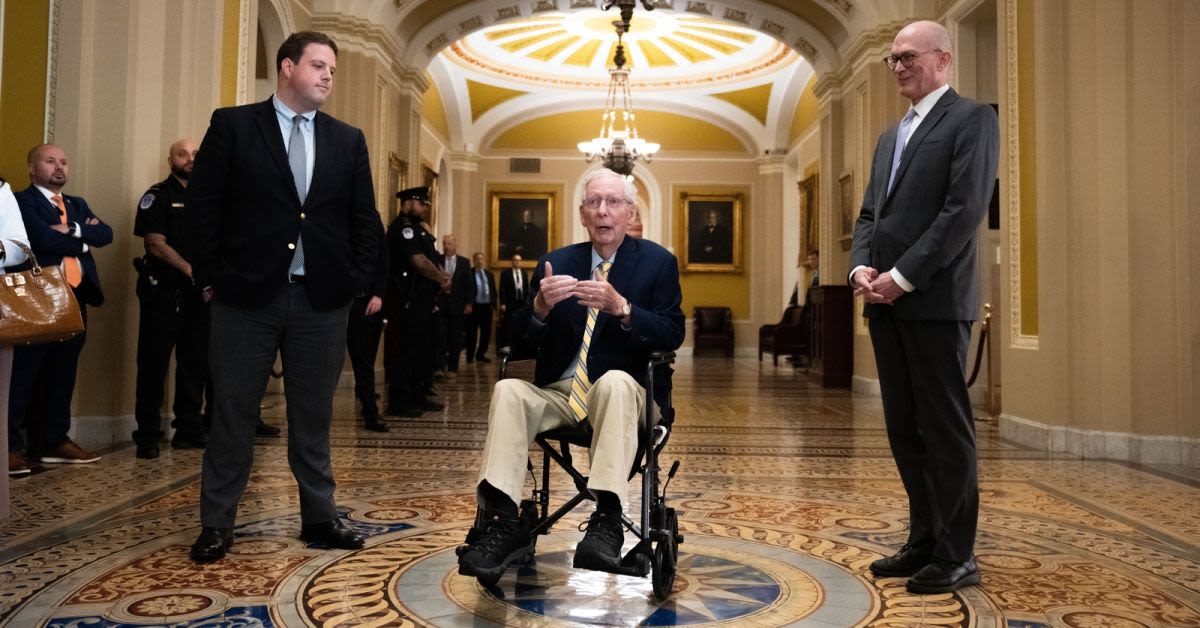
Senate Minority Leader Mitch McConnells latest public stumble has intensified long-standing concerns that his decline is beginning to resemble the late Sen. Dianne Feinsteins final, troubling years in office.
According to Western Journal, the 84-year-old Kentucky Republican, once the most formidable tactician in the upper chamber, has now become the subject of the very kind of speculation and unease that conservatives long directed at aging Democratic incumbents who refused to step aside. McConnell, who spent roughly three months away from the Senate after what was described as a fall at home and subsequent complications, attempted to reassure the public and his colleagues with a carefully crafted message on X, the platform formerly known as Twitter.
Today, Ill cast my first Senate vote since I took a bad fall back in June. Im really looking forward to being back on the Senate floor and seeing my colleagues, McConnell said in an X post Monday. My recovery has been a long and often frustrating process, and the lingering effects of childhood polio havent made it any easier. Im still not quite back to 100%, but Ive assured Leader [John] Thune that, as I continue with physical therapy on the advice of my doctors, I will do my best to be present for tough votes when our Conference needs me.
That polished statement, however, collided almost immediately with a far less reassuring reality on Capitol Hill. During a Senate Agriculture Committee markup of a major farm bill, McConnell appeared confused about how to vote, requiring direct prompting from a colleague seated beside him.
The New York Post described the scene in stark terms, underscoring just how fragile the veteran lawmaker now appears in public settings. The incident unfolded as the clerk called the roll, with McConnell slowly raising his finger as if prepared to vote aye on advancing the legislation, only to be quietly corrected by Sen. John Hoeven of North Dakota, who leaned over and told him to vote no. Undeterred, McConnell quietly voted, Aye but the clerk didnt hear him. Hoeven, again, looked over at the former Senate GOP leader and said, No.
For those who watched Feinsteins sad, drawn-out decline, the moment felt uncomfortably familiar. The California Democrat spent her final years visibly struggling with basic tasks, missing votes, and relying heavily on staff and colleagues to navigate routine Senate business, even as her party insisted on keeping her in place to preserve a fragile majority.
To be fair, McConnells defenders argue that his immediate task is limited and finite. He needs only to remain in office through January, casting votes as directed by Republican leadership, while Kentucky voters head to the polls in November to choose his successor for the next term, a race widely viewed as a safe Republican hold despite the states current Democratic governor.
From a purely tactical standpoint, conservatives also recognize the danger of handing Gov. Andy Beshear an opening to sideline McConnell on grounds of mental incapacity, particularly in the absence of a clear constitutional mechanism for such a move. Allowing a Democratic governor to engineer a high-profile removal of the Senate GOPs longtime leader would be an unnecessary political gift to the left, especially when, in theory, McConnells remaining duties can be reduced to pressing the correct button and following the conferences lead for a few more months.
Yet critics on the right have their own case, and it is not easily dismissed. McConnell was 78 when he chose to run for another six-year term in 2020, still firmly in control of the Republican caucus and fully aware that he could not predict his physical or cognitive condition deep into his eighties, and that decision now looks less like public service and more like hubris.
This was the moment, many argue, when he should have taken a victory lap, acknowledged the limits of age, and handed the reins to a chosen successor rather than risk becoming a burden to his party and an emblem of Washingtons gerontocracy. Instead, he rolled the dice, and the consequences are now playing out in real time: delayed votes, prolonged absences, and even a governor effectively asking for proof of life as rumors swirled about his condition.
The stakes are not merely symbolic, either. As the Des Moines Register reported, the farm bill in question had already been marked up in August, but Democrats refused to move it forward because Republicans had included provisions in what supporters dubbed the Big Beautiful Bill requiring states to reduce payment error rates in the Supplemental Nutrition Assistance Program, better known as food stamps.
That conservative reform, aimed at curbing waste and tightening oversight of welfare spending, triggered predictable resistance from the left, which has long treated federal benefit programs as sacrosanct and bristled at any effort to impose stricter accountability. Without McConnells vote, Republicans struggled to move the bill out of committee in the face of Democratic intransigence, and even with his presence, the markup process nearly stalled because he appeared uncertain about how to proceed.
Despite this, McConnells social media accounts framed the episode as a success, touting the committees action as if nothing were amiss. For observers already skeptical of his capacity, the disconnect between the carefully curated online narrative and the awkward reality in the hearing room only deepened suspicions that staffers, not the senator himself, are now effectively running the show.
Huh. Its almost like hes not writing these posts. Im beginning to think his team may be covering for the guy, the commentary noted, capturing a sentiment that has become increasingly common among conservatives who once respected McConnells strategic acumen but now question whether he remains truly in command. The spectacle evokes the same discomfort many felt watching Feinsteins staff and party apparatus prop her up long after it was clear she could no longer fully perform her duties, all to preserve a seat and a vote.
The tragedy is that this slow-motion decline was avoidable. The preventable unfolding disaster could have been averted had McConnell chosen to step aside at the height of his influence, rather than cling to office until age and infirmity forced the issue in the most public and humiliating way possible.
At this stage, lecturing McConnell personally would accomplish little. As the commentary acidly observed, confronting him now would be a waste of breath six years after a preventable unfolding disaster could have been stopped, and might only elicit a polite, confused response, as if he were a diner asking for an extra menu and another few minutes before making up his mind.
The broader message, however, is aimed not just at one man but at an entire political class that refuses to relinquish power. Washingtons aging leadership on both sides of the aisle has grown accustomed to treating public office as a lifetime entitlement, even as their faculties fade and their dependence on handlers and staff grows more obvious with each passing year.
For conservatives, the lesson is particularly stark. If Republicans are to credibly challenge the lefts entrenched ruling class and present themselves as champions of accountability, limited government, and responsible stewardship, they cannot allow their own leaders to linger in office until they become cautionary tales. However, let this be a warning to every member of the gerontocracy in the District of Columbia: If this is how you go out, this is how youll be remembered, and you have no one to blame but yourself.
Login