
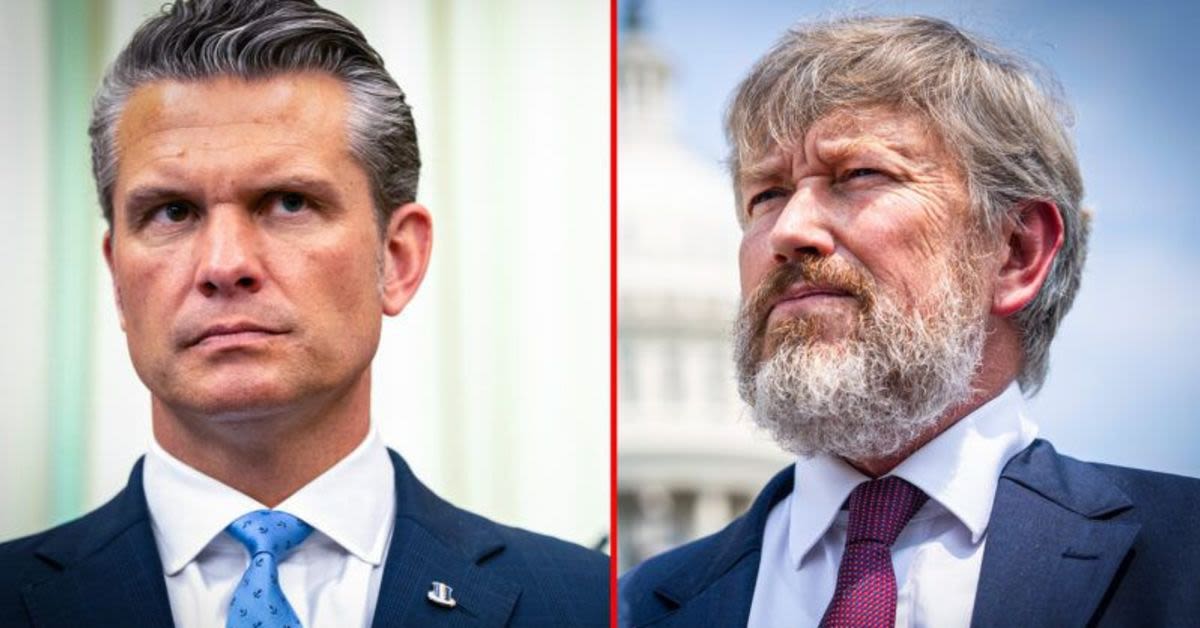
Republican Kentucky Rep. Thomas Massie moved to force a House vote on impeaching Secretary of War Pete Hegseth, escalating a sharp internal GOP clash over war powers and the limits of executive authority.
According to the Daily Caller, Massies impeachment resolution accuses Hegseth of operating in contravention of three specific provisions of the War Powers Resolution of 1973.
The articles of impeachment outline eight charges, including waging war in violation of federal law and disregarding statutory safeguards intended to minimize civilian casualties.
By engaging in hostilities in Iran for more than 90 days without congressional authorization, Secretary Hegseth is breaking the law and must be held accountable, Massie declared, framing his move as a constitutional necessity rather than a partisan maneuver.
Secretary Hegseths constitutional violations extend beyond the illegal war in Iran. He is abusing the power of his office to ignore congressional war powers resolutions, to kidnap foreign leaders, and to intimidate critics of the Trump administration by retaliating against them for exercising free speech. If we are to remain true to our oath to support and defend the Constitution of the United States, Congress must not turn a blind eye to Secretary Hegseths unconstitutional and illegal actions.
The Department of War responded by vigorously defending Hegseths tenure, casting him as a reformer who has strengthened the military and restored traditional standards.
Secretary Hegseth has been a transformative leader for the Department of War. Standards and merit are back, our arsenal is stronger than ever before, and morale and recruitment across every service are at all-time highs, Pentagon press secretary Kingsley Wilson told the DCNF.
Wilson credited Hegseth with cutting red tape and prioritizing the needs of service members over bureaucracy.
Secretary Hegseth has slashed bureaucracy, unleashed innovation, and delivered for our warfighters every step of the way. By every measurable metric, the Department of War is better under President Trump and Secretary Hegseths leadership than before. The entire Department is unified behind the Secretarys vision and will continue working to put our warfighters and America first.
Massies resolution goes far beyond a narrow war-powers dispute, accusing Hegseth of extrajudicial killings and suppression of political dissent.
He alleges that Hegseth oversaw the killings of at least 221 individuals in international waters and sought to intimidate Democratic Arizona Sen. Mark Kelly after Kelly urged service members to refuse illegal orders, while also charging that Hegseth waged an unlawful war in Yemen.
The resolution asserts that Hegseth executed unlawful orders through U.S. involvement in the Iran war and exceeded any plausible constitutional authority.
Massie contends that Hegseth directed and caused U.S. Armed Forces to engage in hostilities against the Islamic Republic of Iran without a congressional declaration of war or specific authorization for the use of military force.
The introduction of United States Armed Forces into hostilities against the Islamic Republic of Iran therefore satisfied none of the circumstances expressly identified in section 2(c) of the War Powers Resolution and was undertaken, from its inception, without congressional authorization or independent Article II authority, thereby rendering both the initial introduction of United States Armed Forces into hostilities, and all subsequent actions taken thereafter, unlawful, the resolution stated.
Secretary Hegseth nevertheless knowingly executed and implemented the order to commence such hostilities, employing the powers, personnel, weapons, and resources of the Department of Defense to initiate military action against another sovereign nation, in violation of section 1541(c) of title 50, United States Code.
Massie further charges that Hegseth continued directing U.S. forces in combat operations against Iran even after both the House and Senate approved a concurrent war powers resolution instructing the president to withdraw from unauthorized hostilities.
Because the measure was concurrent rather than a joint resolution, the Trump administration had no binding legal obligation to comply, underscoring a long-running constitutional gray area that has often favored executive power over congressional intent.
The impeachment resolution warns that Hegseth would remain a threat to the Constitution if allowed to stay in office, casting his alleged overreach as an ongoing danger rather than a past misjudgment.
For conservatives wary of unchecked executive authority, Massies move highlights a deeper rift inside the Republican Party between those prioritizing constitutional limits and those rallying behind Trump-era national security policy.
Massie himself will not be around in the next Congress to press the case, having lost his May primary to Republican Kentucky nominee Ed Gallrein after Trump campaigned aggressively against the incumbent.
Whether his impeachment push gains traction or is swiftly buried, it crystallizes a fundamental question for Republicans: how to reconcile support for a robust national defense and the Trump administrations hawkish posture with the constitutional requirement that Congress, not the executive branch, holds the power to declare war.
Login