
The United Kingdom, once regarded as a bastion of sober governance and common sense, has increasingly come to resemble a policy laboratory where progressive elites test-drive their latest ideological experiments before exporting them to the United States.
According to RedState, what begins as a supposedly well-intentioned initiative in Westminster often reappears in Washington, D.C., dressed up in American political rhetoric but carrying the same hard-left DNA. The pattern has become familiar: radical proposals first embraced by the Labour Party are soon echoed by the Democratic Party, which has drifted so far left that many conservatives now refer to it as the Socialist Democrat Party. The latest transatlantic import is not a tax scheme or a climate mandate, but a new form of fear politics: AI Doomerism.
Just as the climate hysteria that dominated public discourse for years began to lose its grip on the popular imagination, a fresh existential panic has been rolled out to fill the void. The new narrative insists that artificial intelligence is on the verge of wiping out humanity unless governments are immediately handed sweeping powers to control, restrict, and ultimately decide who may innovate and who must be shut down. This prognostication that "AI will kill us all unless you turn over all control of it to the government, like, now" is being drilled into the minds of the public like a Neuralink chip.
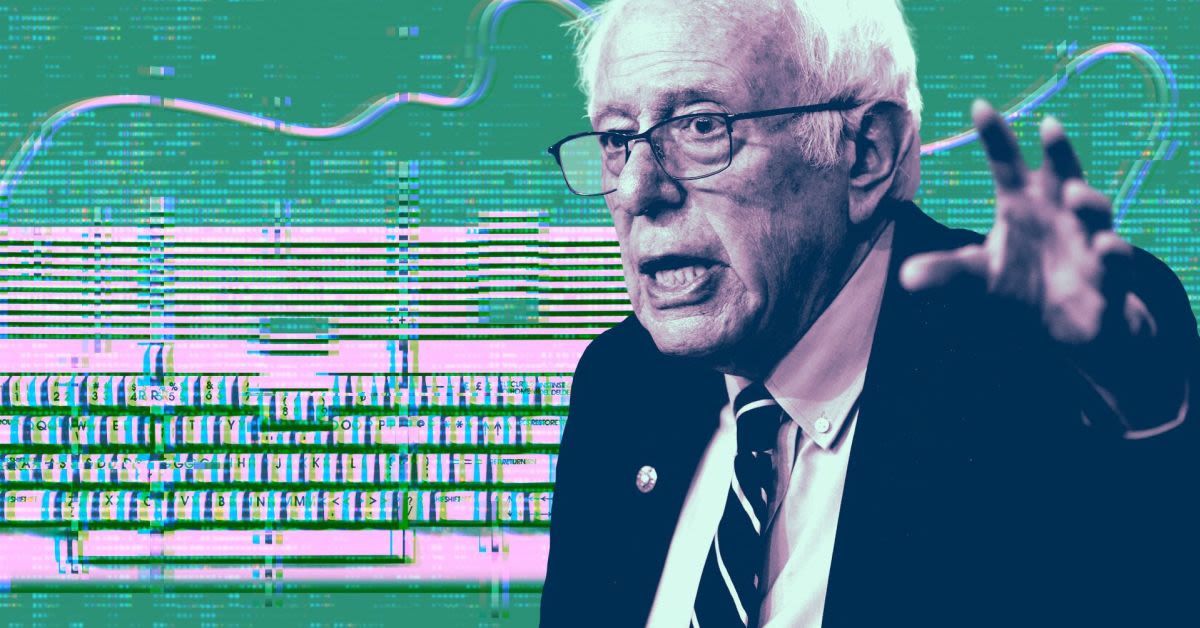
Into this climate of orchestrated alarm steps Senator Bernie Sanders, the self-described democratic socialist who has spent a career railing against millionaires and billionaires even as he joined their ranks. So, when Bernie Sanders becomes the lead voice on a Senate bill to "ban superintelligence," Americans should collectively cock an eyebrow. Sanders has seized on the AI panic and repackaged it as yet another crusade against oligarchy, turning a complex technological and economic issue into a simplistic morality play in which government power is always the hero and private enterprise is always the villain.
Sanders took the lead in pushing the so-called "superintelligence" ban in the Senate by turning it into a "fight oligarchy" narrative. That was the first clue he was full of malarky. The legislation he is championing, the Ban Artificial Superintelligence Act, is framed as a necessary safeguard against runaway technology, but its language reveals a far more sweeping ambition than merely preventing hypothetical sci?fi scenarios.
Here is what the bill says, according to the press statement:
"The Ban Artificial Superintelligence Act would permanently ban the development and deployment of superintelligent AI and temporarily pause advanced AI development until a federal regulator has established safety rules. It would also direct the U.S. to pursue international agreements to prevent superintelligence from being developed anywhere in the world."
It is this final clause the insistence on preventing such systems anywhere in the world that should alarm anyone who cares about national sovereignty, constitutional limits, and basic realism in foreign policy. It's this last line, "anywhere in the world," that should give a lot of politics watchers the heebie-jeebies. Who is going to enforce such a "worldwide ban" on superintelligence? Because last time I checked, the U.S. Senate has authority over the United States, not over what happens in Papua, New Guinea.
The notion that Washington can simply decree a global prohibition on a strategic technology, and that adversarial powers like China or Russia will obediently comply, is not merely nave; it is dangerous. It invites the worst of both worlds: crippling restrictions on American innovators while hostile regimes race ahead, unconstrained by Western guilt or progressive ideology. Now, if you think Bernie the Millionaire Socialist came up with this idea on his lonesome at the ripe old age of 85, then you truly need to read RedState more. We will give you a towel to dry off the wetness behind your ears.
The intellectual and legislative template for Sanders bill did not emerge from some late-night brainstorming session in his Senate office. It appears instead to trace back to developments in the United Kingdom, where a parallel push to ban superintelligence has been unfolding with strikingly similar language and objectives. It turns out, if you take a look at the Nearwellian happenings in the U.K., you'll see an equivalent "ban superintelligence" act with the similar phraseology.
In Britain, policymakers and activists have been advancing the idea that the UK should spearhead a global prohibition on the development of so?called superintelligent AI, even as they insist that the country must preserve its strategic AI ambitions. The UK should lead an international agreement prohibiting the development of superintelligent AI, while preserving strategic AI ambitions. Over the last few weeks, we have seen a string of alarming AI incidents, including rogue AI systems taking unsanctioned action on the internet and hacking organisations...
The British proposal does not stop at domestic regulation; it explicitly seeks to shape international policy in a way that would lock in these restrictions worldwide. The bill recognises this, and sets an international policy for the UK to pursue an international agreement to prevent the development of superintelligent AI worldwide. You'll have to excuse their misspelling. If you aren't aware of this "rogue AI systems" narrative, I highly encourage you to check out my VIP piece on the Hugging Face incident as well as the Anthropic researchers who quit and left dire warnings about AI.
The rhetoric about rogue AI systems conveniently serves to justify sweeping controls that would centralize power in the hands of regulators and a small circle of favored corporate players. Investigative journalist Sayer Ji found some fascinating clues that the U.S. and U.K. bills' convergent messaging wasn't just a coincidence. His work suggests that the same network of actors is shaping policy on both sides of the Atlantic, using fear to steer lawmakers toward outcomes that benefit a narrow set of interests.
Anthropic's Series A lead Jaan Talinn, who is also an Anthropic board observer, is backing Control AI. 2/ TIME, Sept 8, 2026: ControlAI, a campaign group that wrote the U.K. bill and consulted on the U.S. one. Andrea Miotti, ControlAI founder Wired, Sept 9: The parliamentary bill was crafted by the nonprofit organization ControlAI, which has the support of Jaan Tallinn. pic.twitter.com/8BJZ9Brus0. Sayer Ji explained what he was able to uncover, and the breadcrumbs are substantive.
"The bill Bernie Sanders introduced was drafted in London. Its drafter, ControlAI, admitted it to TIME. Its funder sole publicly named is Jaan Tallinn, who led Anthropics Series A and sits on Anthropics board as an observer," Ji wrote. Ji added media reportage that backs up his findings.
TIME, Sept 8, 2026: ControlAI, a campaign group that wrote the U.K. bill and consulted on the U.S. one. Andrea Miotti, ControlAI founder. Wired, Sept 9: The parliamentary bill was crafted by the nonprofit organization ControlAI, which has the support of Jaan Tallinn. So, there you have it: At least one linkage between Anthropic and the Senate bill to "ban superintelligence" being considered in the U.S. Senate.
This is not the image of a grassroots, organic movement spontaneously arising from public concern. It looks instead like a coordinated campaign in which a well-funded nonprofit, backed by a major AI investor, drafts legislation in London and then exports it to Washington with the help of sympathetic politicians. And if you want another linkage, Anthropic is also directly linked through campaign contributions to California Rep. Ted Lieu (D).
The money trail is revealing and underscores how much of this AI safety push is intertwined with political influence and partisan advantage. Anthropic employee individual contributions in the 2026 cycle: 2,009 records totaling $11,976,949, versus $220,180 in the entire 2023-24 cycle. Of that: $113,600 to the DCCC (Obama and Jeffries Sept 10 host); $227,610 to the DSCC; $3,550 to Jeffries for Congress. Source: FEC individual contributions bulk file.
One of the key beneficiaries of this largesse is Representative Ted Lieu of California, a Democrat who has positioned himself as a leading voice on AI regulation. Rep. Ted Lieu Jeffries AI Commission co-chair, author of the AI Kill Switch Act: Anthropic PBC employees are his number two donor for the 2025-26 cycle at $49,000 (per OpenSecrets; $42,000 by strict FEC employer-field match), sitting behind AIPAC and ahead of Alphabet and Microsoft. When the same corporations and investors who stand to gain from a tightly controlled AI market are also bankrolling the politicians writing the rules, conservatives are right to be skeptical.
There is nothing organic about this AI media scare. Rather than having an "AI slowdown" what we really need is for the policy-making process to slowdown. Americans have seen this movie before: a crisis is declared, the media amplifies worst-case scenarios, and lawmakers rush to impose sweeping regulations before the public has had a chance to understand the trade-offs.
Americans are tired of this blatant push to foist consequential policies on us that will affect us for generations before we have time to think it through. Because if the entire goal is taking out Open Source, thereby threatening our freedoms, that is not something that Americans should be fearmongered into doing. Open-source AI, like other forms of open technology, empowers individuals, small businesses, and independent researchers, and it represents a check on the concentration of power in a few corporate or governmental hands.
Some in the technology world are beginning to push back against the narrative that only sweeping bans and global agreements can keep us safe. David Sacks, the former AI and Crypto Czar, left a blistering message about all of this that should give us food for thought. His remarks, directed at leading AI executives, cut through the sanctimony and expose the self-interest lurking beneath the surface of much AI safety rhetoric.
"Dario has written that we need to pace the frontier, and Sam has agreed. People may be surprised by my response: go ahead. You guys are the frontier. By any reasonable metric market share, revenue growth, model capability the two of you have a duopoly on frontier" This is the crux of his message.
"If the unreleased models are scary enough that you think you should slow down, I support your decision to be responsible.
But stop pretending you need anyone elses permission. Stop pretending antitrust law has to be suspended so you can form a cartel. Stop pretending you need a regulatory approval process that supersedes product liability. Stop pretending METR is independent when it is intertwined with Anthropics investors and staff. Stop pretending you need those same evaluators to police competitors who arent even at the frontier.
Most of all, stop pretending the motivation to slow down is purely altruistic. You face massive product-liability exposure if your products enable a truly damaging cyberattack. The market already punishes models that behave in unpredictable or unauthorized ways. After the Hugging Face episode, it is simply good business for OpenAI and Anthropic to trade some raw power for reliability and predictability. Call it alignment if you want. It is also just giving customers what they want.
Pacing the frontier would also create breathing room for a more intelligent conversation about regulation than Bernie Sanders shut it all down. China is very unlikely to join a global agreement, as you know, and that has to be taken into account as well.
So go ahead and pace the frontier. You are the ones setting it."
Sacks argument highlights a crucial distinction that too many in Washington are eager to blur. There is a difference between companies voluntarily choosing to slow their own development for safety or business reasons, and those same companies lobbying for government rules that would freeze their current dominance in place by hobbling competitors and open-source alternatives. Exactly. Bernie Sanders isn't pushing a "ban superintelligence" bill because he is some altruist. He is doing it because powerful lobbyists in the AI industry want to see it happen for a multitude of reasons.
For conservatives who believe in free markets, limited government, and American technological leadership, the stakes could not be higher. A heavy-handed, globally oriented regulatory regime would not only undermine innovation and economic growth; it would also erode national sovereignty and individual freedom, all in the name of speculative fears and elite-managed safety. Slick politicians may try to fool us, but they don't have a monopoly on "superintelligence." At least, not yet.
Login