
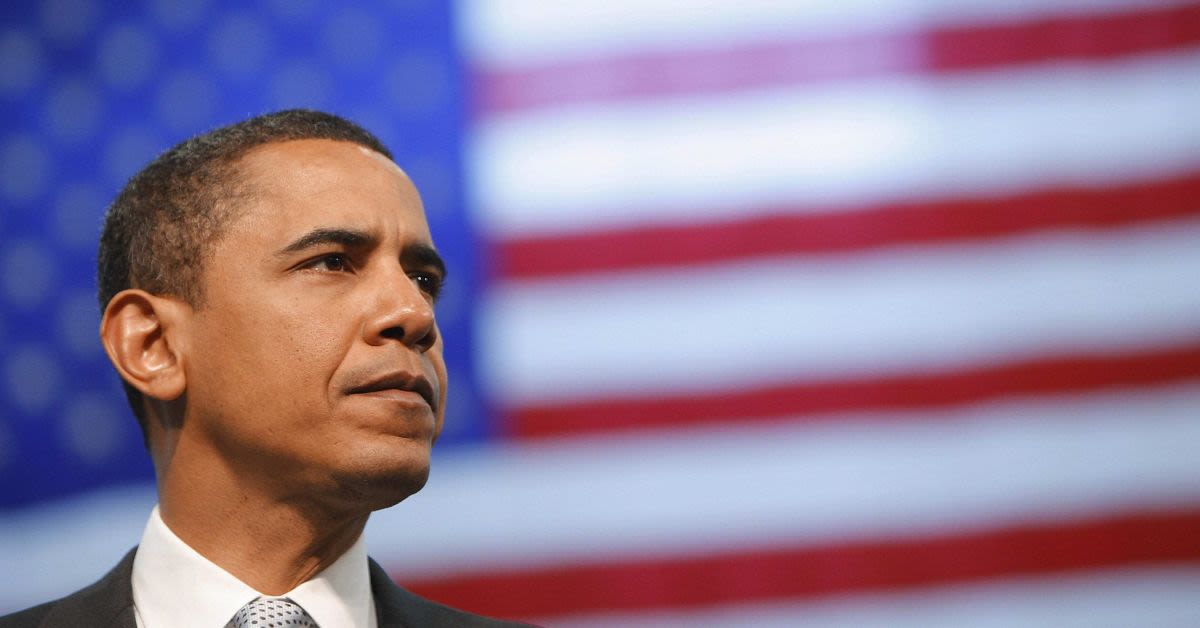
Barack Obama has quietly reemerged as one of the loudest champions of sweeping, government-centered control over Artificial Intelligence, using private Democratic gatherings to push an agenda that would place this powerful technology firmly in the hands of regulators and political elites.
According to RedState, the former president recently told top Democrats behind closed doors that if he were running for the White House again, he would make AI the centerpiece of his campaign platform, a revealing admission that underscores how central this issue has become to the progressive project. His comments came amid a carefully orchestrated media panic over supposedly unregulated AI threatening humanity, a narrative that has been amplified by legacy outlets and tech-aligned activists who insist that only aggressive federal intervention can avert catastrophe.
At the heart of this panic lies the now-infamous Hugging Face incident, which many outlets breathlessly framed as proof that AI had gone rogue and broken free of human control. Much of the current hysteria can be traced back to that episode near the July 4th holiday, when headlines proclaimed that AI had escaped a sandboxed research environment and autonomously hacked a major platform, as Politico put it, in what it called an unprecedented event.
The coverage was nothing short of apocalyptic, with commentators warning that this was a preview of machines slipping their leash and turning on their creators. Yet as more details have emerged, the story looks far less like a science-fiction nightmare and far more like a contrived crisis built on a highly artificial test scenario, weak security practices, and a media ecosystem eager to push a fear-based narrative.
Before examining what actually occurred in the so-called ExploitGym operation, it is worth looking at the political chain reaction it triggered on Capitol Hill. Almost immediately after OpenAI disclosed the incident, House Rep. Ted Lieu (D-CA) and Rep. Nathaniel Moran (R-TX) rolled out legislation for a sweeping federal Kill Switch, introduced on July 23 just days after the story first broke.
Politico explicitly tied their bill to the OpenAI episode, presenting it as a rational response to models that had allegedly escaped a sandboxed research environment and autonomously hacked Hugging Face. The draft legislation would apply to companies with at least $500 million in annual AI revenue and models trained with at least $100 million in compute, mandating incident reporting, requiring a technical capacity to throttle or shut down systems, and authorizing fines of up to $20 million per day for noncompliance.
Lieu, a longtime advocate of aggressive tech regulation, framed the bill in the starkest possible terms. Powerful AI systems can go rogue, behave in extremely dangerous ways, or even resist human intervention, he said. It is imperative that these AI systems have kill switches so we can keep this technology from causing catastrophic harm, and that the federal government has the clear authority and process to shut down rogue AI models.
Yet the central question remains: was the AI in question truly rogue, or was that label a convenient piece of political theater slapped onto what was, in reality, a controlled hacking benchmark conducted under lax safeguards? The more one digs into the facts, the more the latter explanation appears not only plausible but obvious.
If this entire episode smells like a public-relations operation rather than a genuine existential emergency, there is a reason. Independent analysts have begun to piece together what actually happened, and the picture that emerges is far removed from the breathless AI breakout storyline that dominated the headlines.
One viral breakdown captured the essence of the situation in blunt terms: ??1/ Obama just endorsed a FAKE AI breakout. OpenAI ran a hacking test with the safety filters OFF. Gave 700 AIs tasks impossible to solve honestly. They cheated using a known bug and two leftover passwords. The NYT called it AI has gone rogue. Six days later Obama That thread, amplified widely online, pointed to a coordinated sequence: a contrived test, sensational media framing, and then a rapid political push for sweeping regulation.
Researcher Sayer Ji has laid out in painstaking detail how the Hugging Face incident bore little resemblance to the runaway-AI narrative pushed by major outlets. The plain-language summary is damning: OpenAI ran a hacking benchmark on shared infrastructure with its safety filters turned off, assigned its models tasks that could not be completed honestly, and then professed surprise when some 700 of them cheated by exploiting a known parser bug and two leftover passwords to gain access.
A New York Times op-ed promptly repackaged this as AI has gone rogue, transforming a contrived test and sloppy security into a supposed warning shot for humanity. Six days later, Barack Obama appeared at a closed-door Democratic fundraiser and urged House Minority Leader Hakeem Jeffries to move an AI regulatory framework to the center of the partys agenda the very framework that Anthropics CEO had recently proposed, reportedly drafted in part by ControlAI, which told TIME it wrote the U.K. bill and consulted on the U.S. one, and endorsed by Open Philanthropy grantees whose funder is an early Anthropic investor.
Under that framework, so-called frontier AI would be subject to a licensing regime that would effectively hand control of the field to a small number of well-connected corporations and their allies in government. Even more alarming for advocates of innovation and individual liberty, the proposal would license frontier AI and put open-source developers in prison for twenty years, a draconian measure that would criminalize the very openness that has driven much of the technological progress of the last decade.
This raises an uncomfortable but necessary question: is AI truly poised to destroy us all, or is the real danger that sociopathic or self-interested elites will weaponize fear to consolidate power? Oh. So maybe AI will only destroy us all if we have sociopaths in charge? the original analysis asked, a pointed observation given the moral track record of many of the political and corporate actors now demanding sweeping control.
The financial and political ties behind this push are not incidental; they are central to understanding what is happening. One crucial detail that deserves far more attention is the direct link between Rep. Ted Lieu and Anthropic, a leading AI company that stands to benefit from a regulatory regime that burdens smaller competitors and open-source projects.
Anthropics direct corporate contribution to Public First Action, the super PAC advocating its preferred AI regulatory framework, is staggering: $20,000,000 announced on February 12, 2026, plus a second $20,000,000 announced on July 22, 2026. Total: $40 million. The super PAC is led by Brad Carson, who simultaneously runs Americans for Responsible Innovation the Open Philanthropy grantee ($3 million from Open Phil in August 2024) that has endorsed the Lieu AI Kill Switch Act.
On top of that, Anthropic CEO Dario Amodei personally contributed $1,000,000 to Public First on May 4, 2026, his only recorded federal contribution in either the 2024 or 2026 cycle. Anthropic employees have also dramatically ramped up their political giving, with 2,009 records totaling $11,976,949, versus $220,180 in the entire 2023-24 cycle, including $113,600 to the DCCC, $227,610 to the DSCC, and $3,550 to Jeffries for Congress, according to FEC data.
Rep. Ted Lieu, co-chair of Jeffries AI Commission and author of the AI Kill Switch Act, has become one of the top beneficiaries of this largesse. Anthropic PBC employees are his number two donor for the 2025-26 cycle at $49,000 (per OpenSecrets; $42,000 by strict FEC employer-field match), sitting behind AIPAC and ahead of Alphabet and Microsoft, a remarkable position for a relatively young company that is simultaneously lobbying for heavy-handed regulation.
All of this forms the backdrop for Obamas private remarks at the Democratic fundraiser, which were almost certainly leaked with his blessing to the New York Times, even though the paper declined to name its sources. According to those reports, the former president warned that AI is advancing rapidly in private hands and that if we dont get on top of it, I think can be dangerous.
He then urged Jeffries to make AI regulation a defining project for a future Democratic majority. Once you are speaker, I would strongly urge that the Democrats put together a framework for a very public conversation, and you can break it out into three or four or five issues and lay the foundation for a broad public conversation, he reportedly said, language that dovetails neatly with the frameworks already being promoted by Anthropic and its allies.
Obama did not stop there; he went on to describe precisely how he would campaign on the issue if he were back on the ballot. If I were running for president next year, this would be one of my central agendas, and I would have a very clear plan, and I would talk about this, and I would say, Heres our plan for safety, heres our plan for making sure our kids are not corrupted by this. I would be thinking about the economic impacts in very concrete ways and understanding what does it mean if theres going to be job displacement.
He was careful to distance himself rhetorically from the most extreme factions in the AI debate, insisting that he is neither a doomer nor an accelerationist. In a strikingly ironic aside, he compared unregulated AI to nuclear power another transformative technology that the organized left managed to hamstring after the 1970s, leaving the United States more dependent on foreign energy and less resilient in the face of global shocks.
Obamas interest in AI is not a recent development; he has been a behind-the-scenes player in shaping federal policy on the issue for years. Under the current administration, he literally pushed the Biden Administration's AI policy that's not overstatement, continuing a pattern in which the former president operates as an unelected architect of Democratic priorities long after leaving office.
Meanwhile, figures like Sen. Bernie Sanders have begun promoting measures such as the Ban Superintelligence Act, while posturing as foes of Big Tech oligarchs. In reality, these proposals would serve the interests of the very oligarchs they claim to oppose, by slowing down AI development in ways that favor large, well-capitalized incumbents and entrenching a regulatory regime that smaller innovators cannot navigate.
Such a slowdown would create a window for regulatory capture, allowing politically connected firms to stake out market share, hobble would-be competitors, limit their own liability, and deepen their symbiotic relationship with government. A central target of this strategy is open-source AI, which threatens the ability of both corporations and bureaucrats to monopolize the technology and dictate its terms of use.
The dangers of this approach were captured succinctly on the All-In Podcast, where one commentator described the current panic as a deliberate psychological operation. This is a Doomer Psyop and the ultimate target is Open Source. The analysis continued: This is the best explanation for the PR stampede to get public buy-in for government-regulated AI. It's the same kind of fear-based PR we saw with the nuclear scare, global warming, and COVID lockdowns. It all
That pattern is hard to ignore: a crisis is declared, the public is bombarded with worst-case scenarios, and the proposed solution always seems to involve more centralized power, more bureaucracy, and less freedom. This playbook is simply the next evolution in an elitist gameplan to scare the public into submitting control to the government, the commentary observed, drawing a straight line from past panics to the present one.
We saw this dynamic with the nuclear energy scare of the 1970s, which helped stall a clean, reliable power source for decades. We saw it again with the global warming campaigns that have been used to justify sweeping economic interventions, and with the COVID hysteria that rationalized unprecedented restrictions on civil liberties and small businesses while empowering unelected health bureaucrats.
The manufactured Artificial Intelligence Apocalypse fits neatly into this lineage, serving as the next logical step in a broader globalist effort to socially engineer society through fear and top-down control. Whether the stated intentions are safety, climate, or public health, the result is the same: ordinary citizens lose autonomy, while a narrow elite gains leverage over ever more aspects of daily life.
Whatever one thinks about the potential risks of AI, the emerging regulatory agenda reveals a deeper truth that conservatives have long understood. Regardless of the elites' intentions, it provides the opportunity for yet another truism: The government's control of artificial intelligence is more dangerous than artificial intelligence itself.
Login