
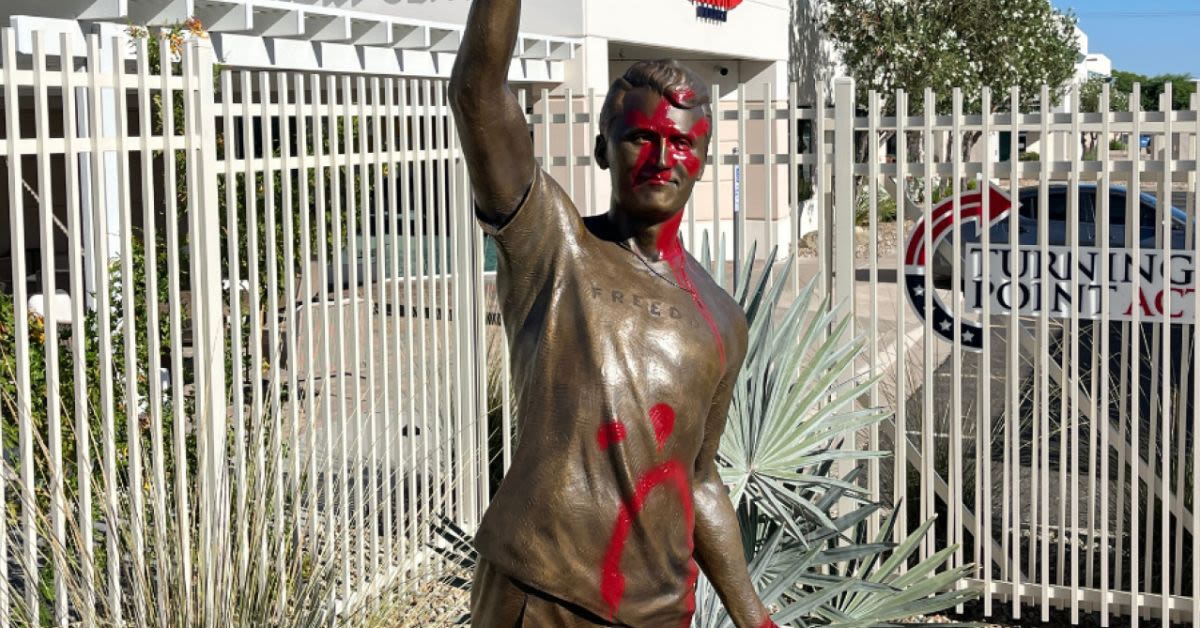
A statue honoring Turning Point USA founder Charlie Kirk at the organizations Phoenix, Arizona, headquarters was desecrated overnight in what conservatives are calling a brazen attack on faith, free speech, and the memory of a slain activist.
The bronze monument, installed Thursday to mark the one-year anniversary of the conservative leaders Sept. 10, 2025, assassination, was found drenched in red spray paint, with a nearby TPUSA billboard also defaced, according to The Post Millennial. Vandals crossed out the word "Jesus" on the sign and scrawled "Satan" over it, a gesture that many on the right see as emblematic of an increasingly hostile left-wing culture that mocks Christianity while demanding tolerance for everything else.
TPUSA spokesman Andrew Kolvet told The Gateway Pundit that the timing and manner of the attack spoke volumes about the perpetrators motives and character. "The vandals doing this in the middle of the night only underscores something weve sadly come to understand in a whole new way," Kolvet said, adding, "Evil never sleeps. But God is in control, and well pray that whoever did this is held accountable and comes to know Him."
Tyler Bowyer, chief operating officer for Turning Point Action, warned that the incident should shatter any lingering complacency among Republicans who still assume Arizona is safely conservative. Calling the vandalism a "wake up call" for those who underestimate the states leftward drift, Bowyer cautioned, "If Arizona becomes California like this, we lose America."
Arizona Rep. Abraham Hamadeh, a Republican and longtime ally of President Trumps America First agenda, denounced the attack in stark terms on X. He labeled the defacement "abhorrent" and blasted the leftist perpetrators as "intolerant and militant," underscoring how political hatred has escalated from online vitriol to physical desecration of memorials.
The statue, crafted by artist Quintin McCann, was rich with symbols of Kirks Christian faith and patriotic activism, including a cross, a wedding band, a TPUSA hat, and his now-iconic T-shirt emblazoned with the word "FREEDOM." Those religious and pro-liberty images were specifically targeted, with vandals drawing an X over Kirks face and painting his neck to mark the spot where a bullet struck him last year as he spoke at a Utah college campus.
Authorities had not identified any suspects as of Sunday afternoon, even as the attack followed a wave of grotesque social-media posts celebrating Kirks death on its anniversary. The online glee from anonymous left-wing users over the killing of a conservative activist has only deepened concerns on the right about a culture that excuses violence when the victim is politically inconvenient.
Bowyer noted in a post Thursday that the statues current placement at TPUSA headquarters was never intended to be permanent. "We placed the bronze statue so that others can enjoy it when visiting before it finds its final spot," he wrote, suggesting that the monument will ultimately be moved to a more secure and prominent location.
The vandalism comes against a backdrop of lawfare and partisan warfare in Arizona, where Bowyer himself was targeted in a politically charged case led by Democrat Attorney General Kris Mayes over efforts to appoint alternate electors in the 2020 election. That prosecution, widely viewed by conservatives as an attempt to criminalize support for President Trump, was tossed out in August by a Maricopa County judge, dealing a blow to Mayes as she seeks reelection in November against Republican state Sen. Warren Petersen.
Mayes previously edged out Hamadeh in 2022 by a razor-thin 280-vote margin after drawn-out counting and legal battles, fueling ongoing distrust of the states election machinery among Republicans. Democrat Gov. Katie Hobbs is likewise on the ballot this year, facing a challenge from former U.S. Rep. Andy Biggs, and the defacement of Kirks memorial is likely to harden conservative resolve in a state that increasingly looks like a frontline contest over religious liberty, political violence, and whether Arizona will remain part of President Trumps conservative coalition or slide further toward California-style progressivism.
Login