
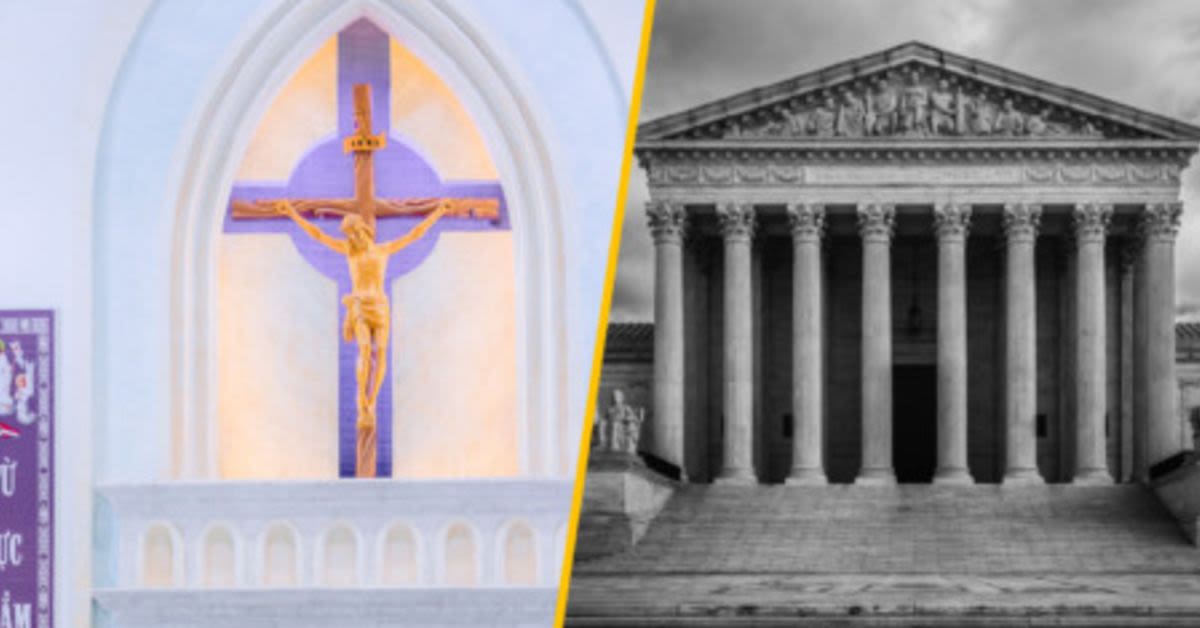
A 13-year-old Maine girl has been barred from attending church with her Christian mother unless her non-churchgoing father grants permission, under a state Supreme Judicial Court ruling that has ignited alarm among religious liberty advocates and defenders of parental rights.
According to Western Journal, the September 1 decision by Maines highest court left intact a 2024 order from Cumberland County Judge Jennifer Nofsinger a judge who identifies as a lesbian granting the girls father final authority over his daughters religious activity and effectively cutting the child off from any church since December 2024. Dr. David Closson, director of the Family Research Councils Center for Biblical Worldview, warned that the ruling is a serious threat to religious liberty, and also a direct blow to the longstanding presumption that fit parents have the right to raise their children in accordance with their faith. Liberty Counsel Founder and Chairman Mat Staver was even more blunt, insisting, This opinion rejects the First Amendment right of a fit parent to raise her child consistent with her Christian faith, and vowing, We will ask the High Court to take this case and overrule the decision.
In a unanimous opinion, the Maine Supreme Judicial Court upheld Nofsingers order, reasoning that allocating authority between two parents does not intru[de] on the parents shared right to direct the upbringing of their child, while concluding that the allocation of religious authority to the father alone was in the childs best interest in this case. The justices further held that a lower court had erred by applying strict scrutiny to the mothers parental rights claim, a striking move given that strict scrutiny is the traditional standard when government action burdens religious exercise.
The dispute traces back to the relationship between the girls parents, Emily Bickford and Matthew Bradeen, who had a child together in January 2013 despite never marrying. By the end of that year, the couple had separated, and a family law magistrate entered an order agreed to by both parents establishing shared parental rights and responsibilities, including a pledge to reach jointly, whenever possible, any major decision concerning their child.
Years later, Bickford experienced a Christian conversion and began attending Calvary Chapel Greater Portland in May 2021, bringing her daughter with her. The Maine Supreme Judicial Court noted with evident concern that Bickford took the girl to multiple services per week, a pattern that would be unremarkable in much of churchgoing America but was treated in the opinion as a red flag.
Bickford did not inform Bradeen about the childs attendance at the church, the court observed in a disapproving tone. After Bradeen learned about the childs participation in a church event, he asked Bickford for more information about the church and its teachings. Bickford told Bradeen that she and the child were attending Calvary Chapel, but she did not provide any other information.
That last line betrays either a profound ignorance of mainstream evangelical churches or a bias against them, as if a mother must submit a theological dossier before taking her child to Sunday worship. Calvary Chapel is mainstream, we believe in the Old and New Testament, protested Travis Carey, pastor of Calvary Chapel Greater Portland, in an interview with The Washington Stand, noting that the denominations Statement of Faith is public, uniform, and easily accessible.
Every Calvary Chapel congregation teaches the same core doctrines, including the authority of Scripture, salvation by grace through faith in Christ, and the reality of heaven and hell, positions that have defined historic Christianity for centuries. These beliefs, far from fringe, would later be treated by the court as if they were exotic or dangerous, setting the stage for a legal clash that pits a mothers religious convictions against a judiciary increasingly suspicious of orthodox Christian teaching.
In September 2021, months after learning of his daughters church involvement, Bradeen asked the court to allocate to him sole responsibility for the childs religious upbringing, according to the state supreme court. Over the next three years, the parents participated in a series of mediation sessions, and they eventually resolved all their disagreements except for those pertaining to religion and healthcare, with Bickford also objecting to COVID and flu shots and the HPV vaccine for her daughter.
The courts opinion then mischaracterized a key event in the girls spiritual life, confusing believers baptism with infant baptism. Bickford made other unilateral decisions about the childs participation in church activities, the justices wrote. For example, Bradeen learned that the child was scheduled to be baptized only when he was informed by a third party. Bradeen then called Bickford to ask about the baptism, and she placed him on speakerphone in front of the child.
Calvary Chapel, like many evangelical churches, practices believers baptism, administered only to those who personally profess faith in Christ. While the court omitted the substance of the speakerphone conversation, the likely purpose was for the girl to explain her conversion to her father herself, a common and deeply meaningful moment in Christian families.
The girl made an outward profession of faith, Pastor Carey told TWS, and she wanted to invite her dad to the baptism. That desire a child wanting her father present at a defining moment of faith is entirely ordinary in Christian communities, yet the Maine Supreme Judicial Court managed to recast it as part of a troubling pattern.
Seeking to portray the church as harmful, Bradeen escalated matters by bringing in an expert witness on cults, Janja Lalich, who flew from California to testify at a two-day hearing in August 2024. Lalich described cults as closed social systems and suggested that Calvary Chapel Greater Portland bore some of those hallmarks, a characterization that many believers would view as a smear against a mainstream evangelical congregation.
The Maine Supreme Judicial Court rejected Bickfords claim that the court evinced hostility toward her religion by describing her church in offensive terms, including referring to it as a cult, insisting that cult was merely the label used by the expert witness. Yet the very decision to admit such testimony and to treat it as relevant to a custody dispute signals that the court was willing to entertain the notion that ordinary Christian doctrine is akin to cultic manipulation.
Christ Himself warned His followers to expect such treatment from the world. It is enough for the disciple to be like his teacher, and the servant like his master. If they have called the master of the house Beelzebul, how much more will they malign those of his household (Matthew 10:25).
The court also took aim at Calvary Chapels method of preaching, which is standard fare in conservative Protestant churches. As described by the pastor, Travis Carey, Calvary Chapel teaches the Bible verse by verse, chapter by chapter, the opinion noted, framing the description in scare quotes before adding, This entails sermons that include, in Careys words, quite vivid description[s] of Hell.
Pressed on what that meant, Carey explained that he simply repeats the words of Scripture. Theres wailing and gnashing of teeth. There is burning and torment. The worm dieth not. Shame, eternal perpetual pain, and regret.
The justices were not finished cataloging doctrines that millions of American Christians hold without controversy. Carey also testified that he preaches about the Second Coming of Christ, which will involve seven years of pure hell on earth under the persecution of the Antichrist for those who have not accept[ed] the terms of God.
Any cursory review of Calvary Chapels statement of faith or of basic evangelical eschatology would reveal that this is simply pre-tribulation dispensationalism, a common end-times view in conservative churches. Yet the courts repeated use of scare quotes and its tone of anthropological curiosity made it sound as if some prehistoric predator had wandered into the courtroom from a museum exhibit.
These teachings became central to the case because the court claimed that the child has experienced fear and anxiety associated with these teachings. That assertion, however, is only partially supported by the record the court itself recited.
The child has asked Bradeen a lot of questions about Heaven and Hell and about why Bradeen and his other child would not be in Heaven with her, the opinion stated. The child has left notes around Bradeens house because she fears that the Second Coming is approaching and that Bradeen will be left behind.
It is harmful for a child to hear negative and frightening messages about one parent from the other parent or the other parents authority figures, the court declared, effectively equating biblical warnings about judgment with psychological abuse.
Yet the evidence suggests that the girls concern was not for her own eternal destiny but for her fathers, prompting her to urge him toward repentance and faith. As the apostle Paul wrote, For we must all appear before the judgment seat of Christ. Therefore, knowing the fear of the Lord, we persuade others (2 Corinthians 5:10-11), and the girls evangelistic impulse is more consistent with genuine belief than with pathological fear.
To sideline Bickfords parental rights without openly discriminating against her religion, the Maine Supreme Judicial Court leaned heavily on the best interest of the child standard. The Constitution does not require the displacement of the best-interest standard and imposition of strict scrutiny any time a parental rights order implicates a parents religion, the court asserted, while adding that it does, however, mandate governmental neutrality between religion and religion, and between religion and nonreligion.
The justices then claimed that vesting final religious authority in Bradeen did not amount to religious discrimination. The courts allocation of religious decision-making to Bradeen ultimately rested on no more than its findings that the parties are unable to coparent on matters of religion, such that it was therefore necessary to allocate decision-making to one or the other, and that Bradeen is better suited to determine whether certain religious activities are in the childs best interest, the opinion alleged.
Why is the non-churchgoing parent better suited to decide whether church is good for the child? The opinion never squarely answers, but the implication is unmistakable: the parent who does not take doctrine seriously is presumed safer than the one who believes that eternal realities matter more than temporal comfort. Bickford believes that the childs relationship with God is more important than anything on earth, including the childs relationship with Bradeen, the court sneered, treating a classic Christian conviction as evidence of instability.
In the justices view, this meant that Bickford has essentially abdicated her independent decision-making to the church. Bradeen, meanwhile, has taken a measured approach and acted in a manner designed to protect [the child] from additional anxiety.
That framing twists the facts beyond recognition. Under the courts logic, whenever one parent wants to take a child to church and the other prefers a secular upbringing, judges should default to less religious exposure a conclusion that runs counter to the nations history of robust religious practice and parental autonomy.
Strikingly, the court never addressed the 13-year-olds own wishes regarding church attendance. Pastor Carey reports that she wanted to continue attending Calvary Chapel, where she had embraced the gospel and been baptized, but her voice was effectively silenced in the legal process.
Instead, the court projected its own secular assumptions onto the child, deciding that her anxiety stemmed from hearing about hell and that shielding her from such teaching would alleviate her distress. In doing so, the justices cast themselves in the role of Felix, the Roman governor in Acts 24:25; as Paul reasoned about righteousness and self-control and the coming judgment, Felix was alarmed and said, Go away for the present. When I get an opportunity I will summon you.
Yet messages about judgment cannot simply be erased from a believing childs conscience, nor can authentic Christian faith be extinguished by court order. Had she been asked, the girl would likely have explained that her anxiety centered on her fathers spiritual condition, not on her own, and that preventing her from worshiping with fellow believers only deepens that concern.
Since winning final authority in 2024, Bradeen has barred his daughter from attending any church at all not only Calvary Chapel, but any Christian congregation. The state, by empowering him to do so, has effectively placed a veto on the girls participation in public worship unless her non-believing parent relents.
The court itself acknowledged that the child has enjoyed a strong, loving relationship with each of the parties. Nevertheless, it concluded that Bickfords decisions regarding religion have endangered the childs relationship with Bradeen by exposing her to messaging that her father is going to burn and suffer for eternity, that he is persecuting her, that he seeks to dismantle her faith.
The opinion never reconciles this alleged endangerment with the admitted reality of a strong, loving relationship between father and daughter. A more reasonable inference is that Christian teaching about hell, properly understood, does not inherently destroy family bonds, and that any strain arises from the unbelieving partys hostility to the faith rather than from the faith itself.
Scripture is candid about the tensions that can arise when one family member follows Christ and another does not. Do not think that I have come to bring peace to the earth. I have not come to bring peace, but a sword, Jesus warned. For I have come to set a man against his father, and a daughter against her mother, and a daughter-in-law against her mother-in-law. And a persons enemies will be those of his own household. Whoever loves father or mother more than me is not worthy of me, and whoever loves son or daughter more than me is not worthy of me (Matthew 10:34-37).
Stories of converts from Muslim-majority countries risking family rejection to follow Christ are familiar to many Christians. Far fewer imagine that a teenage girl in Maine might face comparable relational and legal pressures simply for taking her faith seriously.
The painful facts of this case highlight the challenges that arise when Christians are unequally yoked with unbelievers in marriage and childrearing (2 Corinthians 6:14), a reality that is becoming more common as American culture drifts further from its Christian roots. In Bickfords situation, her conversion came after her relationship with Bradeen had ended and after their child was born, but the tensions that followed mirror those faced by many believers in mixed-faith families.
For Christians in such circumstances, the apostle Paul offers sober counsel in 1 Corinthians 7:12-16, with particular attention to the spiritual implications for children. From a Christian perspective, parents have a God-given responsibility to raise their children in the faith, to teach them Scripture, and to bring them into the life of the church, Closson told TWS, citing Pauls exhortation to fathers: do not provoke your children to anger, but bring them up in the discipline and instruction of the Lord (Ephesians 6:4).
Unmarried parents obviously complicate how those responsibilities are exercised, and courts sometimes have to resolve genuine disputes between two parents who possess equal legal rights, Closson acknowledged. But that does not give judges a blank check to treat historic Christian doctrines as evidence of psychological harm or to rely on an experts characterization of an otherwise mainstream evangelical congregation as a cult or closed social system.
The state certainly has a legitimate interest in protecting children from actual abuse or neglect, Closson continued. But exposure to traditional Christian teaching is not evidence of parental unfitness. Religious liberty means very little if it protects only beliefs that judges, experts, or cultural elites consider benign or fashionable. The government should not be in the business of deciding that the ordinary beliefs and practices of a theologically conservative Christian church are somehow so dangerous that a fit parent may be prohibited from taking her child there.
This is why I think the U.S. Supreme Court should take a close look at this case, Closson added. The principle at stake is much larger than one custody dispute: whether the government may effectively penalize a fit parent because her religious convictions are deemed too conservative or too unsettling by the court.
As tragic as this case is, Pastor Carey lamented, it should be eye-opening for not just Christians, but for every U.S. citizen, that this type of constitutional violation is happening. Teachings about heaven and hell, spiritual warfare, biblical sexual ethics, or the authority of Scripture are not fringe beliefs invented by Calvary Chapel, Closson said. They are part of historic Christianity. Once courts begin treating orthodox Christian doctrine itself as a basis for restricting a parents relationship with her child, the First Amendment concerns become unavoidable.
Login