
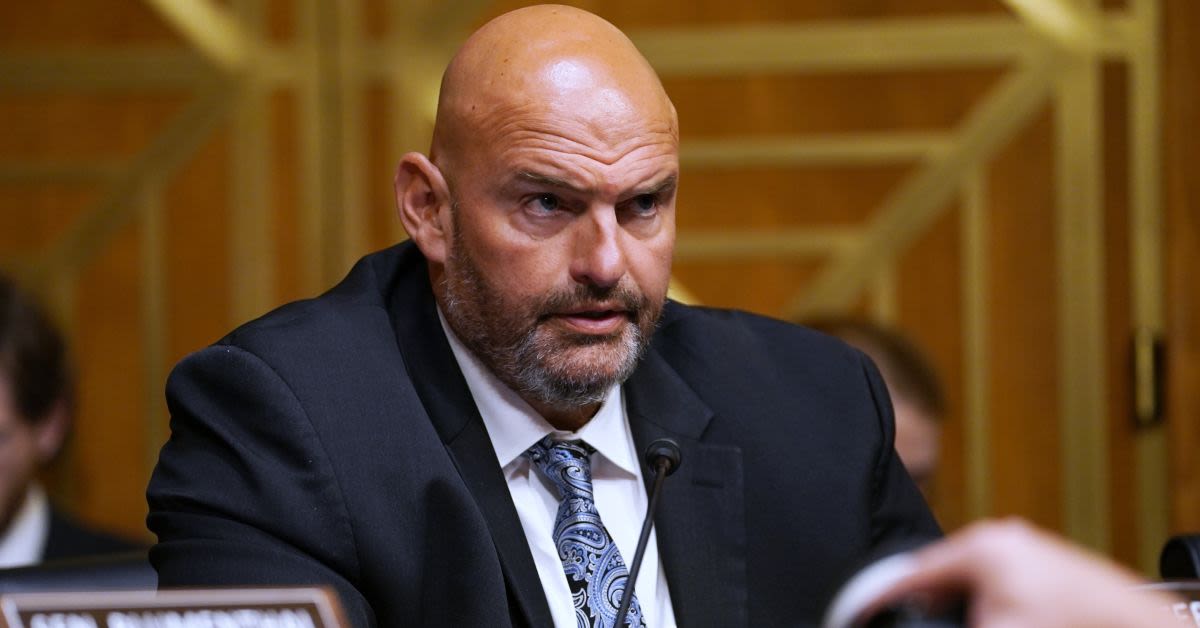
A recent survey of likely voters in Pennsylvania has produced a political anomaly that would have been almost unimaginable a decade ago: a sitting Democratic U.S. senator, John Fetterman, now enjoys a higher approval rating among Republicans than the states own Republican senator, Dave McCormick.
According to RedState, the poll measured the favorability of statewide elected officials and revealed a striking partisan inversion. Among respondents who identified as Republicans, 79% have a favorable opinion of Fetterman, while 17% have an unfavorable view. By contrast, among his fellow Republicans, 66% have a favorable opinion of McCormick, while 10% have an unfavorable view. The same survey found that both senators' approval ratings are underwater among likely voters who identify as Democrats, underscoring the extent to which ideological realignment and intra-party radicalization have scrambled traditional political loyalties.
The polls findings prompted the headline, Fetterman holds a higher approval rating among Republicans than McCormick. For longtime observers of Pennsylvania politics, that is nothing short of astonishing. One veteran of three statewide Senate campaigns in the Commonwealth including Rick Santorums 2000 reelection and Arlen Specters 2004 primary and general victories notes that he has never heard of a Pennsylvania Democrat senator being more popular with Republican voters than his states Republican colleague.
That historical memory frames the central question now being whispered in political circles: Which leads to the big question - is John Fetterman going to switch parties to run for reelection in 2028? The speculation is not idle gossip; it reflects the profound dislocation within the Democratic Party, where traditional, pro-American liberals are increasingly treated as heretics by an activist base steeped in campus radicalism and identity politics.
Before addressing that question, the author of the analysis is candid about his own political stance and voting record. In 2022, as a consistent conservative Republican, I voted against him, he writes, recalling that Fettermans reputation at the time was that of a typical Bernie Bro Democrat, who would be a reliable vote for the Democrat agenda. That expectation, grounded in Fettermans public persona and progressive branding, turned out to be only partially accurate.
It turns out this was wrong, the writer concedes, drawing a sharp distinction between Fettermans voting record on domestic policy and his posture on core questions of national identity, foreign policy, and basic civic sanity. Fetterman has distinguished himself as a principled, old-school Democrat who represents those sane Democrats who dominated their party until the '70s and were still major players until the end of the Clinton administration. In other words, he resembles the kind of Democrat with whom Republicans could once disagree vigorously yet still recognize as fundamentally patriotic and tethered to reality.
The key to understanding Fettermans unusual cross-party appeal lies in his basic view of the United States and the West. The key here was that as a sane Democrat, John Fetterman believes that the U.S. is a good if not perfect country. That simple conviction now sets him apart from much of his partys activist base, which has been marinated in the rhetoric of systemic evil, colonial guilt, and permanent grievance.
Because he believes America is fundamentally good, Fetterman does not root against the U.S. during a war against a jihadist Islamist nation like Iran. He understands the necessity of having border controls to make sure that terrorists, criminals, and psychopaths cant just waltz through the borders (just to get his party a temporary edge in electoral politics). He doesnt think that President Donald Trump is the devil, and that Democrats should obstruct literally anything the president does. And crucially, he understands that the tiny, democratic, and allied Jewish state of Israel is not a U.S. sponsored, evil, settler-colonial project.
Those positions, which would have been utterly unremarkable for a Democrat senator as recently as the 1990s, now place Fetterman at odds with a party increasingly driven by hard-left activists, social media mobs, and academic ideologues. Unfortunately, most of todays Democrats, brainwashed by their leftist college professors and/or teachers, no longer believe in these things. As a result, they have been stirred into a frenzy of hate towards their own Pennsylvania senator, for his heresies. Which is why Fetterman is underwater.
This intra-party hostility explains why Fettermans numbers among Democrats are so poor, even as Republicans reward him for his willingness to break with progressive orthodoxy on Israel, border security, and the demonization of political opponents. Yet the question remains whether this unusual coalition could ever translate into a viable path for Fetterman inside the Republican Party itself.
My educated guess is that Sen. Fetterman will not make the switch to the GOP, the author writes. Because it likely wont work. To understand why, he turns to a cautionary tale from Pennsylvanias recent past: the failed party switch of the late Sen. Arlen Specter, a man whose career once embodied the states moderate Republican tradition.
Specters political journey is instructive. Specter had first been a Democrat during the '50s. However, he later went on to be elected statewide five times as a Republican, where he was considered one of the more moderate or even liberal Senate Republicans, like current Maine Senator Susan Collins (with whom he served). For decades, he navigated the center of Pennsylvania politics, surviving primary challenges and general elections alike by appealing to a broad coalition.
That balancing act nearly collapsed in 2004, when conservative Republican congressman Pat Toomey challenged Specter in the primary. Toomey came up short, narrowly, and then Specter easily won the general, but the close call signaled that the GOP base was growing increasingly impatient with liberal Republicans. By the time the 2010 cycle approached, Specters position had become far more precarious.
Heading into 2010, Specter seemed likely to dodge any interparty challenge, as the Democrats/CW had done a good job of convincing people that the GOP was doomed in 2010. That conventional wisdom, of course, turned out to be spectacularly wrong, but Specter made a fateful decision before the electoral wave fully materialized. But then, snatching defeat from the hands of victory, Specter listened to his great friend, then-Vice President Joe Biden, the dumbest man in U.S. politics, who convinced him that the Obama stimulus package, the usual corrupt grab bag of Democrat funding projects for their constituencies, was necessary to prevent a depression, and that if Specter voted for it, President Obama and the Democrats would help protect him.
Specter took Bidens advice and voted for the stimulus package, and Toomey jumped back into the Senate race. Internal polling from the Specter campaign showed Toomey far ahead. Facing near-certain defeat in a Republican primary, Specter did the only thing he could to stay in office and joined the Democrat Party. It was a move born of political desperation, not conviction, and Democratic voters treated it accordingly.
President Obama promptly endorsed Specter for Senate. As did other important Democrat officials, including Biden and then-Pennsylvania Governor Ed Rendell. Yet the partys base was not so easily managed. But Democrat Rep. Joe Sestak (PA-07), an ambitious two-term congressman from the Philadelphia suburban counties, was undeterred. Obama promised Sestak a prominent administration position to drop out of the race, but Sestak refused.
The result was a humiliating rebuke for Specter. In 2010, Sestak beat Specter in the Democrat primary. The reason was structural as much as personal. This is because Pennsylvania is a strong party state. Only party members are allowed to vote in the primaries, and the people who vote in the primaries are the most committed partisans and the most ideological. For those voters, Specters last-minute conversion was not a principled stand but an opportunistic maneuver.
So, the Democrat voters, who were far to the left and had been voting against Specter for 30 years, voted against him again. The party-switch did not erase decades of mistrust; it merely confirmed it. Nothing has changed in Pennsylvania since this campaign, the author notes, suggesting that any similar gambit by Fetterman would run into the same structural and ideological barriers, only in reverse.
Fettermans own record further complicates any hypothetical Republican future. Fetterman is a left-leaning senator. The Heritage Foundation has his conservative lifetime voting score at just four percent. On core domestic issues, he has consistently aligned with the Democratic caucus.
He has voted for legislation that would grant de facto amnesty to every DACA recipient, to reduce funding for ICE, and against the One Big Beautiful Bill. Those votes place him squarely at odds with the priorities of Republican primary voters, especially in a state where the GOP base remains strongly conservative on immigration, law enforcement, and federal spending. So, despite his willingness to act correctly on certain big issues, he is totally out of step with GOP voters.
Moreover, Pennsylvania Republicans are not starved for alternatives. Pennsylvania Republicans also have a large bench of potential Senate candidates. The author notes that several of the congressmen might be willing to run for that office. Sean Parnell, who once ran and has since joined the Pentagon, could run. There are also several minor statewide officials. In such a crowded field, a recent Democrat with a 4 percent conservative rating would face an uphill battle even with high name recognition.
Institutional rules also work against any Fetterman party switch. Pennsylvania Republicans still have a closed primary. Meaning that the most committed and conservative Republicans will be the ones voting, and they are not necessarily responsive to Republican leadership. That independence was on full display in 2022, when grassroots voters defied the preferences of party elites.
In 2022, despite the almost united objections of the state party leadership, the primary voters strongly supported social conservative Doug Mastriano, a political dud of a candidate who was making no effort to run a modern campaign. If those same voters were willing to nominate Mastriano over more electable options, it is difficult to imagine them embracing a former Democrat senator whose voting record reads like a progressive wish list on many domestic issues.
Therefore, if Fetterman switches parties, and even if President Trump endorses him, the Pennsylvania precedent shows that he is unlikely to win the GOP nomination. The author adds that this calculus is not even considering Fettermans health issue he suffered a massive stroke in 2022, which makes it hard for him to speak and understand people. In a grueling statewide primary, that vulnerability would be relentlessly scrutinized by opponents and voters alike.
The paradox of John Fetterman is that he has become a symbol of sanity on a handful of existential issues national sovereignty, support for Israel, and rejection of hysterical Trump hatred at precisely the moment when his party is drifting away from those positions. That has earned him respect, and even admiration, from many Republicans who would never have considered backing a Democrat in the past. Yet admiration from the opposing partys voters does not automatically translate into a viable path within that partys primary system, especially in a state with closed primaries and a robust conservative bench.
To sum up, I dont think John Fetterman will ever get elected as a Republican senator from Pennsylvania. His stance on key cultural and foreign policy questions may continue to win him plaudits from the right and scorn from the left, but the structural realities of Pennsylvania politics, combined with his overwhelmingly liberal voting record, make a successful party switch highly improbable. For now, Fetterman remains an outlier: a Democrat increasingly alienated from his own base, unexpectedly popular with Republicans, and trapped in a political no-mans land of his own partys making.
Login