
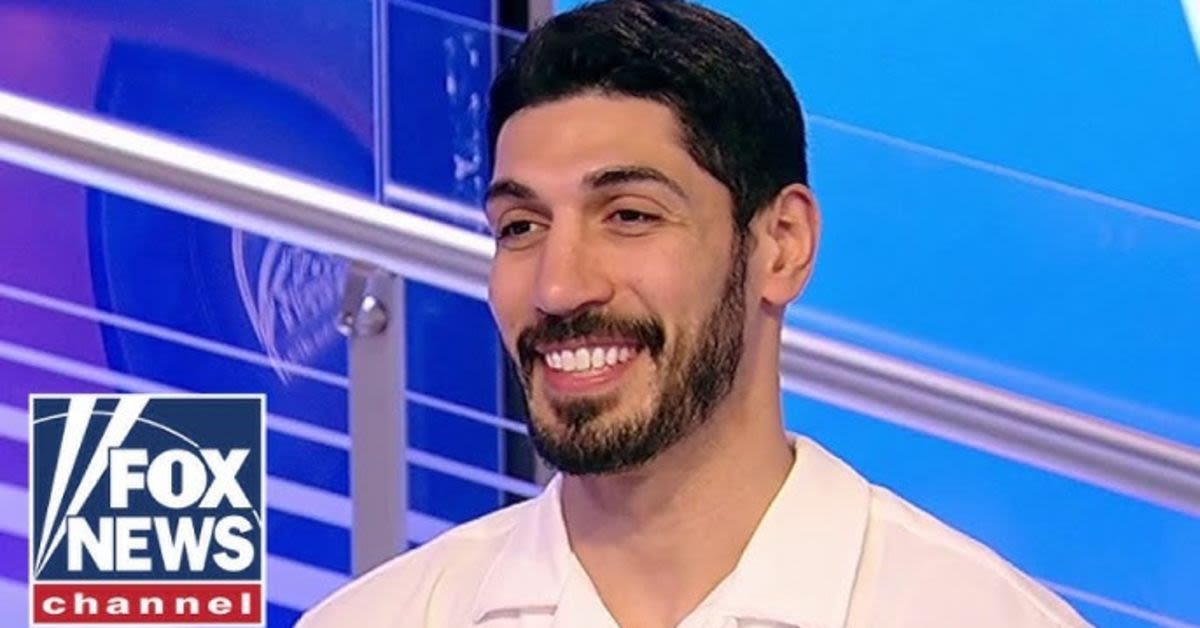
A former NBA star who has become one of the most outspoken defenders of womens sports is now taking his fight from the hardwood to federal court.
As reported by RedState, Enes Kanter Freedomwho has drawn national attention for challenging the transgender ideology being imposed on womens athleticshas been far more vocal and active in recent weeks than most of the WNBAs own players and coaches, with the notable exception of Indiana Fever guard Sophie Cunningham. Freedom has mocked the leagues embrace of gender ideology by announcing that he will declare for the 2027 WNBA draft, arguing that under the lefts own rules, all he needs to do is self-identify as a woman to qualify, a pointed jab at what he sees as the absurdity of Woke Inc., which includes many WNBA players and fans.
His activism moved from satire to confrontation during a recent matchup between the Fever and the Chicago Sky in the Windy City, where Freedom attended courtside and was ultimately ejected and banned from future Sky home games. The incident unfolded after Sky player Natasha Cloud attempted an aggressive confrontation with him following a play, prompting Freedom to stand and take roughly two steps forward with his arms extended at his sides, a gesture that arena officials and team leadership later portrayed as threatening.
Chicago Sky owner Michael Alter escalated the rhetoric by declaring Freedom a threat, likening his presence to that of someone armed with a gun and harboring malicious intent. That characterization, coupled with the sweeping ban, did not sit well with Freedom, who quickly signaled that he was exploring legal action over what he views as blatant retaliation for his political and biological views on sex and womens sports.
On Thursday, Freedom announced that he is moving forward with a federal lawsuit grounded in the First Amendment and basic constitutional protections for peaceful speech. The former Boston Celtics center has sued the Chicago Sky, the Metropolitan Pier and Exposition Authority (MPEA), and the City of Chicago, alleging that all three entities acted in concert to have him removed from the August 23 SkyFever game at Wintrust Arena without lawful justification.
According to the complaint, the defendants did not merely eject him in the heat of the moment but have continued to enforce an ongoing ban that he argues is unconstitutional given the public nature of the venue. The Chicago Sky; MPEA, through Wintrust Arena Security; and the City of Chicago, by its Police Department, worked together to eject Plaintiff in retaliation for protected expression, and continue to work together to enforce the ongoing, unconstitutional ban of Plaintiff from Wintrust Arena, which is public property owned by MPEA, Freedoms lawsuit stated.
Freedom took his case directly to the public on X, underscoring that he was removed not for any violent act but for wearing a T-shirt that challenged the WNBAs refusal to define basic biological reality. SEE YOU IN COURT!!! Just filed a federal complaint, he wrote, adding, Im taking legal action over my ejection from the @chicagosky game while peacefully exercising my First Amendment rights.
He emphasized that his message was simple and rooted in science, not hatred. My T-shirt did what the whole @WNBA apparently couldnt: define a woman, Freedom declared, stressing, No threats. No violence. Just biology.
Despite that, he noted, arena officials and law enforcement treated his presence as if it were a security emergency rather than a peaceful expression of opinion. And somehow, that required a security escort, he wrote, before reminding his critics that disagreement does not justify censorship: You dont have to agree with my speech but you dont get to silence me for it.
Freedom vowed that he would not back down in the face of institutional pressure from a league and a city government that appear more interested in appeasing radical activists than in protecting basic civil liberties. I will not be intimidated. I will not be silenced, he wrote, concluding, I will continue to stand for women and defend free speech.
The dispute echoes concerns raised earlier this year by Alliance Defending Freedom (ADF), which sent a warning letter to the WNBA after multiple reports that fans who shared Freedoms and Cunninghams views were harassed and ordered to cover up shirts supporting womens sports. ADFs letter highlighted the constitutional problems that arise when teams playing in publicly owned arenas attempt to suppress disfavored viewpoints, especially when those venues were built and maintained with taxpayer funds.
While the WNBA and its teams are private entities that are not typically bound by the First Amendment, many of the stadiums where those teams play are owned by public entities and built with public funds, ADF wrote, noting that courts sometimes treat the actions of private entities as state action when they are intertwined with government bodies. And courts sometimes consider actions by private entities to be state action based on the nature of the private-public relationship. Burton v. Wilmington Parking Auth., 365 U.S. 715, 72122 (1961). When that happens, the private actors must abide by First Amendment rules and allow speakers to express their views consistent with the nature and purpose of the venuein this case, a sporting event.
ADF further warned that such viewpoint-based crackdowns may run afoul of state and local public-accommodations laws that bar discrimination in services. Censorship like this could also violate some state and local public accommodations laws. Most states and localities have laws that prevent private entities from denying services to individuals based on protected characteristics, such as race, sex, or religion.
Although ADF is not representing Freedom in this particular case, his legal team at the America First Policy Institute (AFPI) appears poised to advance a similar line of argument, focusing on the public ownership of Wintrust Arena and the coordinated role of city police and arena security. If the court agrees that the Sky, MPEA, and Chicago authorities acted together as state actors to punish a viewpoint grounded in biology and traditional womens sports, the case could set an important precedent for fans and athletes who refuse to bow to gender ideology.
For conservatives who have watched the WNBA and other professional leagues drift further left, the lawsuit raises a fundamental question: will publicly funded venues be allowed to function as ideological safe spaces where only progressive speech is welcome, or will they remain open forums where citizens can peacefully assert that womens sports are for women? Freedoms full complaint, now on file in federal court, will test whether the Constitution still protects those willing to say out loud what many Americans quietly believe.
Login