
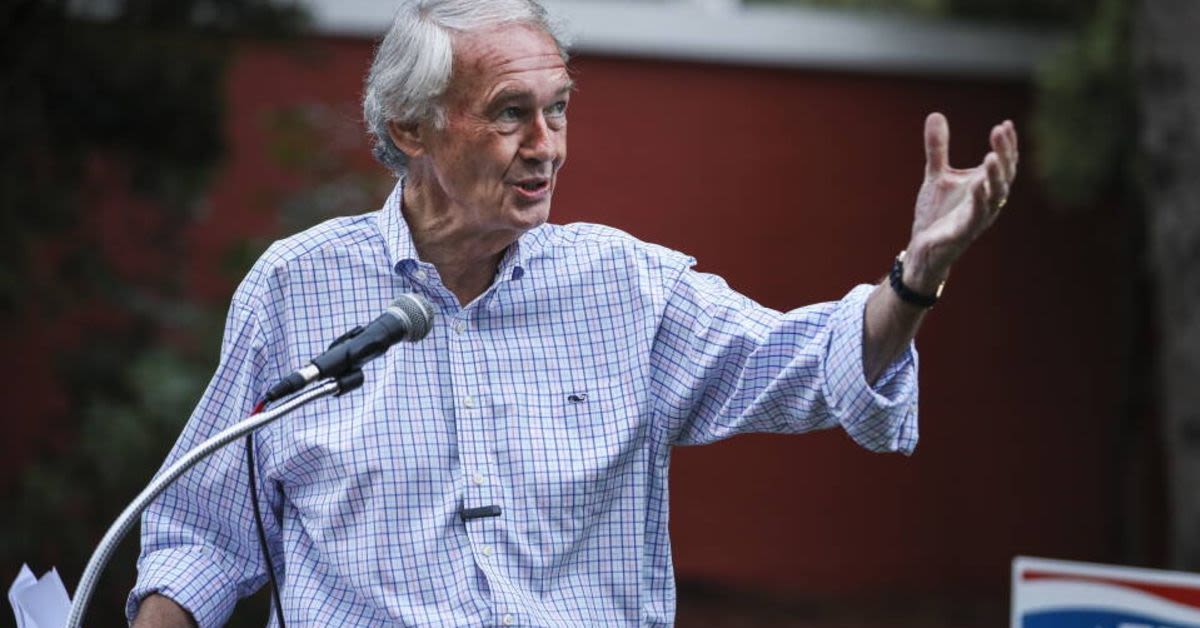
The Democratic Party, already reeling from a series of high-profile reminders that age and public office do not always mix, has once again chosen to double down on its gerontocracy rather than change course.
In Massachusetts, voters were given a clear opportunity to pivot away from the pattern that produced President Joe Biden, the late Sen. Dianne Feinstein and longtime Delegate Eleanor Holmes Norton all emblematic of the risks that come when officials remain in power long after their prime. Yet, according to Western Journal, they opted instead to send 80-year-old Sen. Ed Markey back to Washington, brushing aside a younger challenger in a race that served as a referendum on whether Democrats are willing to elect leaders who can credibly promise to serve out a full term in good health and sound judgment.
Markey, who first entered Congress when Gerald Ford occupied the White House, easily defeated 47-year-old Rep. Seth Moulton in the Democratic primary for a U.S. Senate seat that is all but guaranteed to remain in the partys hands. In a political climate where 47 now passes for a new generation of leadership, as Moulton himself put it, the party faithful in this deep-blue state chose the octogenarian incumbent by a lopsided 64.9 percent to 35.1 percent margin.
The contrast in ages is not trivial, particularly in a state that once produced a young, vigorous president in John F. Kennedy, who was only a year older than Moulton when he was assassinated and had already served in both the House and Senate. But Massachusetts Democrats appear convinced that Markey will still be up to the job at 86, effectively dismissing the growing national concern that advanced age in high office has become a serious liability rather than a mere talking point.
The Washington Post noted that Markeys victory came despite a rough year for establishment candidates, with the senator maintaining a steady lead in polls throughout the race. Despite a rough year for establishment candidates, Markey led in polls throughout the race, in large part because he is viewed as more progressive in a state that skews leftward, the outlet reported, pointing out that Sen. Bernie Sanders and Rep. Alexandria Ocasio-Cortez lined up behind him as the progressive choice.
That progressive label rests largely on rhetoric and symbolism rather than substantive legislative achievement, but it has been enough to keep Markey in good standing with the partys activist base. His most prominent crusade in recent years has been a push to expand the Supreme Court, insisting that seats were stolen by Republicans and signaling his willingness to blow up long-standing institutional norms to achieve a left-wing judicial majority.
Markey has vowed to abolish the Senate filibuster, clearing the way for Democrats to ram through sweeping changes with bare majorities, and he has embraced the kind of maximalist court-packing schemes that would effectively turn the judiciary into a partisan super-legislature. In cultural battles, he has taken positions that place him firmly on the far-left fringe, including the view that biological boys who identify as transgender should be allowed to compete in girls sports a stance Moulton rejected, to his political detriment in a state dominated by progressive orthodoxy.
On the campaign trail, Markey cast himself as a tireless fighter for the people of Massachusetts, leaning heavily on familiar populist language. Massachusetts needs a senator who stands up and fights back, a senator who never forgets who they are fighting for, Markey said in his victory speech, according to the Associated Press, before adding, That has been the mission of my life, and it always will be.
Those lofty words sit uneasily beside his actual record, which is long on tenure and short on transformative accomplishments. Markey has occupied a seat in Congress for nearly half a century and was effectively gifted John Kerrys Senate position when Kerry joined the Obama administration as secretary of state, yet he has not emerged as a major legislative architect or reformer in any significant policy area.
Pressed on the question of generational change, Markey tried to reframe the issue as one of ambition rather than age. Generational change isnt about compromising, to do the small things better, Markey told supporters, adding, Its about fighting to do the big things best.
In practice, however, his big things have often amounted to cable news appearances and social media posturing rather than serious, bipartisan lawmaking. Markey has become a fixture on friendly outlets such as CNN and MSNBC, where he reliably echoes the progressive line, functioning more as a media personality than a statesman a kind of long-running, elected version of the Michael Avenatti phenomenon, minus the criminal convictions and professional disgrace.
When he ventures outside that protective media bubble, the senators age and rhetorical limitations become more apparent. His public statements can veer into confusion and hyperbole, reinforcing the perception that he is a relic of an earlier political era who has learned to repeat the latest progressive slogans without offering coherent, grounded policy solutions.
Markeys record in the 21st century also undercuts the moral high ground Democrats claim on issues such as election integrity and respect for democratic outcomes. As a House member, he refused to vote to certify the 2004 Ohio results, indulging conspiracy theories about voting machines manufactured by Diebold supposedly handing the state to President George W. Bush, and later supported convicting an impeached president for questioning election results a striking inconsistency that underscores the partisan nature of his principles.
Despite his loud advocacy for court packing, the odds of such a radical restructuring of the judiciary actually occurring remain slim, even under unified Democratic control. What is far more likely is that Massachusetts and the nation will be saddled with yet another aging officeholder another Biden, another Feinstein, another Holmes Norton tasked with making urgent decisions for millions of Americans while operating well past the point at which most people have retired from demanding professional roles.
The Massachusetts result thus serves as a microcosm of a broader problem within the Democratic Party: a stubborn refusal to confront the costs of clinging to elderly incumbents simply because they are ideologically reliable and politically entrenched. Voters in the state, which famously stood alone in casting its electoral votes for George McGovern in 1972, have once again signaled their comfort with being an outlier, this time by embracing a status quo that many Americans increasingly view as untenable.
For conservatives, the lesson is clear: The lefts rhetoric about new leadership and generational change is often little more than a marketing slogan, especially when the alternative is a younger Democrat who deviates, however slightly, from progressive dogma on issues like womens sports and judicial power. If the partys base in a place as liberal as Massachusetts will not trade an 80-year-old incumbent for a 47-year-old congressman, even in the face of mounting evidence that age is impairing governance at the highest levels, there is little reason to believe Democrats will voluntarily reform themselves on this front.
And if younger voters or disillusioned moderates in Massachusetts want to know how long this pattern can continue, they might consider asking Ed Markey about George McGovern assuming, of course, that the senator still remembers the last time his state proudly stood alone on the wrong side of political reality.
Login