
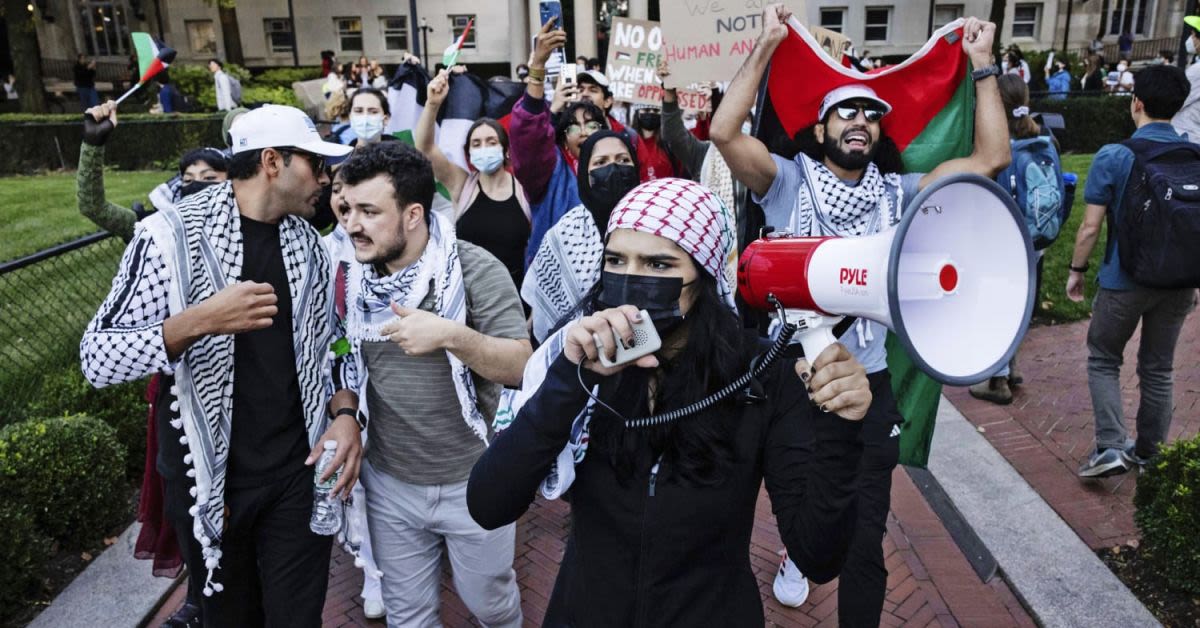
A federal court has handed a major victory to the Foundation for Individual Rights and Expression (FIRE) in its challenge to the Trump administrations effort to deport foreign students whose campus activism crossed the line from criticism of Israel into open agitation for the Palestinian cause and, in many cases, open sympathy for Hamas.
According to The Post Millennial, FIRE, led by Greg Lukianoff, hailed the decision as a landmark affirmation of speech rights for noncitizens already admitted to the United States.
FIRE described the case as involving "a noncitizen student holding an F-1 visa issued by the United States," and Lukianoff announced, "FIRE won a huge First Amendment victory today. And before anyone mischaracterizes it: This ruling does NOT say the government must admit anyone, issue anyone a visa, or grant anyone citizenship."
He stressed that the courts holding was limited to those already lawfully present in the country, adding, "It says that once a person is lawfully here, the government cannot deport them because they engaged in protected speech. The government cannot tell a legal immigrant: An American is free to say this, but if you say it, youre out. Thats the principle we sued to defend. And today we won."
The courts opinion framed the case around allegations that the federal government had altered its enforcement posture toward foreign students after the October 7, 2023 Hamas massacre in Israel.
The ruling recounted that "Plaintiffs allege that, since March 2025, the government has changed its immigration policy and pattern of enforcement, namely by arresting, detaining, and deporting students with F-1 visas when those students use their freedom of speech to express opinions that the government does not likesuch as expressing support or empathy for Palestinian people, or criticizing Israel's actions regarding the Palestine or the conflict in Gaza."
In other words, the plaintiffs claimed that immigration authorities were weaponizing deportation tools to punish political expression, particularly speech critical of Israel and sympathetic to Palestinians.
Judge Wise accepted that the governments posture had chilled speech among foreign students who feared that public advocacy for the Palestinian cause could cost them their legal status.
Part of Wise's ruling is that the threat of visa revocation led to a chilling of speech by the plaintiffs, who felt that they were no longer free to publicly advocate for the Palestinian cause, which is one of Israeli eradication.
"Stanford Daily," ruled Wise, "on behalf of its members, has adequately demonstrated facts to support that its members have an actual and well-founded fear that the Deportation and Revocation Provisions will be enforced against them, and that members refrained from expressive activity based on their reasonable fear that the government may disapprove of their speech as to Israel and Palestine, much like the governments disapproval of the speech of Khalil, ztrk, and Mahdawi."
Yet what the court and the plaintiffs describe as "expressing support or empathy for Palestinian people" has looked very different to many Americans watching campus unrest unfold since October 7.
From the perspective of Senator Marco Rubio and the Trump administration, this was not mere empathy but "supporting Hamas," blocking Jewish students from attending class, and staging disruptive and sometimes violent actions on college campuses.
The ruling itself underscores how central Israel was to the controversy, mentioning the Jewish state 102 times across 37 of its 90 pages.
It is also significant that the loudest voices in these campus protests often came from foreign students, including those from the Middle East and Gaza, who were among the most vocal in championing Hamas and the broader Palestinian cause; at Stanford, a professor was suspended after targeting a Jewish student in the wake of the October 7 attacks.
Not all legal scholars are convinced the courts reasoning is sound, particularly when it comes to the governments authority over immigration, which has long been treated as distinct from domestic civil liberties.
University of Minnesota law professor and author Ilan Wurman argued that FIREs victory stretches First Amendment doctrine beyond its proper bounds, saying, "FIRE does amazing work, but this is just wrong. The government is in fact allowed to condition public privilegesincluding immigration privilegeson the recipient forgoing rights he might otherwise have, so long as the condition is germane to the privilege."
Wurman emphasized that immigration is a conditional benefit, not an inherent right, adding, "The government should absolutely be able to kick out foreigners if they say things like death to America or whatever. (Not sure exactly what these individuals said, but I am making a point about the broader principle.)"
The case raises fundamental questions about the intersection of immigration law, national security, and constitutional protections.
Was the speech at issue by these noncitizen students mere political advocacy, or did it amount to incitement or material support for terrorism under longstanding legal standards?
Did these foreign students misrepresent their views on terrorism or violent movements when they applied for visas, particularly when they certified that they did not support terrorist organizations or the overthrow of the United States government?
And more broadly, does the First Amendment, which protects speech, also effectively shield noncitizens from deportation when their speech veers into praise for terrorist groups?
Critics of the ruling argue that FIRE is blurring the line between speech rights and the sovereign right of a nation to decide who may remain within its borders.
"FIRE takes a right everyone has speech and uses it to import a right only citizenship guarantees: the right to remain in America," said Fox News' Will Ricciardella.
"Americans cannot be deported from their own country. But noncitizens can be removed from a country that admitted them conditionally, and SCOTUS said a noncitizens continued residence is not his right but is a matter of permission and tolerance. The 1st Amendment cannot smuggle citizenship into a visa or a green card."
Among those poised to benefit from the ruling is Columbia University agitator Mahmoud Khalil, a prominent figure in the Gaza-related protests who was cited in the case as a target of the Trump administrations enforcement efforts.
The student plaintiff, identified as Jane Doe, filed suit after the State Department moved to revoke her visa and those of other activists who had been at the forefront of pro-Palestinian uprisings on campuses, encouraging unrest and apparent violence after the October 7 terrorist massacre in Israel.
Khalil, who has refused to distance himself from Hamas, dismissed criticism of his stance as bigotry, insisting it was "racist" to ask Palestinian students like himself to condemn terror group Hamas.
The timing of the protests is not incidental: it was only after Hamass brutal October 7 assault that many foreign students in the United States began openly advocating for Hamas and calling for the eradication of Israel.
Say what you will about Israeli policy, but the spectacle of foreign nationals on American soil boosting calls for massacre and the destruction of a sovereign ally raises serious concerns for those who believe immigration should serve American interests, not undermine them.
The Center for Immigration Studies (CIS), a restrictionist think tank, has maintained that deporting Khalil and similarly situated foreign agitators is entirely consistent with the Constitution.
CIS rejected Khalils self-description as a "political prisoner" once he was detained, pointing to the Supreme Courts 1969 decision in Brandenburg v. Ohio, which held that speech "directed to inciting or producing imminent lawless action" falls outside First Amendment protection.
From the Trump administrations vantage point, Khalil was not a mere protester but an advocate for terrorism, and if he was indeed promoting Hamas terrorists, the question becomes whether that advocacy crossed the Brandenburg line into unprotected incitement.
Judge Wise, however, drew a sharp boundary around the relief the lower court could grant.
Wise concluded that the Court "denies Plaintiffs' requested relief... under the Deportation Provision, as only the Supreme Court may provide that relief."
When FIRE filed the case in August 2025, it accused the Trump administration of attempting to subordinate a core civil liberty to bureaucratic discretion, stating that Trump was "trying to turn the inalienable human right of free speech into a privilege contingent upon the whims of a federal bureaucrat, triggering deportation proceedings against noncitizens residing lawfully in this country for their protected political speech regarding American and Israeli foreign policy."
At the heart of the dispute is the character of the speech itself and who gets to define it.
Was this rhetoric simply "basic 1A protected yammering," as the court effectively found, or was it, as the State contended, a form of incitement and ideological support for terrorism that justifies removal under immigration law?
For now, the judiciary has sided with FIRE and the activists, but the Trump administration retains the option to seek clarity from the Supreme Court, which alone can definitively reconcile the First Amendments broad protections with the nations sovereign authority to decide which foreign nationals may stay and which must go.
Login