
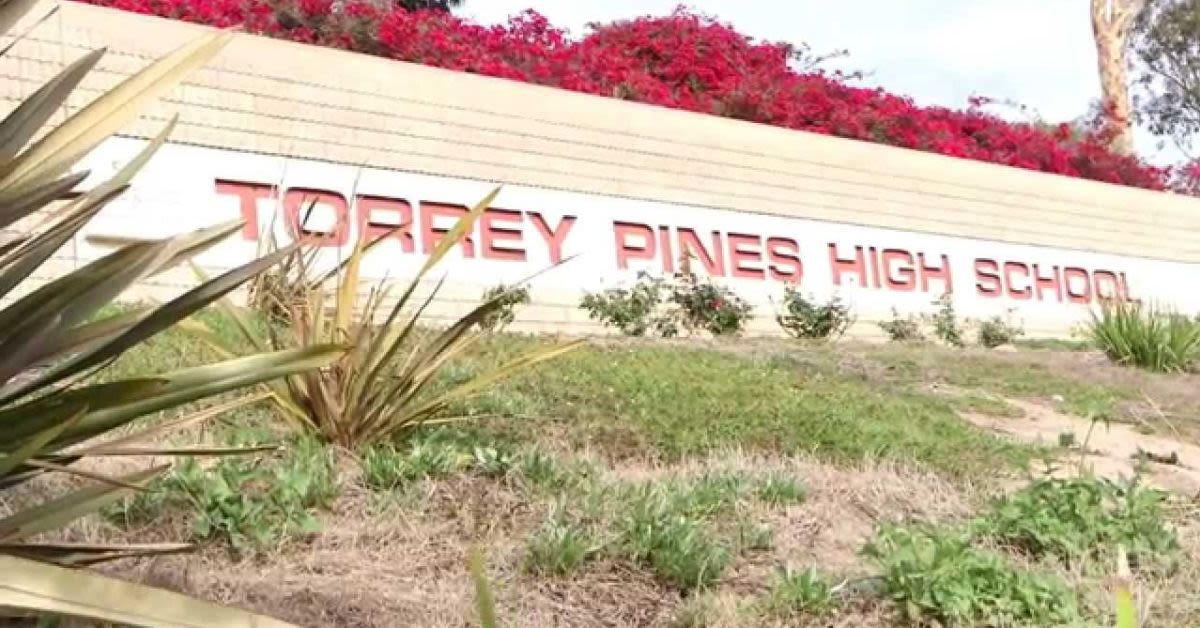
A California high school student is suing his school district in federal court, alleging that administrators weaponized safety protocols and mental health laws to punish him for displaying pro-Trump material during a campus protest.
According to One America News, the lawsuit was filed by a Torrey Pines High School student identified as M.F. against the San Dieguito Union High School District, claiming retaliation and violations of his First Amendment rights. The dispute stems from a February 2025 student protest against U.S. Immigration and Customs Enforcement (ICE), where M.F. and his friend, A.F., brought a flyer that reimagined the LGBT acronym with conservative themes.
The graphic, according to the complaint, used L for Liberty, G for Guns, B for Beer and T for Trump. The two boys reportedly stayed at the anti-ICE demonstration for only about five minutes before leaving, after A.F. was physically assaulted by protesters opposed to ICE.
The lawsuit alleges that when M.F. and A.F. returned to class carrying the flyers, their teacher abruptly left the room in tears. Both students were then given two days of lunch detention by Assistant Principal Angela Guerrero for allegedly frightening their classmates, a punishment their attorneys argue was based solely on the political content of their message.
Matters escalated sharply later that week when school officials summoned M.F. to the vice principals office and accused him of conducting disturbing online searches on a shared school computer. Administrators claimed he had looked up topics such as how to load a firearm and how to dispose of a body, despite, according to the complaint, lacking concrete proof that he personally made those searches.
M.F. adamantly denied the allegations and explained that student accounts on unsecured school devices are routinely accessed by multiple students. Nevertheless, the situation intensified the following afternoon when five to six police officers arrived on campus and interrogated the teenager without a parent or guardian present, raising serious due-process concerns.
The lawsuit further asserts that school officials blocked M.F.s parents from seeing their son during the police questioning. Instead, they were directed to a crisis social worker, who allegedly told them that the teacher had requested law enforcement involvement because the purported search history made her feel unsafe, even though the school had no evidence tying M.F. to the searches.
Police ultimately placed the student on an involuntary 5150 psychiatric hold and conducted a search of his home. Subsequent investigations, however, reportedly found no evidence of violent intent, gun-related research, or any effort at target selection, and after two evaluations at the psychiatric facility, staff concluded that M.F. was not a threat.
The federal complaint also describes what it characterizes as a continuing campaign of punitive measures after M.F. returned to school. Administrators allegedly branded him an LGBT bully and tried to force him into mandatory mental health monitoring and Special Education assessments, despite his status as a straight-A student at the time, according to his family.
Attorneys for the student contend that this is not an isolated incident but part of a broader pattern within the district. They argue that students who express conservative or Republican viewpoints are targeting and disproportionately disciplining compared with peers who promote left-wing causes, reflecting an ideological double standard in how school rules are enforced.
District spokesperson Edwin Mendoza issued a brief statement citing federal and state privacy protections as the reason officials cannot discuss confidential student matters or ongoing litigation. He added that the district remains committed to maintaining a safe and welcoming learning environment for all students, a claim that will now be tested against the factual record in federal court.
The case raises fundamental questions about whether public schools are using safety and mental health mechanisms as neutral tools or as political cudgels against right-leaning students. As the lawsuit proceeds, it will likely become a flashpoint in the broader national debate over free speech, parental rights, and the growing perception among many families that conservative students are second-class citizens in Americas public education system.
Login