
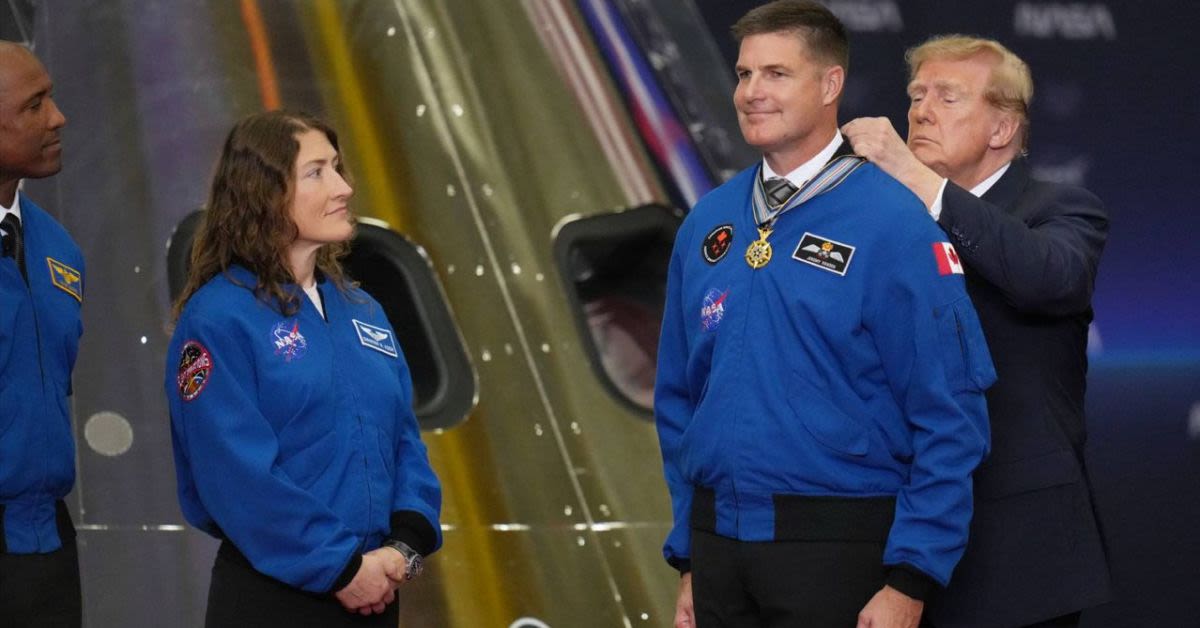
President Donald Trump returned to the Johnson Space Center in Houston, awarding the Congressional Space Medal of Honor to the four Artemis II astronauts who journeyed closer to the Moon than any crew in more than half a century.
According to RedState, the honorees were Commander Reid Wiseman, Pilot Victor Glover, Mission Specialist Christina Koch, and Mission Specialist Jeremy Hansen. Their 10-day Orion test flight, completed on April 10, made them the first people to travel beyond the Moon since the Apollo era and, as NASA noted, the humans who have ventured farthest from Earth.
NASA Administrator Jared Isaacman outlined an ambitious roadmap for Americas future in space, underscoring the scale of the nations renewed aspirations. He also praised Trump's effort in space, a reminder that the prior administration treated space exploration as a strategic priority rather than a symbolic gesture.
Trump, in turn, lauded Isaacman and the broader NASA team, calling Johnson Space Center a monument to grit and determination and pure American excellence, and produced some of the greatest achievements in human history. He added that he had no doubt they would go further than they ever have before, signaling confidence in American ingenuity when government steps back and lets innovators lead.
Trump then recognized the Artemis II astronauts individually, highlighting their courage and professionalism before an appreciative audience. They presented Trump with a NASA jacket, a gesture that underscored the rapport between the crew and a President who championed the Space Force and a robust space policy.
Trump also announced he would be signing an executive order establishing a U.S. National Space Academy, apparently to feed into the Space Force and NASA. He also explained they would have a nuclear-powered interplanetary spaceship, a concept that reflects a bold, unapologetically pro-advancement vision often resisted by risk-averse bureaucrats.
Trump even called the astronauts in the International Space Station, extending the celebration beyond Houston to those currently in orbit. He took the time to put their family members on the phone instead of himself, a small but telling act that emphasized family, sacrifice, and the human side of American greatness in space.
Login