
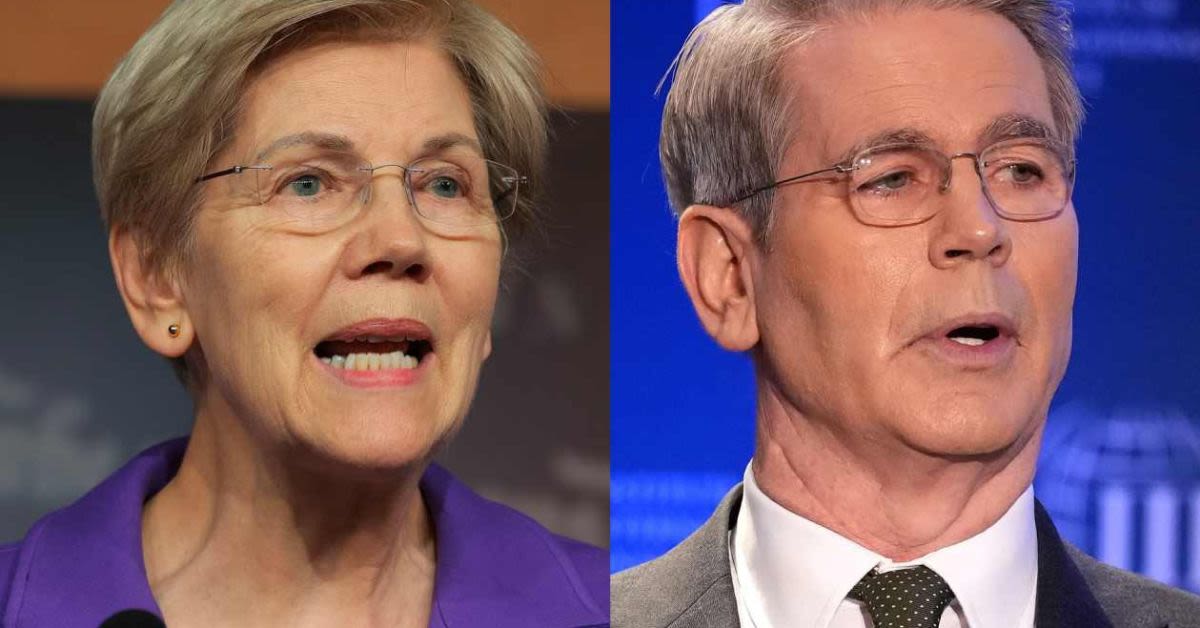
Treasury Secretary Scott Bessent delivered a caustic rebuke to Sen.
Elizabeth Warren, offering to personally tutor the progressive firebrand on Foreign Exchange for Dummies after she attacked the administrations move to shore up the Japanese yen.
In a sharply worded letter dated Thursday, Bessent told the Massachusetts Democrat that her latest broadside unfortunately reveals that you know even less about foreign exchange markets than you do about banking, according to the New York Post.
He went on to deride her opening salvo on the issue, writing, Terrifyingly, the opening paragraph is wrong about where the money came [from], what the transaction was, and whether there was even a borrower.
Bessent, a former currency trader now overseeing the nations finances, accused Warren of misleading the public and being shielded by a sympathetic press corps.
What is equally shocking, but not surprising: not a single member of your media mob has a rudimentary-enough level of financial market literacy to spot your remedial error, he wrote, skewering both the senator and her allies in the media.
The Treasury chiefs letter was prompted by Warrens Aug. 13 demand for detailed disclosures about the departments use of the Exchange Stabilization Fund, or ESF, in a joint US-Japan operation to support the yen after it plunged to a 40-year low.
Warren, the ranking Democrat on the Senate Banking Committee and a longtime critic of Wall Street and market interventions, claimed that American taxpayers could be left holding the bag if Japan failed to repay Treasury a scenario Bessent dismissed as fantasy.
Treasury exchanged existing Exchange Stabilization Fund foreign-currency assets for yen, Bessent explained, directly contradicting Warrens premise that US taxpayers were effectively lending money to Tokyo.
No new congressional appropriation was involved, and no credit was extended to Japan. Japan owes Treasury nothing, he wrote, underscoring that the transaction did not create any new liability for the United States.
There is therefore no risk that Japan will fail to repay a debt that does not exist, Bessent added, making clear that Warrens central claim rested on a misunderstanding of the basic structure of the deal.
His response highlighted a broader conservative critique of Warrens economic populism: that her rhetoric routinely outpaces her grasp of financial mechanics while stoking public anxiety about phantom risks.
The yen operation marked the first coordinated US-Japan intervention to bolster the currency since 1998, reflecting concern in both capitals about financial stability and the health of global markets.
Acting through the Federal Reserve Bank of New York, Treasury sold euros and bought yen, though officials have not disclosed the precise size of the US purchase.
Speculation about the scale of the intervention intensified after a Reuters photograph on July 31 captured a notepad in front of Bessent bearing the handwritten reminder: To Do Buy Japanese Yen (JPY) $5-10 bil.
The note suggested a contemplated purchase in that range but did not confirm how much Treasury ultimately acquired, leaving room for critics like Warren to insinuate hidden risks and backroom dealings.
In her Aug. 13 letter, Warren seized on the lack of public detail, demanding to know the total US commitment, the potential cost to taxpayers, and the legal basis for deploying the ESF in this manner.
Bessent, in turn, used her legal challenge as another opportunity to question her competence.
Your legal question is answered by the statute cited in your own footnote, he wrote, pointing to Section 5302, which authorizes the Treasury secretary, with presidential approval, to conduct foreign-exchange operations to support orderly exchange arrangements.
Treasurys legal analysis begins with reading the statute. I recommend you try the same, he added, in a pointed reminder that the law already grants the executive branch broad discretion in this arena.
Bessent further argued that the intervention was not some ideological experiment but a practical step to safeguard US economic interests and financial stability.
He emphasized Japans status as a major holder of US Treasuries, a key trading partner, and a treaty ally whose financial turmoil could quickly spill over into American markets.
Disorderly yen markets can trigger forced unwinds, which could destabilize global markets and ultimately raise borrowing costs for American families and businesses, he wrote, framing the move as a pre-emptive defense of Main Street rather than a bailout of a foreign government.
For a fuller explanation, I recommend any entry-level course in international finance for you and your staff, or I can give you a tutorial on Foreign Exchange for Dummies, he added, twisting the knife with a mocking offer of remedial education.
Japan itself spent a record $96.5 billion intervening in foreign-exchange markets between July 30 and Aug. 26, according to government data released Friday, while Treasury has kept its own yen purchase amount under wraps.
The yen initially rallied on the back of the joint action before surrendering much of those gains later in August, a reminder of how volatile currency markets can be even when governments step in.
Seeking to bolster her case, Warren cited Treasurys prior use of the ESF to provide $20 billion in support to Argentina, which she portrayed as a politically motivated rescue.
Bessent countered that narrative, insisting the Argentina operation was aimed at addressing acute, short-term illiquidity and forestalling a broader regional meltdown.
The best-managed crisis is the one that never happens, he wrote, defending the principle of early, targeted intervention to prevent systemic shocks.
You, by contrast, appear to view preventable crises not as failures to avert but as welcome opportunities to expand government control with ordinary Americans paying the price, he added, accusing Warren of exploiting turmoil to justify bigger government and tighter regulation.
Bessent ended his letter with a final admonition that blended technocratic critique with a broader warning about political grandstanding.
The American people deserve oversight grounded in facts rather than slogans, he wrote.
Although I am not holding my breath, I hope your next letter will demonstrate that you have learned the difference between a currency purchase and a swap or a loan, he added, urging Warren to distinguish between legitimate scrutiny and misinformed attacks.
For conservatives wary of progressive efforts to micromanage markets from Washington, his message underscored the importance of expertise, limited government interference, and disciplined use of existing statutory tools rather than reflexive calls for new controls.
Democrats on the Senate Banking Committee, however, showed no sign of backing down, with spokeswoman Saloni Sharma insisting that Warrens inquiries remain unanswered.
He should focus less on his petty grievances with Senator Warren and more on reducing the cost of living for the American families struggling in President Trumps economy, Sharma said in a statement, attempting to shift the debate from Warrens missteps to broader economic frustrations.
Login