
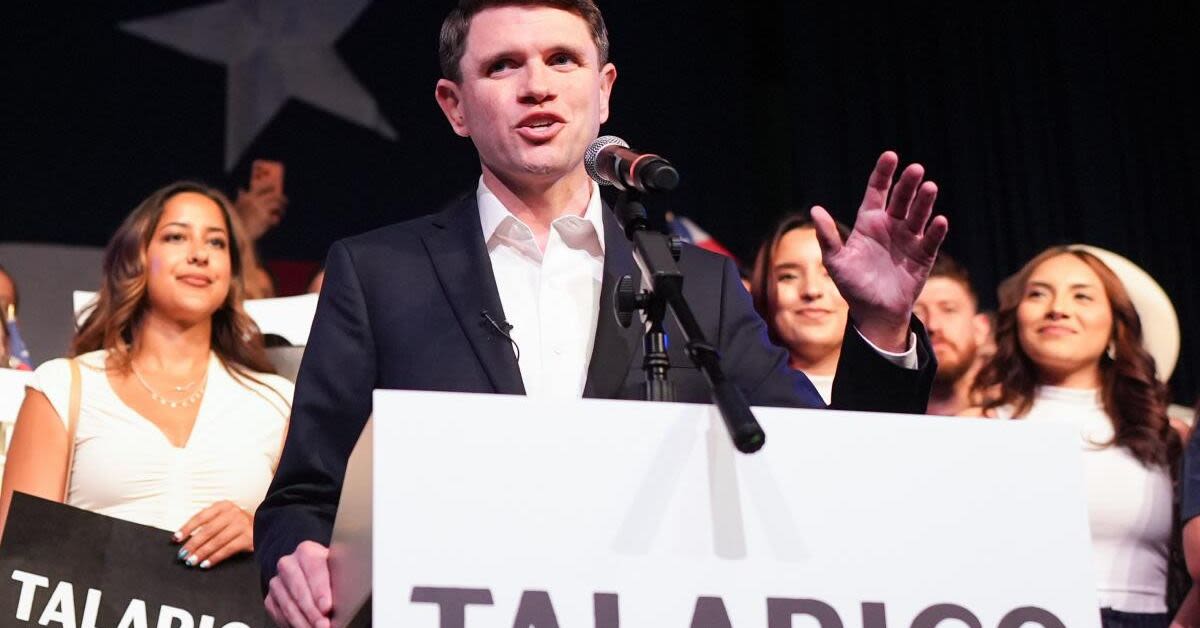
Texas Democratic Senate nominee James Talarico has inserted himself into the racially charged murder case of high school football standout Austin Metcalf by publicly aligning with the convicted killer, 19-year-old Karmelo Anthony.
Anthonys defense team returned to a Texas courtroom on Thursday seeking a new trial, after scoring a significant procedural victory the previous day when the judge who presided over the original case was removed from the proceedings. According to the Washington Free Beacon, the judge, who is white, was taken off the case in part because he had remarked that the jury got it right in convicting Anthony.
Talarico, a Democratic member of the Texas House of Representatives, used a recent appearance on a black-oriented radio program to cast Anthonys conviction as evidence of systemic racial injustice in Texas. The case centers on Anthony, a black teenager who fatally stabbed Metcalf, a white 17-year-old, at a high school track meet in Frisco, a crime Talarico framed as proof that the criminal justice system is not working for black Texans.
Right now we've got a system that doesn't serve all Americans equally, and, and we know that black Texans have been, um, have not gotten the justice they deserve, Talarico declared during the interview, echoing progressive talking points that have become increasingly out of step with Texass law-and-order electorate. His comments place him squarely on the side of a convicted killer in a case that many Texans view as a straightforward act of violence, not a civil-rights cause.
Talarico delivered his remarks on The Breakfast Club, a New York City talk radio show that has become a favored venue for white Democrats seeking to burnish their credentials with black voters. The program has a history of awkward racial pandering by national Democrats: in 2016, Hillary Clinton boasted that she carries hot sauce in her purse, a claim host Charlamagne tha God said sounded like she was pandering to black voters, and in 2020, Joe Biden infamously told listeners that if you have a problem figuring out whether you're for me or Trump, then you ain't black.
During the August 5 interview, Talarico was pressed about a viral clip from a recent town hall where he was seen vigorously nodding as a woman described Anthonys conviction as a tragedy. A Texas jury had sentenced Anthony to 35 years in prison on June 9, 2026, for stabbing Metcalf in the heart at a track meet outside Dallas on April 2, 2025, an attack that witnesses said followed threats Anthony made against Metcalf and other students.
Metcalf, a star linebacker on his high school football team, died in the arms of his twin brother Hunter, a detail that has seared the case into the public consciousness and fueled outrage among Texans who see the killing as senseless and brutal. Witnesses testified that Anthony, then 17, brandished a large knife and plunged it into Metcalfs chest after issuing threats, testimony that persuaded a jury to convict him of murder.
In the aftermath of the stabbing, Anthonys supporters turned to crowdfunding and raised more than $630,000 for his benefit through the Christian platform GiveSendGo. How Anthonys family used that money has become a point of controversy, especially as Metcalfs backers mounted their own GoFundMe campaign that likewise brought in more than $630,000 for the slain teenagers family.
Anthonys legal team is now challenging the conviction on procedural and racial grounds, arguing that their client was tried by a jury that included no black jurors. They contend that the trial judge improperly allowed prosecutors to strike all three black members of the jury pool, a move they say tainted the fairness of the proceedings.
Talarico, in his radio appearance, doubled down on his characterization of the case as a tragedy and strongly implied that Anthony was either wrongfully convicted or punished more harshly because of his race. I'm not an expert on this particular case, but I know that there were no black members of the jury, and to me, that's, that's the only evidence you need to, to really prove this system is not working for black Texans, he said, adding that if elected to the U.S. Senate he would continue his efforts in the Texas House to reform this system.
Such rhetoric is likely to deepen concerns among Texas voters that Talarico is far to the left of the states mainstream, particularly on crime and justice. The Democrat, a Presbyterian seminarian who has publicly proclaimed that God is non-binary, has already drawn scrutiny for cultural and theological positions that clash with the traditional values held by many Texans.
The defenses successful bid to remove the original trial judge has given Anthonys supporters fresh hope of overturning the conviction, even as the victims family and many in the community insist that justice was already served. The judges remark that the jury got it right in convicting Anthony was cited as evidence of bias, a claim that critics argue reflects a broader effort by activists and progressive politicians to undermine jury verdicts that do not align with their racial narrative.
Talaricos campaign, however, has remained conspicuously silent on key questions about the case. His team did not respond to inquiries about whether he explicitly supports a new trial for Anthony or whether he believes Anthony is innocent of the murder charges that a jury unanimously found proven beyond a reasonable doubt.
The Breakfast Club appearance comes as Talarico struggles to consolidate support among black voters after a bruising primary battle with Rep. Jasmine Crockett, a black Democrat from Dallas and frequent guest on the show. Crockett, who has also defended Anthony, accused Talarico of running a racist race in the primary and he faced backlash over allegations that he referred to former Senate candidate Colin Allred as a mediocre black man.
In an apparent bid to shore up his standing with the left wing of his party, Talarico has embraced a slate of progressive priorities that sit uneasily with Texass conservative electorate. He denounced the SAVE Act, which would tighten voter ID requirements, as an attempt to rob black voters, and he has endorsed the concept of reparations for slavery, asserting that repairing past harms is part of my faith tradition.
For many Texans who prioritize public safety, equal justice under the law, and election integrity, Talaricos decision to side rhetorically with a convicted murderer while attacking voter ID and championing reparations raises serious doubts about his fitness for higher office. As Anthonys legal team presses for a new trial and the Metcalf family relives their loss in yet another courtroom battle, voters are left to weigh whether Talaricos brand of racialized politics and radical policy prescriptions reflect the values of a state that has long prided itself on personal responsibility, respect for law enforcement, and a justice system that protects victims rather than excuses violent offenders.
Login