
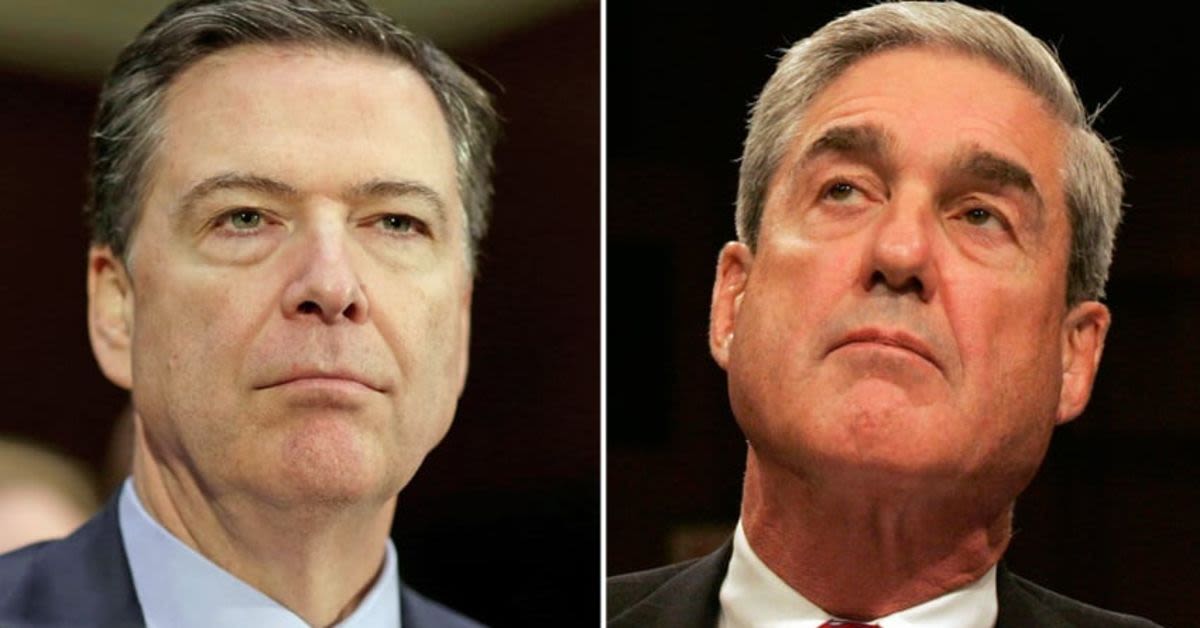
Notwithstanding the insistence of Attorney General Todd Blanche and other officials that a grand jury not partisan prosecutors indicted disgraced former FBI Director James Comey, the case now unfolding against him carries an air of small-bore retribution that belies its potentially explosive implications.
According to RedState, Comey currently faces two federal charges: one for allegedly issuing a threat against President Donald Trump, and a second tied to an interstate and foreign commerce violation, both arising from his May 2025 decision to post an Instagram photograph of seashells arranged to spell out 86 47, a phrase widely recognized on the radical Left as a coded endorsement of political violence. The numerals, read in context, are understood by many as a call to 86 eliminate the 47th president, a meaning that prosecutors argue was neither accidental nor benign.
The new case arrives on the heels of a far more substantial prosecution of Comey over his role in leaking classified information, a case that was tossed on a technicality by a Clinton-appointed judge despite extensive evidence of misconduct. By the standards of the lawfare campaigns that Democrats and their allies in the bureaucracy have waged against Trump and his supporters, this latest indictment might appear to be the lowest of low-hanging fruit, almost a consolation prize after the earlier failure.
Yet, unlike the prior case, which grew out of the corrupt Crossfire Hurricane operation that the FBI under Comey ran in concert with the Hillary Clinton campaign to smear Trump as a Russian asset, the current prosecution in the Eastern District of North Carolina appears far more straightforward and, crucially, far more winnable. The evidentiary trail is tighter, the legal theories are simpler, and the jury will not be asked to untangle years of counterintelligence intrigue but to assess the intent behind a single, highly symbolic act.
Court records filed last week revealed that just before Comey posted the controversial Instagram image, he received a text message from his wife, Patrice Comey, suggesting a more innocuous interpretation of the term 86 than the one he himself had previously acknowledged in a televised interview with late-night host Stephen Colbert. That interview, now resurfacing as a key exhibit, shows Comey openly conceding that he understood the darker meaning of the phrase, undermining any claim that he was merely engaging in whimsical beach art.
Comey literally admits that he knew the meaning of 86 when he made his instagram post, one commentator noted in a post shared widely on social media, highlighting the clip as a potential smoking gun. The prosecution is expected to argue that Comey, a seasoned former lawman and Washington insider, was far more likely to be familiar with the military connotation of 86 a reference to Strike Fighter Squadron 86, a U.S. Navy unit historically associated with target-elimination missions than with the restaurant slang for removing a menu item.
Compounding Comeys difficulties, another relative of the family has reportedly corroborated the more violent reading of the seashell message, as well as the Comeys likely awareness of that meaning, in a newly unearthed text message. In that blistering communication, the relative did not mince words, writing to Patrice Comey that the post amounted to a call for violence against Trump and confessing, I have held my tongue for a long time, but I just can't do it anymore. You guys have a sentiment that prosecutors will likely portray as evidence of how the post was perceived even within Comeys own circle.
Thus, rather than providing the plausible deniability that Patrice Comey may have intended when she floated a softer explanation for the 86 reference, her text could instead be introduced as proof of premeditation, suggesting that the couple discussed the symbolism in advance and proceeded anyway. That narrative, if accepted by a jury, would transform the Instagram post from a careless joke into a calculated threat.
Other elements of the Department of Justices case including Comeys references to his recently published thriller novel, "FDR Drive," which reportedly glorifies political violence and features plotlines uncomfortably close to real-world events have already given investigative journalist Paul Sperry ample material for analysis. Yet it may be the discovery process and the behind-the-scenes legal maneuvering, rather than the final verdict, that ultimately prove most consequential for Comey and for the broader network of anti-Trump operatives with whom he has long been aligned.
The text messages at the heart of the case surfaced only after FBI investigators were forced to serve Apple with a subpoena, following the Comeys refusal to provide the original 86 47 photograph containing crucial metadata, Sperry reported. NEW: James Comey and his DC lawyer David Kelley refused to provide federal investigators the original photo Comey took of his 86 47 seashell threat on Trump (target of 2 prior ass*ssination tries) b/c it held key metadata, so the FBI had to serve Apple w/ a warrant to search Sperry wrote, underscoring the lengths to which Comey allegedly went to withhold potentially incriminating evidence.
That refusal raises serious questions about what other damaging material Comeys former agency may have recovered from his electronic devices once it obtained access through Apple. Some of that data may intersect with ongoing inquiries into the Russia-gate hoax and other anti-Trump schemes including the shadowy 0xferd Comma operation in which Comeys fingerprints have reportedly appeared, suggesting that the seashell case could be a gateway to far more serious revelations.
Conservative watchdog Julie Kelly, who has chronicled the excesses of the modern security state, observed that the seashell prosecution is fitting for Comey, who has a flair for the dramatic. She added that, [I]ts only appropriate that the federal criminal case against him now involves a former mob boss; a disgruntled relative cooperating with the government; and revelations that, contrary to Comeys story, he and his wife likely made the shell formation rather than stumbled upon it during a beach walk, a narrative that reads more like one of Comeys own novels than a sober account of a former FBI directors downfall.
For many on the Right, the most satisfying aspect of the unfolding drama is that the precarious legal edifice now collapsing around Comey bears an uncanny resemblance to the tactics he once deployed against Trump-world figures, turning minor infractions into sprawling process-crime prosecutions. The man who helped normalize weaponized investigations and pretextual charges now finds himself ensnared in the very machinery he helped build.
The decision to subpoena Comeys phone records, for instance, serves as a pointed echo of the aggressive lawfare operations orchestrated by Bidens special prosecutor-for-hire Jack Smith, whose wide-ranging fishing expeditions swept up the private communications of multiple Republican lawmakers and even current FBI Director Kash Patel. BREAKING: Jack Smith subpoenaed @Verizon for roughly TWO YEARS' worth of @FBIDirectorKash's private records, including his text and call logs, residential address and credit card number. New subpoenas made public by Chairman @ChuckGrassley, @SenRonJohnson and @SenTedCruz, one report noted, illustrating how invasive such tactics have become when aimed at conservatives.
With the legal walls closing in on Comey in the 86 47 matter, the case could soon take an even more dramatic turn. Should he opt to negotiate a plea agreement rather than risk a trial and potential prison term at North Carolinas Butner Federal Correctional Complex, he could emerge as a powerful cooperating witness in multiple conspiracy investigations now being overseen by DOJ prosecutor Joseph diGenova, who is reportedly working to connect senior Obama-era officials to a politically motivated coup attempt against Trump.
Such a development would mirror, in ironic fashion, the very strategy Comey and his allies including special counsel Robert Mueller once used against Trumps associates, leveraging relatively minor or unrelated offenses to exert pressure and erode the presidents defenses against the now-discredited Steele Dossier. The same playbook that turned peripheral figures into informants against Trump could now be repurposed, with Comey himself in the role of pressured witness.
Although Trump ultimately emerged largely unscathed from the Mueller investigation, the collateral damage to his orbit was severe. Advisers such as Paul Manafort, Rick Gates, Michael Flynn, Roger Stone, George Papadopoulos and Michael Cohen saw their lives upended, their finances destroyed and, in several cases, their freedom curtailed, not because they had conspired with Russia to steal an election, but because they were ensnared in perjury traps, process charges and unrelated white-collar offenses dredged up by Comeys FBI and its prosecutorial partners.
The case of Michael Cohen, Trumps former personal attorney, was particularly devastating, as he was swept up in an FBI raid on his office and later charged over so-called campaign hush money payments to porn actress Stormy Daniels. Bidens Department of Justice then capitalized on the resulting bitterness to transform Cohen into a star witness for Manhattan District Attorney Alvin Braggs brazenly contrived criminal case against Trump the only one to yield a conviction, thanks in no small part to a hostile judge and a heavily Democratic jury pool even though Cohen would later recant key portions of his testimony.
Despite that history, Trump and Cohen have recently managed to repair their relationship to a surprising degree. They weaponized you like nobodys ever been weaponized like few have been, Trump told Cohen during an appearance on Cohens 77 WABC radio program, acknowledging the extent to which the legal system had been turned into a political bludgeon, not only against the president but against those in his orbit.
Michael Cohen goes down memory Lane 2016 with President Trump, one social media post observed, sharing a clip of the unlikely reunion and underscoring how the shared experience of lawfare can reshape old animosities. That reconciliation, forged in the crucible of politicized prosecution, now serves as a cautionary tale for figures like Comey, who may soon face similar choices about cooperation and contrition.
For Comey, the prospect of trading information for leniency may prove irresistible if the alternative is a lengthy stay at Butner, a facility that has housed some of the nations most notorious white-collar and political offenders. In that scenario, he could end up rivaling Cohens role as a deep-state asset, only this time his cooperation would be marshaled not against Trump, but potentially on Trumps behalf, as investigators seek to unravel the full scope of the Obama-era and early Trump-era operations aimed at subverting a duly elected president.
Whatever the ultimate outcome, one reality is already clear: by being subjected to the same weaponized legal process that he helped pioneer and normalize, Comey is now confronting a measure of poetic justice that many conservatives view as long overdue. The man who once stood atop the federal law-enforcement apparatus, using its immense power to pursue political enemies under the guise of protecting democracy, now finds himself on the receiving end of that apparatus, forced to answer for a cryptic arrangement of seashells that may yet expose far more than a single ill-advised social media post.
Login