
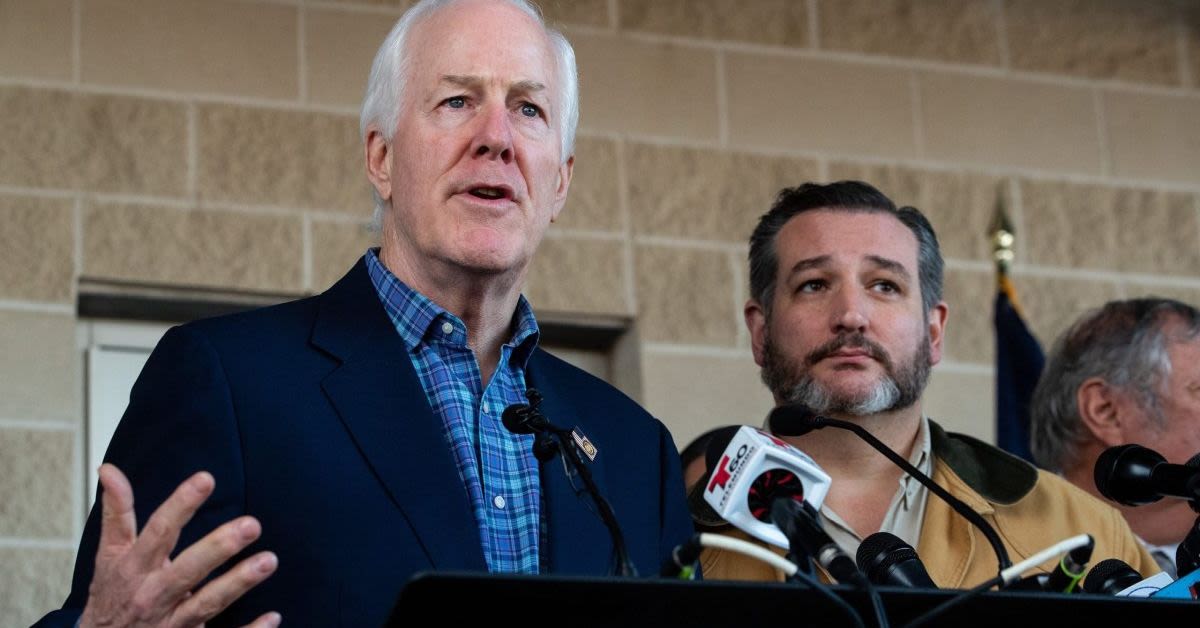
Senator John Cornyn (R-TX) has aligned himself with local officials and Democrat State Representative James Talarico (D-Austin) in opposing key border security infrastructure planned for Big Bend National Park, despite mounting concerns over illegal crossings and cartel activity along the southern border.
As reported by Breitbart, Cornyn outlined his objections in an August 7 letter to Department of Homeland Security Secretary Markwayne Mullin, arguing that the rugged landscape in the Big Bend region already serves as a natural barrier that limits large-scale movements. The senator urged Mullin to meet with local stakeholders, reconsider the scope of the projects, and halt construction until their concerns are fully addressed, effectively placing environmental and local political pressure ahead of the broader national security imperative.
Cornyns move drew immediate praise from Democrat Senate hopeful James Talarico, who is seeking to unseat Senator Ted Cruz in 2026 and has made opposition to the Big Bend project a centerpiece of his campaign. Talarico quickly posted on social media, declaring, I applaud Senator Cornyn for taking action on this corrupt Big Bend Border Wall. He and I agree: we need to secure our border by listening to local sheriffs and Border Patrol. But this monument to corruption represents wasteful, irresponsible government spending that no Texan asked for, enriching wealthy contractors without making Texans one bit safer.
In his letter, Cornyn cited a coalition of Texas border sheriffs and county judges, private landowners, and Big Bend Park advocates who have raised objections to the planned infrastructure. Their concerns, while framed as local stewardship and fiscal prudence, dovetail neatly with the Biden administrations broader pattern of scaling back or slow-walking physical border barriers in favor of less intrusive measures that have repeatedly failed to stem the flow of illegal immigration.
Talarico has aggressively capitalized on this sentiment, staging a Commonsense Border Security press event in June in Sanderson, Texas, as part of a Frontera Tour that took him to several border communities. The event was designed to project an image of bipartisan unity against the Big Bend projects, even as the Biden administration faces criticism for record numbers of illegal crossings and a porous border that strains local resources and undermines national sovereignty.
At the Sanderson event, Talarico appeared alongside a slate of mostly Democrat local and state officials, including several sheriffs from Texas border counties. Among them was Terrell County Sheriff Thaddeus Cleveland, a Republican and former U.S. Border Patrol agent, who has publicly opposed the Customs and Border Protection (CBP) projects in the region, arguing that the harsh terrain itself serves as a natural deterrent and that technology, rather than new barriers, should be the preferred solution.
Talaricos campaign quickly seized on Clevelands presence to claim cross-party validation for its stance, posting a message on social media that read, Republican border sheriff endorses James Talaricos commonsense border security plan. That framing allowed Talarico to present his opposition to physical infrastructure as commonsense, even though conservatives have long argued that technology alone is insufficient without a robust physical barrier and strong enforcement policies.
CBP, for its part, has emphasized that recent movement of heavy equipment inside Big Bend National Park is focused on repairing storm-damaged roads and conducting surveys, not erecting a towering wall through the park. Officials say some brush is being cleared to support future phases of construction that explicitly do not include a 30-foot border wall within the parks boundaries, undercutting claims that the project is a massive, intrusive structure.
According to CBP, the planned work in Brewster County will include 17 miles of a vehicle barrier system consisting of steel posts and rails, along with a roadway to block vehicles from moving away from the border. This type of barrier is aimed primarily at stopping drug and human smuggling vehicles, a key component of border enforcement that conservatives generally support as a basic function of national defense and law and order.
The broader project also calls for the construction, improvement, and maintenance of roughly 205 miles of 24-foot-wide patrol roads to help Border Patrol agents navigate the remote and treacherous terrain. In addition, CBP plans to install lighting, surveillance cameras, and underground fiber-optic cabling, integrating physical infrastructure with technology in a way that many border security advocates have long argued is necessary for an effective layered defense.
In a June media release, CBP noted that the DHS Secretary had invoked authority granted under the Illegal Immigration Reform and Immigrant Responsibility Act (IIRIRA) of 1996 to issue an environmental waiver for the project. At the same time, the agency pledged that DHS remains committed to responsible stewardship of natural and cultural resources within the project footprint, a nod to environmental concerns that often serve as a pretext for delaying or blocking border barriers.
CBP acknowledges that the Big Bend Sector historically records fewer illegal crossings than other parts of the southwest border, but the numbers are not trivial. The sector saw more than 11,800 arrests in 2023 at its peak, and since October, Border Patrol agents have apprehended more than 1,500 illegal border crossers in the area, underscoring that even so-called natural barriers are far from impenetrable to determined smugglers and migrants.
The infrastructure projects are funded through the One Big Beautiful Bill, which allocated $46.5 billion to complete border infrastructure, including primary wall segments and smart border technology. That investment reflects a long-standing conservative priority: using federal resources to secure the nations borders, protect American communities, and uphold the rule of law, even as some Republicans now appear willing to side with Democrats and environmental activists to scale back or stall those efforts in politically sensitive regions like Big Bend.
Login