
For generations, Americans have repeated the same half-humorous, half-earnest lament: Where are the flying cars we were promised?.
That familiar question, rooted in the futuristic optimism of the mid-20th century, traces back to cultural touchstones like The Jetsons, the 1962 cartoon that imagined George, his boy, Elroy, daughter Judy, and Jane, his wife zipping through the sky in family-sized spacecraft. According to RedState, while much of that shows once-fantastical technology has quietly become mundane reality from video calls to household robots that vacuum and mow the flying car has stubbornly remained in the realm of science fiction.
That may be about to change, and not in California or New York, but in a state that has made a point of embracing innovation without surrendering to bureaucratic paralysis. Florida Governor Ron DeSantis (R) announced that the Sunshine State will begin actively testing electric flying cars technically known as eVTOLs, or electric Vertical Take-Off and Landing aircraft by the end of the year.
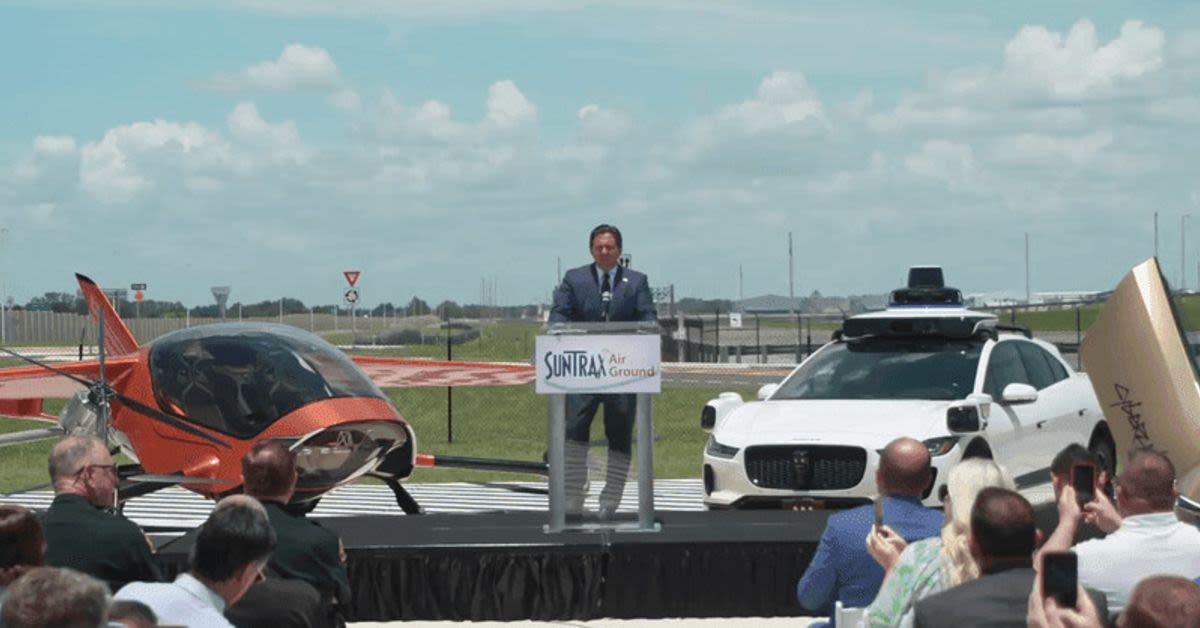
Standing at the states SunTrax testing facility, DeSantis cast the initiative as a deliberate step toward turning a long-running sci-fi fantasy into a concrete transportation project. I cant promise well ever be able to take you to the future, to the past, he told reporters, nodding to the Back to the Future franchise, But I think were going to be able to get you up in the air at some point in the not too distant future.
The governor emphasized that this is not mere blue-sky talk; Florida has already constructed vertiports and is preparing aircraft to operate without the need for traditional runways. He announced on social media that the state would begin actively testing the aircraft by years end, underscoring Floridas intent to lead rather than follow in next-generation mobility.
At the same SunTrax facility, DeSantis also showcased Floridas broader push into autonomous ground transportation, highlighting a Waymo Jaguar and a Tesla Cybercab. He noted that some of these vehicles are being developed without steering wheels or pedals, a sign that the state is willing to accommodate disruptive technologies that many regulators elsewhere are still trying to slow-walk.
Were the only high-speed autonomous vehicle test track in the United States, he bragged, framing Florida as a national outlier in its willingness to pair infrastructure with innovation. For conservatives who favor limited but effective government, the message was clear: the states role is to clear the path, not to micromanage the journey.
Florida Department of Transportation Secretary Jared Perdue underscored the historic nature of what the state is attempting with eVTOLs. When is the last time we, as civilization, got to usher in a new way to move people? he asked. Weve improved the automobile with autonomy, and now were entering the age of flying cars.
Perdue went further, explicitly tying the moment back to the pop-culture vision that helped inspire it. Florida transportation officials say the state is preparing to enter a new era as flying cars are expected to begin testing in Floridas airspace by the end of the year, and the FDOT chief declared, What you saw in the Jetsons is becoming a reality.
These flying cars are compact electric aircraft that lift off and land vertically like helicopters, eliminating the need for runways and allowing them to operate in dense urban environments. Once airborne, they transition to forward flight, functioning as quiet air taxis designed to carry a small number of passengers over short-to-medium distances.
The promise is straightforward: a cleaner, quieter, and more efficient alternative to grinding ground traffic in congested corridors. They are envisioned as a market-driven solution to gridlock, not a top-down mass transit scheme, aligning neatly with a conservative preference for private-sector innovation over government-run megaprojects.
And they are absolutely wild. The obvious question for Floridians is whether these electric air taxis could one day ease the daily misery of routes like I-4, or whether the current effort is primarily an impressive proof of concept that paves the way for future commercial adoption.
Either way, Florida is clearly moving faster than most states to transform a Jetsons-era promise into something tangible, signaling that the state intends to compete for the jobs and investment that come with being an early adopter. While some may still be waiting for those whimsical dress-o-matic machines that get you fully dressed and ready for work in the morning, or throw back on your pajamas when its time to retire, the states leadership appears content to start with a more practical dream.
But flying cars are pretty cool too, and in Florida, they may soon be more than just a punchline to an old question.
Login