
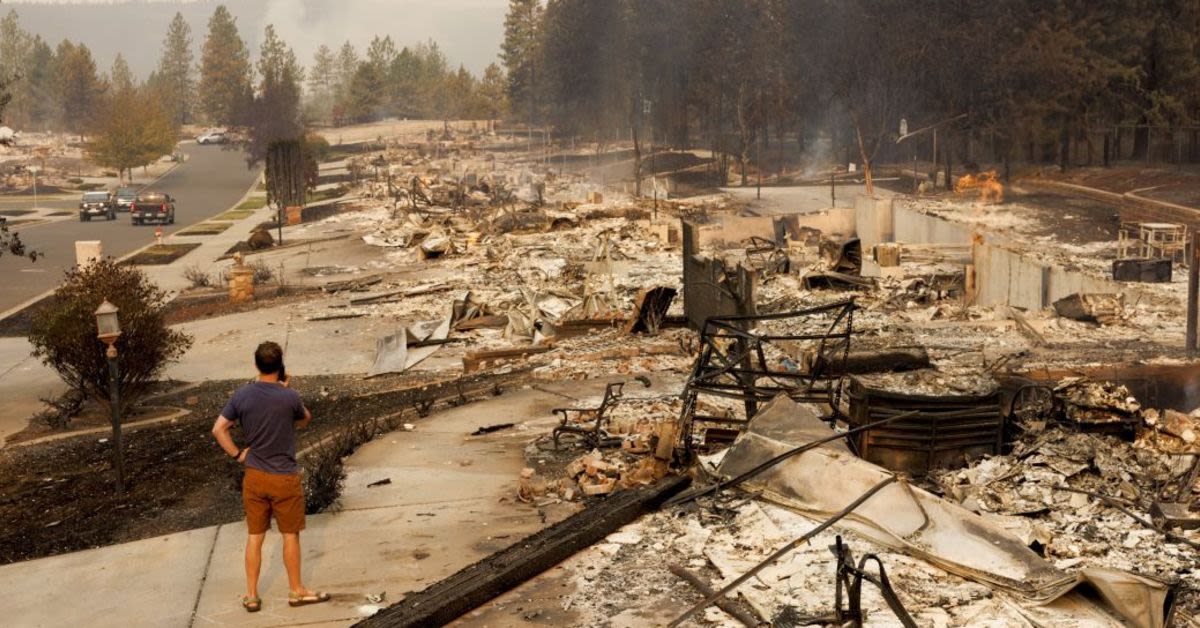
The man accused of sparking one of Spokane Countys most destructive wildfires in recent memory allegedly spent weeks methodically planning the blaze and has now reportedly admitted to setting dozens of other fires across the region.
According to The Post Millennial, newly released court documents paint a chilling portrait of 37-year-old convicted killer Aaron Forrest Farinacci, who is accused of deliberately igniting the Old Trails Fire and then calmly watching it grow into a catastrophe. The records, obtained by The Ari Hoffman Show on Talk Radio 570 KVI, state that Farinacci told Spokane County Sheriffs detectives he began planning the Old Trails Fire roughly two weeks before it erupted, even going so far as to study weather forecasts in search of a day with high winds, low humidity, sort of high heat.
Prosecutors now allege that this was not an impulsive act, but a calculated operation carried out by a man who understood both the science of fire and the vulnerabilities of a community already on edge from extreme conditions.
Investigators say Farinacci was fully aware that Spokane County was under a Red Flag warning and a PDS, or Particularly Dangerous Situation, advisory in the hours leading up to the blaze. According to the affidavit, he admitted that from his own observations he knew the conditions were ideal to start a fire and let the fire take its course. Detectives contend that this was not a case of a careless camper or an accidental spark, but of a suspect who deliberately sought out the very circumstances that state leaders would later blame on climate change to justify their broader political narrative.
The court documents allege that Farinacci told investigators the day was planned out, the weather was planned out and that he anticipated strong winds. The affidavit further claims he researched notorious serial arsonist John Leonard Orr and purchased materials to construct a time delay device designed to ignite a wildfire using notebook paper, matches, a cigarette and a rubber band. Authorities say this level of preparation underscores a disturbing level of intent, raising serious questions about how a man with his history was free to roam the community at all.
Investigators say Farinacci considered several potential ignition points before settling on an area near West Euclid and Old Trails roads. The location, they allege, was not chosen at random but selected because of the terrain, vegetation and wind patterns that would help the fire spread rapidly. Detectives argue that the suspects familiarity with the area and his apparent understanding of how fire behaves in such conditions made the outcome tragically predictable.
On the morning of August 1, Farinacci allegedly left his apartment early, timing his movements around his expectation that winds would increase around 11 am or noon, reaching roughly 15 miles per hour. He reportedly walked along the railroad tracks, visiting two locations without starting a fire before ultimately choosing a spot that investigators later determined was less than 320 feet from the blazes actual point of origin. Authorities say this sequence of events shows a man actively hunting for the most destructive opportunity, not someone acting on a fleeting impulse.
According to the affidavit, Farinacci allegedly told detectives he chose the final location because he knew it was gonna get bad. Investigators said the area featured grass leading into young trees and then larger trees, with the wind blowing in the same direction the fire would ultimately travel. They allege that Farinacci assembled his delayed ignition device, lit the cigarette that would trigger it, placed the device in the grass near a fence and then fled along the railroad tracks, periodically glancing back at the growing plume of smoke.
Farinacci reportedly claimed he did not intend for the fire to become as large as it did, despite the fact that he allegedly selected the site precisely because he believed it would get bad. The Old Trails Fire went on to become one of three catastrophic wildfires in the Spokane area, destroying hundreds of structures and forcing tens of thousands of residents to evacuate their homes. For many families, the devastation was not an abstract climate event but the direct result of a human decisionone that, if the allegations are true, was carefully and coldly premeditated.
According to the affidavit, Farinacci acknowledged that he knew law enforcement would likely be looking for suspects walking along the railroad tracks after the fire started. Investigators say he had even devised a plan that, if confronted by officers, he would pull a knife from his backpack and attempt to provoke police into shooting him. Instead, the affidavit states, Farinacci abandoned that plan and decided to feign innocence, a strategy he allegedly employed when first contacted by authorities.
An Airway Heights police officer encountered Farinacci roughly 1.5 miles from the fires origin point, questioned him, collected his identifying information and then released him. Detectives continued to investigate in the days that followed, ultimately gathering enough evidence to arrest him on suspicion of arson. The initial encounter, now under scrutiny, illustrates the difficulty law enforcement faces when dealing with suspects who are willing to lie, manipulate and exploit procedural caution.
The affidavit also details what investigators describe as Farinaccis longstanding fascination with fire. According to Drapeau, a detective involved in the case, Farinacci told investigators he views fire as powerful, beautiful, and believes that objects passing through it undergo a kind of rebirth. This romanticized view of destruction, authorities suggest, may have fueled his alleged pattern of setting blazes in and around his own community.
He allegedly told detectives he considered arson an easy crime to get away from if you have time. Farinacci also allegedly said he routinely carried marijuana or cigarettes so that he would have a plausible reason to possess a lighter or matches, a tactic he described as an arson alibi. For residents who lost homes, businesses and peace of mind, such statements underscore the callousness of a suspect who appears to have treated their safety as a mere variable in his personal obsession.
The Old Trails Fire, investigators now believe, may represent only a small portion of Farinaccis alleged criminal activity. According to the affidavit, he confessed to being responsible for 25 fires in the vicinity of his residence dating back to July 2025. Detectives say they have already corroborated evidence linking him to at least four of the fires he described, and they continue to examine other incidents that may fit his pattern.
Farinacci allegedly told detectives that he started his first fire on July 4, 2025, using a lighter. He also allegedly confessed to starting the Aubrey White Fire in July 2025, though the affidavit notes that he disputed certain aspects of the evidence investigators presented regarding that blaze. The Aubrey White Fire burned more than 1,200 acres in Riverside State Park and triggered evacuation orders, once again displacing families and straining local resources.
Farinacci also allegedly admitted to starting another fire two days later in west Spokane that forced residents of nearby homes and apartment complexes, including his own, to evacuate. The affidavit further alleges that he spent several days planning before igniting five fires around his Copper River Apartments complex in late July 2025. Investigators said he described using a paper towel wrapped around a rock as an ignition method for at least one of those fires, a crude but effective device that again suggests premeditation rather than accident.
On Thursday, prosecutors requested four additional counts of first-degree arson and signaled that more charges could follow as they work to determine the full extent of Farinaccis alleged actions. A Spokane County judge raised his bond to $2 million and reviewed the conditions that would apply if he were ever released from custody. The judge also granted a request from Farinaccis attorney for a competency evaluation, reopening questions about his mental state that have followed him for more than a decade.
Farinacci previously underwent competency proceedings after killing his father in Arizona more than 15 years ago. In 2010, when he was 21, Farinacci fatally shot his father, Jeffrey Farinacci, after an argument at their Mesa home that police said began when the younger Farinacci refused to do the dishes. The case, which at the time raised alarms about mental health and violent behavior, now appears in a darker light as communities in two states grapple with the consequences of his alleged actions.
According to Mesa police, Farinacci entered his parents bedroom, locked the door and retrieved his fathers handgun from a nightstand. When his father entered the room, police alleged, Farinacci shot him twice. Investigators said he then pointed the firearm at his mother when she rushed in after hearing the gunshots, forcing her to flee and call police as her husband lay mortally wounded.
Jeffrey Farinacci was transported to a hospital, where he later died from his injuries. Aaron Farinacci was found several blocks away suffering from what police described as a self-inflicted gunshot wound to the chest, an apparent suicide attempt that he survived. The Arizona case set in motion a series of legal and psychiatric evaluations that, critics may now argue, failed to protect the public from a man with a demonstrated capacity for lethal violence.
Maricopa County prosecutors initially charged Farinacci with first-degree murder and aggravated assault. His court docket shows that the defense later requested a Rule 11 mental health evaluation, leading to the appointment of experts and subsequent competency proceedings. The docket ultimately recorded Farinacci as competent to proceed, clearing the way for a negotiated resolution rather than a full trial on the original charges.
The case was eventually resolved through a plea agreement. In 2012, Farinacci pleaded guilty to a reduced charge of manslaughter, a Class 2 felony, and separately pleaded guilty to aggravated assault, a Class 3 felony. He was sentenced to prison followed by probation and served roughly a decade behind bars, with court records indicating he remained under supervision until he received an Order of Discharge of Probation in January 2024.
The timing is now impossible to ignore: within roughly a year of being fully discharged from supervision, Farinacci stands accused of orchestrating a campaign of arson that terrorized Spokane County. For many observers, this sequence raises hard questions about lenient plea deals, early releases and a criminal justice system that too often prioritizes the offenders rehabilitation over the publics safety. When a man with a known history of deadly violence is allowed back into society and then allegedly sets fires that destroy homes and livelihoods, the cost of those policy choices becomes painfully clear.
The allegations and confessions also cast a harsh light on the political rush to blame climate change for every wildfire, regardless of evidence. Former Washington Governor Jay Inslee publicly claimed that climate change caused the Spokane fires while the inferno was still raging and before any alleged arsonist had been identified. After Farinaccis arrest, Inslee did not retreat from that narrative but instead doubled down, writing, When you hear suspected arson, its easy to think, that wildfire has nothing to do with climate change.
Inslee continued, While severe drought, low snowpack, and heat didnt ignite this firethey are why its so big, destructive, and fast. Yet investigators allege that Farinacci deliberately sought out the very dangerous weather conditions Inslee cited, using them as a tool to maximize destruction rather than as an unavoidable act of nature. For residents who watched their homes burn, the distinction matters: the fire did not spontaneously erupt from a warming planet, but, if the charges are proven, from the deliberate actions of a man who exploited those conditions.
This case underscores a reality that many on the left are reluctant to acknowledge: human agency, criminal intent and policy failures often play a far greater role in modern disasters than abstract climate models. When a convicted killer is released, allowed to wander free and allegedly sets fire after fire while politicians rush to microphones to blame climate change, the priorities of the governing class come into sharp focus.
Spokanes suffering families are not statistics in a climate talking point; they are victims of a system that failed to restrain a dangerous individual and of leaders more eager to advance an agenda than to confront the hard truths about crime, punishment and public safety.
Login