
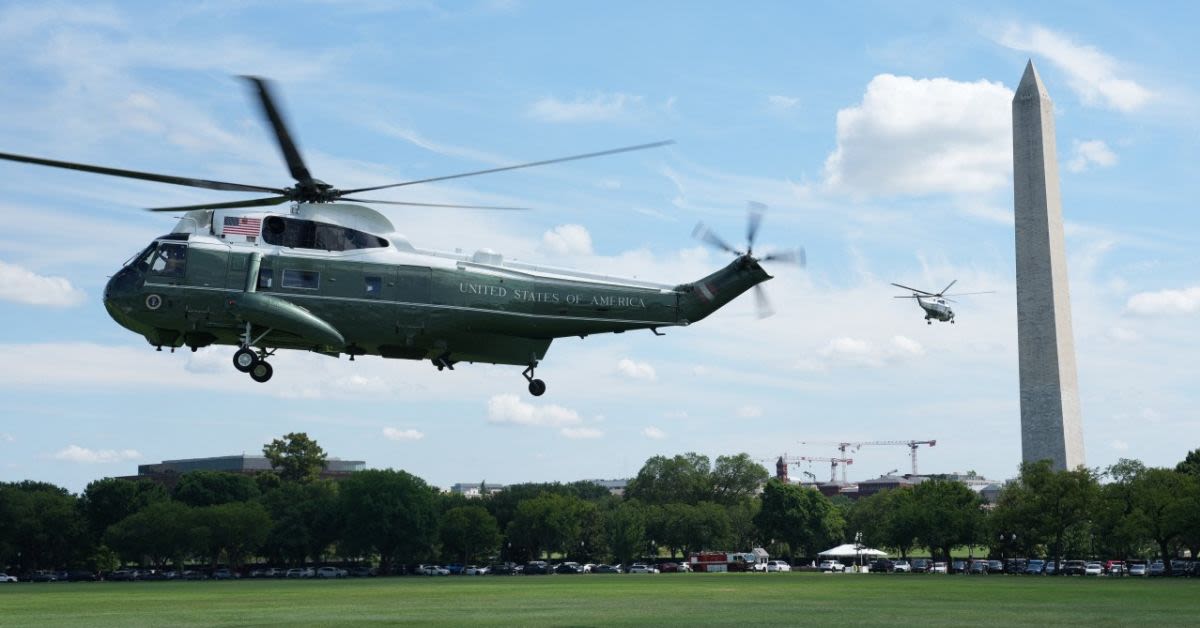
The Federal Aviation Administration has opened a probe into a serious air-traffic safety lapse involving Marine One while President Trump was aboard the presidential helicopter departing the White House for Joint Base Andrews.
As reported by the Gateway Pundit, the incident occurred Tuesday afternoon when Marine One lifted off from the Ellipse en route to Andrews for a trip to Southern California, yet standard safety protocols at Ronald Reagan Washington National Airport were apparently not followed. The presidents Marine One helicopter took off from the White House Tuesday afternoon, but air-traffic controllers hadnt halted commercial flights at nearby Ronald Reagan Washington National Airport as required under safety protocols, people familiar with the matter said, The Wall Street Journal reported.
According to Reuters, Trumps helicopter lifted off from the Ellipse near the White House around 2:33 p.m. (1833 GMT), on his way to Joint Base Andrews for a trip to Los Angeles, according to a pool report. A source further told Reuters that Envoy Air 3742, a regional E170 jet bound for Pensacola, Florida departed at 2:34 p.m. and was involved in the apparent loss of separation incident with Marine One, noting that Envoy is a wholly owned subsidiary of American Airlines, which did not immediately comment.
Federal rules mandate that aircraft maintain at least 1.5 miles of horizontal and 500 feet of vertical separation in the vicinity of airports, a buffer designed to protect passengers and, in this case, the Commander-in-Chief. The sources told Reuters it appeared Marine One and the plane did not maintain separation, though one source added it appears they were not converging during the incident.
Video circulating online shows Marine One flying over East Potomac Park with a commercial airliner visible nearby, underscoring how narrow the margin for error may have been. A wider-angle recording of the episode further illustrates the proximity between the presidential helicopter and civilian air traffic in one of the nations most sensitive air corridors.
Even more troubling, audio from the air traffic control frequency suggests Marine Ones crew was actively trying to ensure proper coordination before departure. Per 7 News DC: Air traffic control audio captures multiple attempts by Marine Ones crew to contact the control tower before departure, with repeated calls stating the presidential helicopter was three minutes to lift.
For a country that rightly expects robust protection of its president and strict adherence to aviation protocols, the notion that Marine One could be placed in an apparent loss of separation with a commercial jet raises serious questions about competence and accountability within the federal bureaucracy. As the FAA investigation proceeds, many Americans will be watching closely to see whether this near miss is treated as a wake-up call to tighten enforcement of existing rules, or simply brushed aside by the same regulatory establishment that too often escapes meaningful scrutiny.
Login