
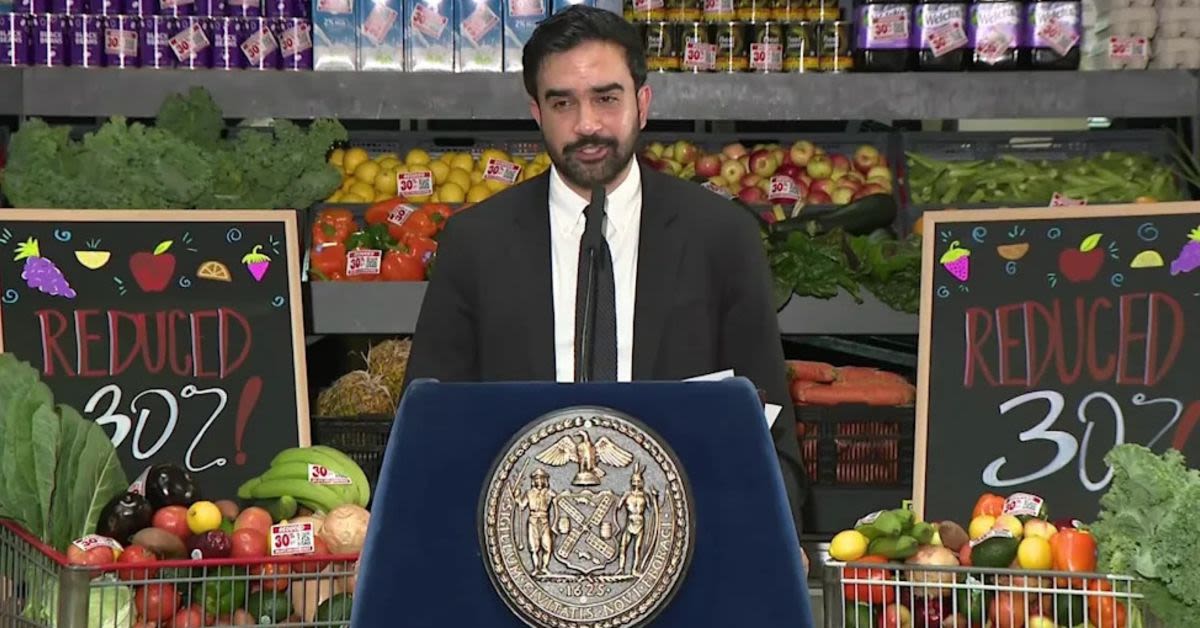
New York Citys latest experiment in progressive governance is a taxpayer-funded foray into government-owned grocery stores that looks less like innovation and more like a rerun of failed socialist projects abroad.
According to RedState, Mayor Zohran Mamdani has unveiled a plan that would place City Hall directly into the supermarket business, promising New Yorkers steep discounts on basic staples if they are willing to shop at municipally owned outlets. The proposal, pitched as a bold response to high food prices, would see the city open five public grocery stores where New Yorkers will soon enjoy a 30 percent discount on their meat, seafood, milk, and bread so long as they shop at a city-owned store.
Under this scheme, the city would own the supermarkets and dictate its pricing and labor practices, while private grocery companies would handle the day-to-day operations.
At a press conference promoting the initiative, Mamdani boasted of the bargain-basement prices and the supposed relief they would bring to struggling families, even as critics immediately noted the obvious: when the government fixes prices below market levels, someone eventually pays the bill. The mayors office promoted the plan with the promise that Prices set at 30% below retail prices, a soundbite tailor-made for social media and for those who believe that economic laws can be suspended by political decree.
For anyone with even a passing familiarity with 20th-century history, the concept of government-run grocery stores is not new, nor is it reassuring. As commentators have noted, if you're like Marty McFly and you're saying I've seen this one, this is classic! that's because government-run stores used to be a thing. They were, of course, a hallmark of the Soviet Union, where central planners attempted to manage every aspect of production and distribution, with predictably disastrous results.
The contrast between American abundance and socialist scarcity was seared into Cold War memory when Soviet Premier Nikita Khrushchev toured a U.S. supermarket in 1959. Nikita Khrushchev regards a cantaloupe in a San Francisco supermarket in 1959, one famous caption recalls, capturing his astonishment at the sheer variety and quality of goods available to ordinary Americans. That moment was so emblematic that a few years later, this scene was recreated when Soviet cosmonaut Gherman Titov toured a San Francisco Safeway, again underscoring the chasm between free-market prosperity and state-controlled deprivation.
The reason those visits were so striking is simple: communist-run grocery stores were nearly barren of basic foodstuffs due to the inability of the state planners to manage supply and demand. Shelves were empty, lines were long, and corruption flourished as people scrambled to secure basic necessities in a system that punished initiative and ignored price signals. The Soviet experience was not an aberration but a predictable outcome of a model that subordinates markets to ideology and replaces competition with bureaucracy.
Mamdanis proposal, dressed up as a compassionate response to inflation, walks down the same well-trodden path that has historically led to shortages and the destruction of private enterprise. As critics have warned, while Mamdani's grocery gimmick might seem good on paper (if you are historically illiterate), it will drive out small grocery stores and bodegas, thereby crowding out businesses. Once the government uses taxpayer money to undercut private competitors, the mom-and-pop shops and neighborhood bodegas that define so many New York communities will find it impossible to compete.
The likely result is not just fewer private options but the familiar hallmarks of socialist mismanagement: It will also lead to food shortages and bread lines. This is what happened in Hugo Chavez's Venezuela. That Latin American cautionary tale is not theoretical; it is a recent and painful example of how state-run food systems unravel when ideology trumps economics.
In 2003, when Venezuela's socialist president, Hugo Chvez, created a nationwide network of government-run grocery stores called Mercal in 2003, he faced the same conundrum of how to control excess demand when prices are set artificially low. Initially, the program appeared to succeed, and at first, Mercal seemed to work. It quickly became one of Chvez's most popular social programs. [...] The political benefits were immediate, as cheap food bought short-term loyalty, but the underlying distortions were already taking root.
The artificially low prices created a thriving black market and rampant corruption, as opportunists exploited the gap between subsidized and market rates. The gap between Mercal's subsidized prices and prices at other grocery stores created an obvious resale opportunity. There were complaints of diverted goods, fictitious purchases, store clerks allowing their friends and relatives to jump the line, and corruption in procurement and distribution. The dysfunction spread beyond Venezuelas borders as hauling food across the border to resell at market prices in Colombia became a booming industry. Black-market reselling even spawned a new profession: .
Rather than admit the failure of central planning, the Venezuelan government responded with even more control and surveillance. The government responded to the shortages with tighter controls. It capped purchases, assigned shoppers a weekday based on the final digit of their national ID number, and registered sales by ID and fingerprint. In a chilling illustration of how quickly rights become rationed privileges under socialism, some stores required shoppers to bring a baby or present a birth certificate before they could buy diapers.
To be sure, Mercal alone did not cause Venezuela's food shortages. It operated inside a larger system of national price and exchange controls, subsidized imports, expropriations, precarious property rights, monetary financing of government deficits, and declining oil production. Yet Mercal was emblematic of the broader socialist project: a state that promises cradle-to-grave security while steadily eroding economic freedom, property rights, and basic competence. The end result was not equity or dignity but hunger, dependency, and collapse.
Defenders of Mamdanis plan argue that New York is not Venezuela and that the scale and context are entirely different. Thankfully, Mamdani's program is limited to New York City. As proponents note, New York's experiment is local, far more limited, and therefore, lower-stakes. Private contractors will operate the stores, while auditors, courts, reporters, and the public can scrutinize the results. Chvez, by contrast, clamped down on the free press and suppressed reporting on his failed policies. In other words, the guardrails of American institutions may mitigate the worst excesses.
Moreover, the citys food market is already dense and competitive, which could blunt the impact of five municipal stores. New Yorkers will also have plenty of alternatives. The city's five municipal stores will become part of a food retail market that includes more than 1,100 grocery stores and 10,000 bodegas. Yet even if the immediate stakes are lower, the underlying economic logicor lack thereofremains the same, and the precedent of government-owned retail is troubling.
That is why the comparison is still useful because, like Chvez, Mamdani will find that he can't escape the laws of supply and demand. No amount of progressive rhetoric can repeal the basic reality that when prices are forced below market levels, demand rises, supply falls, and someone must either absorb the losses or ration the goods. In practice, that someone is usually the taxpayer, the consumer facing shortages, or both.
Beyond the economic folly, there is a particularly glaring irony in how access to these subsidized groceries will be controlled. Now, we come to the hitch in Mamdani's program: You've got to present a government ID proving residency in order for the government to recognize your human right to grocery prices that are 30 percent below retail. In other words, the same political class that denounces voter ID laws as racist and oppressive suddenly finds identification requirements perfectly acceptable when it comes to discounted food.
Pressed on how the city would prevent abuse and limit how much any one person could purchase, Mamdani explained the mechanism in casual terms. When asked how he was going to keep people from taking advantage of the deal and putting a limit on how many groceries people could get, Mamdani said, We are looking to make sure that we target New Yorkers sort of a library card-esque thing. He reiterated the point in a clip shared widely online: We are looking to make sure that we target New Yorkers sort of a library card-esque thing.
The hypocrisy was not lost on observers, including high-profile critics of progressive policies. Elon Musk immediately replied with: Oh, the irony is too much. He underscored the absurdity again in a follow-up post: Oh, the irony is too much highlighting how the lefts supposed opposition to ID requirements evaporates when it serves a favored program.
The reason this struck such a nerve is that Democrats routinely insist that requiring identification to vote is an intolerable burden, even as IDs are demanded for countless everyday activities. As one critic put it, Why is that? Because get a load of everything the Democratic Party ignores when it comes to Americans producing IDs, yet they rabidly oppose them to vote. The same commentary noted, People dont carry crockpots either but somehow dinner still gets made. Planning ahead is not oppression. You need photo ID for: 1. Buying alcohol 2. Buying cigarettes or vapes 3. Purchasing Sudafed or restricted OTC meds 4. Renting a car 5. Driving a car 6. Boarding a
The list continues and is familiar to anyone living in modern America. You need photo ID for: 1. Buying alcohol 2. Buying cigarettes or vapes 3. Purchasing Sudafed or restricted OTC meds 4. Renting a car 5. Driving a car 6. Boarding a plane 7. Getting on Amtrak (for passengers 18+) 8. Opening a bank account 9. Cashing a check 10. Applying for a credit card 11. Renting a hotel room 12. Applying for most jobs 13. Applying for government assistance (SNAP, Medicaid, Section 8) 14. Visiting someone in jail/prison 15. Picking up a prescription 16. Entering certain office buildings, courthouses, or secure federal facilities 17. Buying a gun 18. Getting married (in most counties/states for the license) 19. Buying a house or signing a lease (for background/credit/ID checks) 20. Getting utilities turned on (in many providers) 21. Filing for unemployment or disability 22. Donating blood (age/verification) 23. Attending 18+/21+ events or some concerts 24. Replacing a Social Security card.
Yet Blue State Democrats don't oppose voter IDs but require them on everything from getting into the DNC to collecting food stamps because they lack intellectual consistency. The more plausible explanation, as conservatives have long argued, is not confusion but calculation. They oppose voter IDs because they are exploiting America's broken election system. There, I said it.
Progressives respond with moral outrage whenever this is pointed out, insisting that voting is uniquely sacrosanct. Why, that's far too harsh there, right-winger! That's because voting is a right and those other things are, uh, not rights! But this rhetorical move collapses under the weight of their own expansive rights agenda, which increasingly treats every material need as a government-guaranteed entitlement.
That raises an obvious question: What about the human rights to food and housing and healthcare and all of those other socialist demands (that can't actually be rights if it mandates that other human beings expend their labor to provide them)? If food is a human right, as the left often claims, why is it acceptable to condition access to discounted groceries on producing government identification, while demanding ID to protect the integrity of elections is denounced as bigotry?
The broader socialist project, after all, is framed in the language of rights and liberation. Isn't the entire socialist program about human rights (entitlements, actually) being given to people by the state (i.e., by forcing people to provide them)? Stripped of its lofty rhetoric, this model depends on coercion: the state compels some citizens to fund or provide goods and services for others, while politicians reap the political rewards.
That is why socialism isn't about liberation. It's a scheme to enslave people by promising them free stuff that isn't actually free. The promise of subsidized groceries, like free healthcare or free housing, is ultimately a promise that someone else will be forced to pay, and that bureaucrats will decide who gets what, when, and on what terms. Dependence replaces responsibility, and political loyalty becomes the currency of survival.
Mamdani's subsidized grocery stores are yet the latest version of that socialist scheme. And it will fail for exactly the same reasons the others did. Whether the failure comes in the form of wasted tax dollars, shuttered private businesses, creeping rationing, or yet another expansion of the surveillance state through ID-based access, the pattern is familiar. New Yorkers, and Americans more broadly, would do well to remember that every time government crowds out the free market in the name of rights, it chips away at the very freedoms and prosperity that made this country a place where even a Soviet premier could marvel at a simple cantaloupe in a supermarket aisle.
Login