
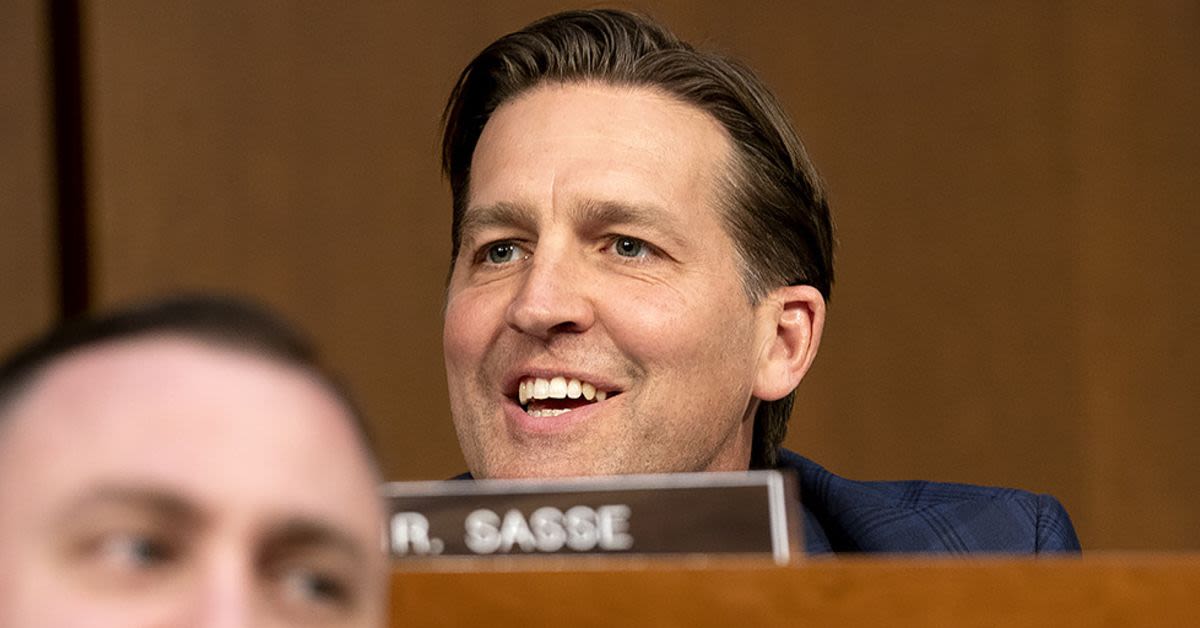
Facing down Stage 4 pancreatic cancer, former Nebraska Sen. Ben Sasse says his own prognosis has brightened even as his outlook for the country grows more grim.
In a pre-recorded interview for the Western Conservative Summit in Lakewood, Colorado, Sasse warned that the United States has not yet encountered its most serious tests, even as he expressed gratitude for the time he has been given. According to Fox News, the conversation recorded on the campus of Colorado Christian University and shared exclusively with Fox News Digital ranged from his battle with cancer to the geopolitical struggle with China, the collapse of American education and the disruptive force of artificial intelligence.
"Pancreatic cancer is nasty, and I would never wish it on my worst enemy, but I also would never want to go back to a stage of my life where I didn't know the power of pancreatic cancer prayer," said Sasse, quoting Pastor Tim Keller of Redeemer Presbyterian Church in New York. The 54-year-old former senator revealed in December 2025 that he has metastatic pancreatic cancer that has spread to multiple organs, including his liver and lungs.
Doctors initially gave Sasse just three to four months to live, a death sentence he has so far defied through an aggressive experimental treatment. He entered a clinical trial for daraxonrasib, an oral therapy designed to block a defective gene that drives uncontrolled cell growth, a cutting-edge approach that underscores the promise of private-sector innovation in medicine.
"My tumors have shrunk by over 80% in the six and a half months I've been on this drug," Sasse reported in his update. "The drug has been amazing, and I'm grateful for that common grace extension of time."
"We're a couple days away from being seven months since my diagnosis at three to four months to live." That reprieve, he suggested, has sharpened his sense of urgency about the direction of the nation his generation will leave behind.
Even as he reflected on his own mortality, Sasse said he is increasingly alarmed about the country's trajectory, arguing that the United States must decisively outcompete communist China, repair its failing schools and prepare for an AI-driven economy. "I want the U.S. Via decentralized corporate structures to rule the world, not CCP, tyrannical, Maoist to rule of the world, and I think most middle powers, most countries in the world, know that somewhere between 25 years from now, we're going to say the world is Western/U.S. led," said Sasse.
He sketched a future in which American leadership is defined by free trade, the rule of law, transparency and respect for human rights principles long championed by conservatives as the foundation of a stable world order. The alternative, he warned, is a globe dominated by Beijings centralized, authoritarian model.
The alternative would be "CCP led," said Sasse. "Which is them controlling all trade through Beijing."
From the Western Conservative Summit, where activists and thinkers gathered to promote limited government and traditional values, Sasse also turned his fire on the state of American education. "Our educational systems are just a complete disaster," said Sasse.
The latest Nation's Report Card underscores his concern: roughly one in three eighth graders cannot read at even a basic level, nearly 40% fall below basic in math, and fewer than one-third are proficient in reading, according to the National Assessment Governing Board report for 2025. For Sasse, those numbers are an indictment of a system that has absorbed ever-increasing taxpayer dollars while producing ever-worse results.
Sasse argued that academic benchmarks are far too low and that more government spending has failed to lift student performance, a critique that echoes long-standing conservative skepticism of federal education bureaucracy. "The potential and the capacity of most souls and most brains is a lot more than that, and we've just got a disastrous system," said Sasse.
He said the rapid rise of artificial intelligence will "externalize a lot of IQ" and fundamentally alter what schools should be teaching, making the current model even more obsolete. He added that America is entering an AI revolution that will upend work, education and the global balance of power, rewarding nations that embrace innovation and punishing those mired in bureaucratic stagnation.
"A hundred years from now, when we look back on our moment, we're not gonna talk about our politics very much. I think we're gonna talk about the fact that we are living through a technological revolution," said Sasse. For a conservative former senator fighting for his life, the message is stark: personal hope, national warning, and a call for the United States to reclaim its competitive edge before it is ceded to an authoritarian rival.
Login