
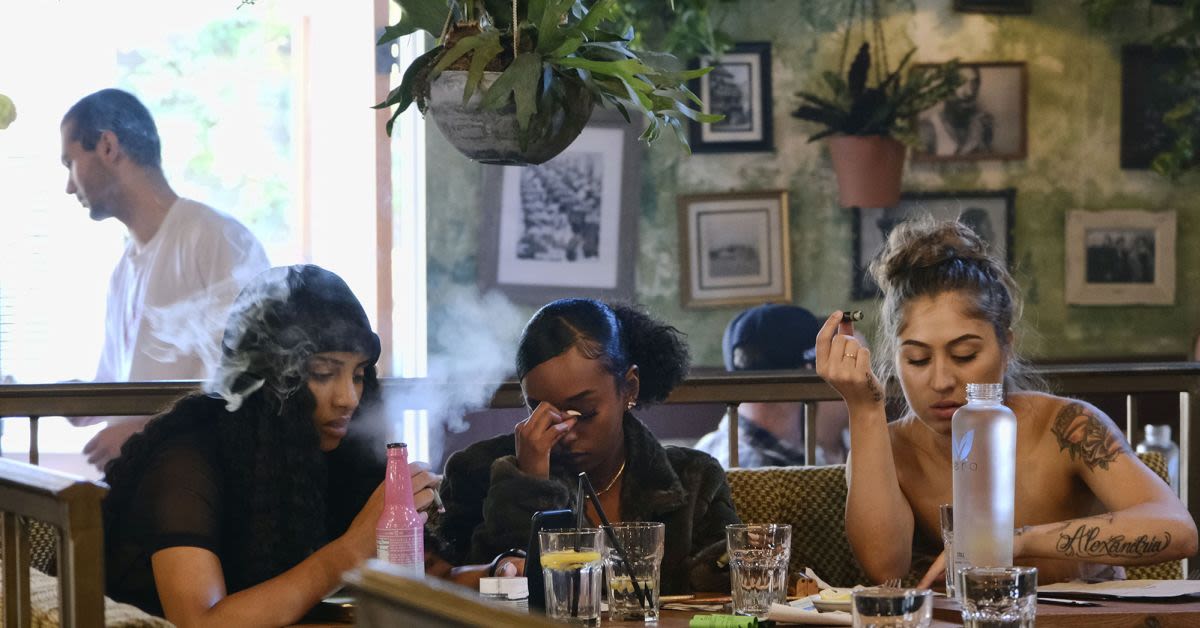
Amsterdam-style cannabis cafs are edging closer to reality in San Francisco, raising fresh questions about public health, tourism and the citys priorities as it struggles to recover economically and socially.
According to Fox News, the San Francisco Board of Supervisors voted in mid-July to let licensed cannabis retailers serve food and nonalcoholic beverages on-site, mirroring the caf-style model long associated with the Netherlands. While progressives in City Hall tout the move as an innovative economic tool, critics warn it risks normalizing drug use and further eroding public standards in a city already grappling with addiction, homelessness and crime.
Under the new ordinance, cannabis must be consumed only on the premises and cannot be taken off-site, while alcohol and tobacco are explicitly banned. Operators will be required to secure a Department of Public Health consumption permit in addition to an Office of Cannabis permit, comply with restaurant-level food safety rules and electronically verify every customers age at the door.
The measure is designed to dovetail with AB 1775, a 2024 state law signed by Democratic Gov. Gavin Newsom that authorizes cities to license cannabis cafs, as local outlet KQED reported. In a statement, Board of Supervisors President Rafael Mandelman claimed San Francisco "just gave our legal cannabis industry a real tool to compete and grow," signaling that city leaders see marijuana hospitality as a pillar of their economic strategy.
Mandelman and his allies argue that cannabis cafs could draw more visitors and help revive struggling commercial corridors hollowed out by remote work and rising crime. Mayor Daniel Lurie, a Democrat, signed the legislation on July 23, and the Office of Cannabis is slated to begin accepting caf permit applications on August 23.
For city officials, the move is being framed as a bold step toward revitalization rather than a risky social experiment. The passage of the cannabis caf legislation "marks a new initiative for the citys economic recovery and for the broader cannabis community," said Nikesh Patel, director of the San Francisco Office of Cannabis.
Patel insisted that regulators are not simply throwing open the doors without guardrails. His office "is working closely with other city departments to implement this new permit type responsibly, while maintaining core services to enforce compliance across the industry," he told Fox News Digital.
Industry advocates are already looking beyond San Francisco, hoping the model spreads statewide and beyond. Amy O'Gorman Jenkins, executive director of the California Cannabis Operators Association, told Fox News Digital she thinks other cities "can and should consider similar models," assuming San Francisco's experiment is a success.
For Jenkins and other cannabis lobbyists, the goal is to turn marijuana from a quick retail purchase into a full-fledged lifestyle experience. "The purpose of authorizing cannabis cafs was to transform a brief retail transaction into a hospitality experience," she said.
She argued that the cafs could become a magnet for tourism and spending, especially among visitors seeking novelty in a city that has struggled to maintain its once-iconic allure. "Allowing this activity in San Francisco will attract visitors and generate broader economic activity," she asserted.
Jenkins pushed back on the idea that these venues are just glorified dispensaries with seating. Cannabis cafs, she said, "are not simply dispensaries where people can stay longer."
She also pointed to provisions in AB 1775 that are supposed to shield workers from excessive secondhand smoke, a key concern for labor and health advocates. Yet not everyone is convinced those safeguards are sufficient or even enforceable in real-world conditions.
A representative from the American Lung Association told Fox News Digital that the ordinance moves San Francisco "in the wrong direction," particularly when it comes to secondhand exposure. "Permitting cannabis lounges normalizes [the] deleterious effects of smoking cannabis and exposes the adjacent properties to secondhand cannabis smoke, which contains many of the same toxic chemicals, carcinogens and fine particulate matter found in tobacco smoke," said Kesa Bruce, director of California Advocacy for the American Lung Association.
Bruce warned that the people most at risk may be the very workers progressive politicians claim to champion. "Employees working in cannabis cafs would be required to spend hours each day in an environment where they are repeatedly exposed to harmful airborne pollutants simply to do their jobs," Bruce contended.
Medical and addiction specialists are also sounding alarms about the broader cultural message being sent by normalizing high-potency marijuana in a lounge setting. "Were seeing very real mental, emotional and physical consequences in clinical settings every day."
"Theres a widespread belief that marijuana is natural and therefore harmless," Corey Gamberg, a mental health and addiction specialist who serves as executive director of the Rockland Recovery Center and Massachusetts Center for Addiction, previously told Fox News Digital. "In reality, todays products are far more potent than in previous decades, and were seeing very real mental, emotional and physical consequences in clinical settings every day."
Trent Carter, a board-certified nurse practitioner, addiction recovery expert and founder of Renew Health, an outpatient treatment center in New Mexico, has observed similar patterns among his patients. He noted that marijuana has become more socially acceptable, but that acceptance has not come without a cost.
"As time went on, I discovered that the vast majority used marijuana to treat a number of mental and physical issues, only to induce a litany of other symptoms as a result," he told Fox News Digital earlier this year. For conservatives wary of expanding drug culture, such testimony underscores the risk of turning a once-taboo substance into a centerpiece of urban nightlife.
Online reaction suggests that even in liberal San Francisco, enthusiasm is far from universal. On a local Reddit forum, some users cheered the idea, with one commenter writing, "This is sooooo needed. Cant wait," while another joked, "I'll be seeing you guys there in 10 years when the first caf finally opens!"
Others voiced concerns that echo long-standing conservative critiques about public order and quality of life. "I hope this [will] limit some public weed smoking," one person said. "Its such an anti-social behavior. Dont like getting hit with other peoples big puffs out on the street."
Another user highlighted the practical downside of turning indoor venues into smoke-filled spaces, even if they are tightly regulated. "It would be nice to have more social spaces, but the indoor smoke makes them pretty much un-attendable for more than a few minutes."
The timing of San Franciscos move is notable as cannabis increasingly intersects with global travel and tourism, often outpacing public understanding of the legal risks. Earlier this month, officials reminded Americans that bringing cannabis products across international borders remains illegal in many countries, warning travelers that even legal purchases made in the U.S. lead to steep fines or prison sentences abroad.
As San Francisco races ahead with its cannabis caf experiment, the city is effectively betting that more drug-centered hospitality will revive its economy without deepening its social crises, a wager many conservatives view with skepticism given the mounting evidence of health risks, addiction concerns and regulatory blind spots.
Login