
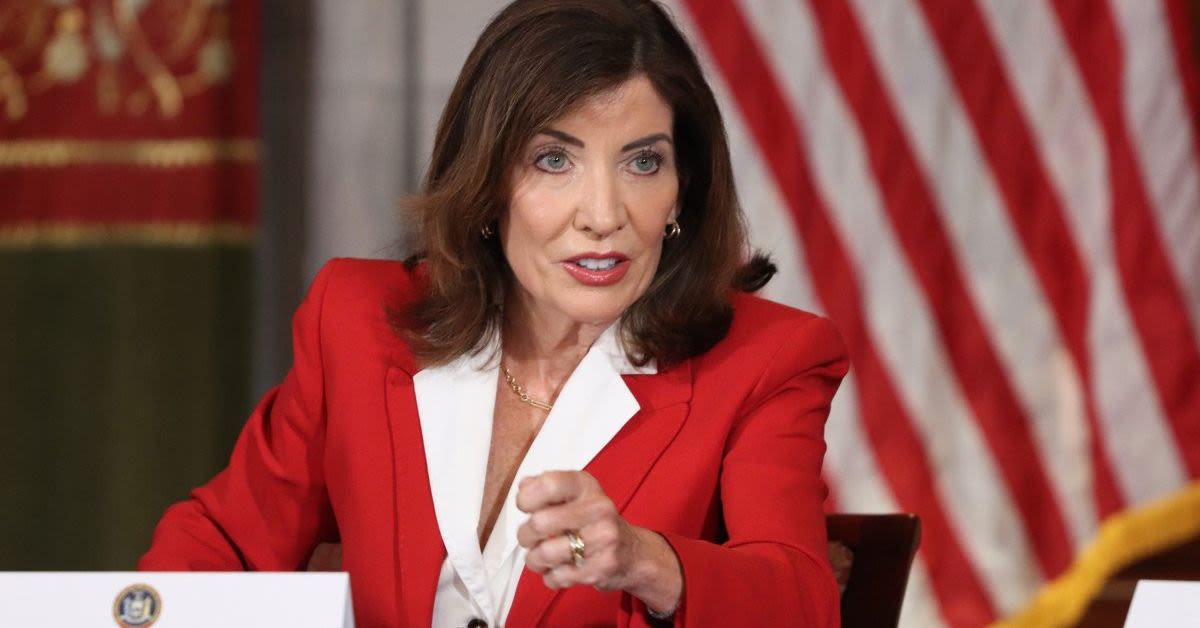
New York governor Kathy Hochuls decision to impose a yearlong statewide halt on new data-center development has ignited a fierce backlash from business leaders, national-security hawks, and labor allies who warn the move will further cripple upstate New Yorks already fragile economy and undermine Americas position in the global race for artificial intelligence dominance.
According to the Washington Free Beacon, the moratorium also places Hochul, a Democrat, on a collision course with one of the countrys most influential financiers, Citadel founder and CEO Ken Griffin, whose firm has a $6 billion development project planned in New York City. Citadel signaled in May that it may scrap that investment after New York Citys socialist lawmaker Zohran Mamdani publicly vilified Griffin, turning him into a symbol for a proposed taxation-without-representation levy on apartments owned by nonNew York residents such as Griffin.
The clash comes at a moment when the United States and Communist China are locked in a high-stakes contest over AI, advanced computing, and the broader technological infrastructure that will shape economic and military power for decades. As reported by the Washington Free Beacon, Beijing is pouring resources into its own data and AI backbone while simultaneously bankrolling information and activist campaigns designed to slow or derail Americas buildout of similar facilities.
Hochuls moratorium, framed by her administration as a pause to study the impact of hyperscale AI data centers, effectively hands China a strategic gift by stalling critical infrastructure on American soil. It is a decision that conservatives, national-security experts, and pro-growth advocates see as emblematic of a broader progressive hostility to industry, energy production, and private investment that has already driven jobs and capital out of New York.
Griffin, whose firm has been courted by multiple states eager to host high-tech and financial jobs, has been blunt about what is at stake. "We better damn well build the data centers in America because they're going to get built somewhere in the world. And can you imagine how absolutely inane it would be if we end up having to be dependent on foreign countries for data centers?" Griffin said in a Goldman Sachs podcast released July 9.
He continued with a warning that cuts to the heart of the debate over industrial policy and national resilience. "Build that damn data center in America. It would kill me if we end up having to pay a bunch of foreign countries tens or hundreds of billions of dollars of money a year."
Griffin then posed the question that many in Washington and on Wall Street believe policymakers are refusing to confront honestly. Said Griffin, "They're going to get built. Do you want them built here in America? Or do you want them built abroad? Answer that question."
In his remarks, Griffin criticized the "Not in My Backyard" mentalityNIMBYismthat has long plagued American infrastructure projects. New York under Hochul, he suggested, is drifting beyond NIMBY into what critics derisively call BANANA: Build Absolutely Nothing Anywhere Near Anyone.
That posture is not new in the Empire State, where for decades state policy has effectively blocked or strangled energy projects, driving electricity prices to some of the highest levels in the nation. Now, in a twist of circular logic, Hochul is citing those very energy costscreated in large part by Albanys own green mandates and regulatory hostilityas justification for delaying data-center construction that could anchor future economic growth.
The national-security implications of such obstruction have not gone unnoticed in Congress. The chairman of the Senate Select Committee on Intelligence, Senator Tom Cotton, Republican of Arkansas, sent a June 10, 2026, letter to acting attorney general Todd Blanche urging the Justice Department to "investigate foreign influence efforts targeting the buildout of AI infrastructure."
Cottons letter underscored the growing concern that foreign adversaries, particularly Beijing, are exploiting American environmental and activist networks to slow U.S. technological progress. "Alarming reports indicate that a network of foreign actors, led by the Chinese Communist Party (CCP), is attempting to manipulate U.S. policy and public opinion on data centers," Cotton wrote.
He stressed that the stakes extend far beyond local land-use disputes or utility bills. "Maintaining Americas AI advantage is vital to American economic strength, diplomacy, national security, and military power."
Energy policy experts say Hochuls moratorium cannot be understood in isolation from a broader pattern of anti-development decisions by New Yorks Democratic leadership. "Albany wants to talk about data centers because Albany doesn't want to talk about what actually sent electricity rates to the moon, which was largely Albany's own policies," a fellow at the Manhattan Institute, Ken Girardin, told the Washington Free Beacon.
Girardin pointed to a sweeping 2019 climate law signed by then-governor Andrew Cuomo as a turning point. He said the law "imposed renewable-energy subsidies, thwarted new power plants from coming online, and hit the electric utilities with huge costs."
Cuomos closure of the Indian Point nuclear power plant in 2021 removed a major source of carbon-free baseload power from the grid, forcing the state to rely more heavily on costlier and less reliable alternatives. At the same time, New York has slow-walked or outright blocked critical natural gas pipelines, including the Northeast Supply Enhancement pipeline and the Constitution Pipeline, both of which would have brought abundant, relatively clean gas from Pennsylvania into New York.
The Marcellus Shale formation, a vast natural-gas reservoir, stretches across the Pennsylvania border into New York, but the two states have taken radically different approaches. Pennsylvania has embraced responsible hydraulic fracturing and pipeline development, reaping jobs, lower energy costs, and tax revenue, while New York has chosen to leave its share of the resource untapped in the name of environmental virtue.
Critics argue that this is not genuine environmental stewardship but political theater that simply exports productionand emissionsacross state lines. As Girardin and others note, the gas is still being produced and burned, just in Pennsylvania rather than New York, while New Yorkers pay higher prices and watch energy-intensive industries flee.
Hochuls data-center moratorium, they say, is the latest manifestation of this pattern: a policy that sacrifices economic opportunity and strategic capability on the altar of progressive symbolism. It is a move that has even alienated some of the governors traditional allies in organized labor, who see in data centers not just servers and cooling towers but thousands of high-paying construction and maintenance jobs.
The general president of the United Association of Union Plumbers and Pipefitters, Mark McManus, issued a scathing rebuke of Hochuls decision. "A shortsighted moratorium only accomplishes one thing: it kills good-paying union jobs. Rather than implementing guardrails to build the future of American ingenuity, Governor Hochul is taking her ball and going home," McManus said.
Business and economic-development groups in upstate New York, a region that has struggled for decades with population loss and industrial decline, are equally alarmed. A pro-growth coalition, Upstate United, warned that the governors executive action sends precisely the wrong message to companies considering long-term investments in the state.
"While we understand there are some valid concerns around data center development in New York State, many stemming from the states self-inflicted power generation shortage, executive action to enforce a moratorium on the development or construction for up to one year sends mixed signals. This will not only prolong uncertainty for companies looking to New York, but ultimately jeopardize potential investment, economic development and skilled jobs," said Upstate Uniteds executive director, Justin Wilcox.
Wilcox emphasized that New York is already at a competitive disadvantage compared with states that have embraced energy production and streamlined permitting. "While states like Virginia and Texas are far more likely to be approached by possible developers, the fact of the matter is that a statewide moratorium strips away local control and a communitys ability to decide on projects that could be pivotal to their economic growth and job creation. We simply cannot claim to be a state at the forefront of AI innovation if we preemptively turn down opportunities that would help ensure that to be true," Wilcox said.
In announcing her decision, Hochul largely echoed the talking points of activist groups that have opposed data centers on environmental and quality-of-life grounds. "These hyperscale AI data centers consume enormous amounts of power truly threatening to outpace our grid's capacity and they drive up costs for local ratepayers," she said.
She added a litany of land-use and nuisance complaints that critics say could be leveled at virtually any major infrastructure project in a modern economy. "They occupy massive amounts of land, potentially displacing agricultural space and open spaces. And if you live near one, they emit vibrations and noise."
If such objections had governed earlier generations of policymakers, New York would never have built the subway system, the bridges, or the industrial base that once made it the envy of the world. Likewise, if the mere possibility of displacing farmland were disqualifying, Brooklyn and Upper Manhattan would still be pastoral fields rather than global centers of commerce and culture.
Hochul also floated the idea of creating a new mechanism to extract payments from data-center operators in exchange for permission to build and operate in the state. She framed it as a way to support the grid and local communities, but critics see it as yet another shakedown that will drive investment elsewhere.
"We're going to explore having hyperscale data centers pay into a larger fund to support our grid statewide," she said. "The bigger the data center, the bigger the investments that communities can and should expect. We also want to make sure that labor has a seat at the table so projects can include wage standards and labor agreements and prioritize local hiring."
The governor insisted that her administration remains committed to technological progress and innovation, even as she moves to stall one of the core building blocks of the digital economy. She said, maybe a little too defensively and inaccurately, "no one can accuse New York of fearing innovation."
Hochul then pivoted to the emotional climate surrounding AI, invoking public unease as a rationale for caution. She went on, "But that said, a lot of Americans for a lot of them, the specter of unchecked AI brings up fear, anxiety, a lot of worry. ... Their feelings are valid, and we cannot ignore them."
For conservatives, the episode encapsulates a broader philosophical divide over how a free society should respond to technological change and global competition. On one side are those who believe in harnessing private capital, abundant energy, and local decision-making to build the infrastructure of the future on American soil; on the other are progressive leaders who respond to every new challenge with moratoria, mandates, and new revenue schemes.
New Yorks official motto, "Excelsior," means "ever upward" in Latin, a fitting aspiration for a state that once symbolized American dynamism and opportunity. Today, under one-party Democratic rule in Albany, critics argue that the operative principle is closer to paralysis than progress, as policymakers reach reflexively for the pause button whenever growth collides with activist pressure.
Some have suggested that Hochul and the legislature might more honestly adopt "moratorium"another Latin-derived term meaning "tending to delay"as the states guiding watchword. Or, taking the governor at her own words, they note that "fear, anxiety, a lot of worry" could serve as an apt slogan for an administration that treats public apprehension not as a challenge to be overcome through leadership, but as a pretext to halt the very investments that could secure New Yorks and Americas future.
Login