
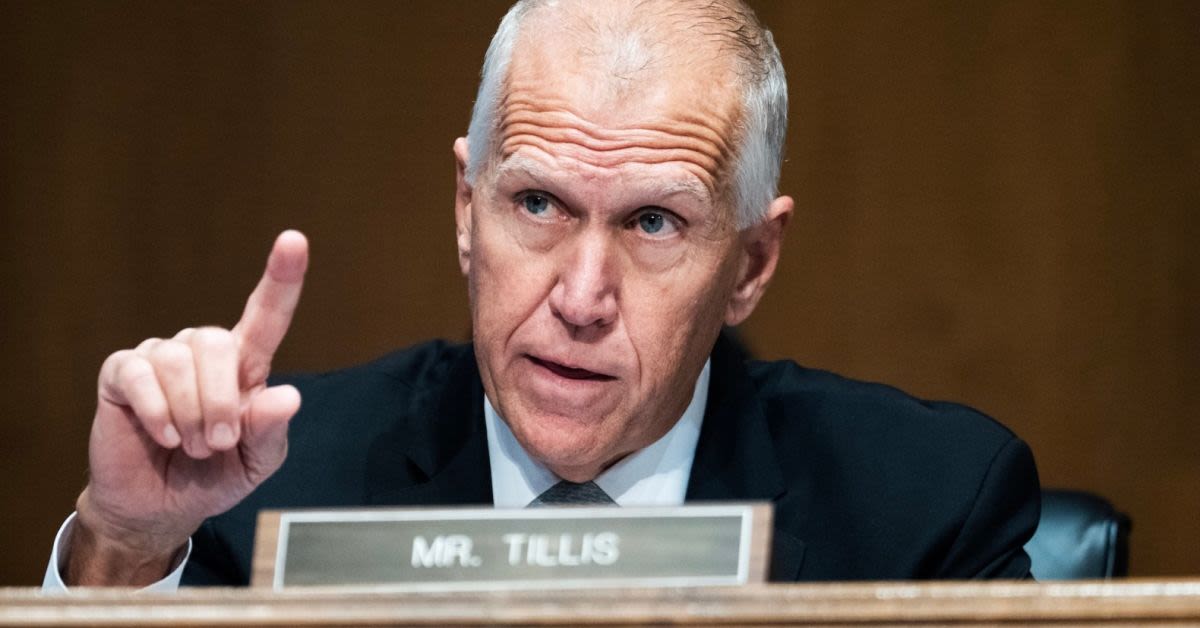
As President Donald Trump renews his push for stronger election safeguards, retiring North Carolina Sen. Thom Tillis is vowing to use every procedural weapon at his disposal to block those reforms in the Senate.
According to Western Journal, Trumps planned remarks on election integrity were previewed by White House Press Secretary Karoline Leavitt, who framed the issue as a unifying, common-sense priority rather than a partisan wedge. I think all Americans Democrat, Republican should agree that we are the greatest country in the history of the world. We should have the safest and most secure elections in the history of the world, Leavitt said, underscoring the basic expectation that the worlds leading constitutional republic should be capable of running clean, transparent elections.
And what the president will be speaking about tonight will show you that perhaps that is not the case, and we need to make some adjustments moving forward, including the SAVE America Act, she added, pointing to the Safeguard American Voter Eligibility Act as a key component of that effort.
The SAVE America Act is designed to tighten voter eligibility rules and reinforce the principle that only American citizens should decide American elections, a concept conservatives regard as foundational to self-government. Yet earlier Thursday, Tillis signaled he is prepared to obstruct that agenda, saying he will do anything necessary to prevent election reform from passing the Senate, according to The Hill.
If I see a reconciliation bill come from the House with another failed attempt to confuse this election, I will use every device I have available to slow down the wheels of government until people cop a clue and do the math, Tillis said, casting the reform effort as a disruptive intrusion into the legislative calendar. His rhetoric places him at odds not only with Trump but with grassroots conservatives who see election integrity as a non-negotiable prerequisite for public trust in government.
Tillis argued that even if the bill were to pass, it could not be implemented in time for the upcoming midterm elections in November, citing the multiple layers of government involved in administering elections. I have been trying to explain for nearly a year that the SAVE Act, whether its the SAVE Act, the SAVE America Act, the new SAVE legislation thats being proposed in the House, SAVE goes to Hollywood, SAVE goes to Hawaii, whatever the sequels are, all of them are fundamentally flawed and impossible to implement by this election, Tillis said, mocking the legislation with a series of dismissive nicknames.
The North Carolina Republican said he is open to the idea of giving states grants to support voter ID, a core conservative priority, but rejected the use of the budget reconciliation process as the vehicle for advancing the SAVE America Act. Lets stop the charade. Lets stop the distraction, he said, suggesting that election security is a sideshow rather than a central responsibility of Congress.
Lets get the government funded, lets use reconciliation if we need to, but lets not clog it up with another piece of policy airdropped by a member of this Senate or the White House that will undermine this bill, undermine what we need to get done before the election, he continued, framing the integrity measures as a threat to routine governance. Reconciliation allows budget-related bills to pass the Senate with a simple majority, and with Republicans holding a 53-47 edge, it represents the most viable path for enacting reforms over unified Democratic opposition.
As a standalone measure, however, the bill would require 60 votes to clear a filibuster, a threshold that appears out of reach with Democrats uniformly lined up against it. Their resistance has been further illuminated by a recently unearthed video of Democratic Sen. Elissa Slotkin of Michigan, who openly acknowledged the partisan stakes, according to Fox News.
It would be hard for any Democrat in any state to win any election, Slotkin said of the SAVE America Act, effectively admitting that stricter safeguards on voter eligibility would disadvantage her party. Slotkin did not explain how the proposal would do that, leaving unanswered whether Democrats fear losing access to questionable ballots or simply worry that tighter rules would expose weaknesses in their message.
Republican Rep. Tony Wied of Wisconsin seized on Slotkins candor as proof that the lefts opposition is driven by political self-interest rather than principle. Democrats are saying the quiet part out loud, he said. They know they cant win on their own merit.
For conservatives, the clash over the SAVE America Act highlights a deeper divide within the GOP between those aligned with Trumps insistence on robust election safeguards and establishment figures like Tillis who treat such reforms as an inconvenience. With Democrats openly conceding that stronger election rules would make it hard for any Democrat in any state to win any election, the debate is no longer just about process but about whether both parties are truly committed to fair contests in which citizens and only citizens decide the outcome.
Login