
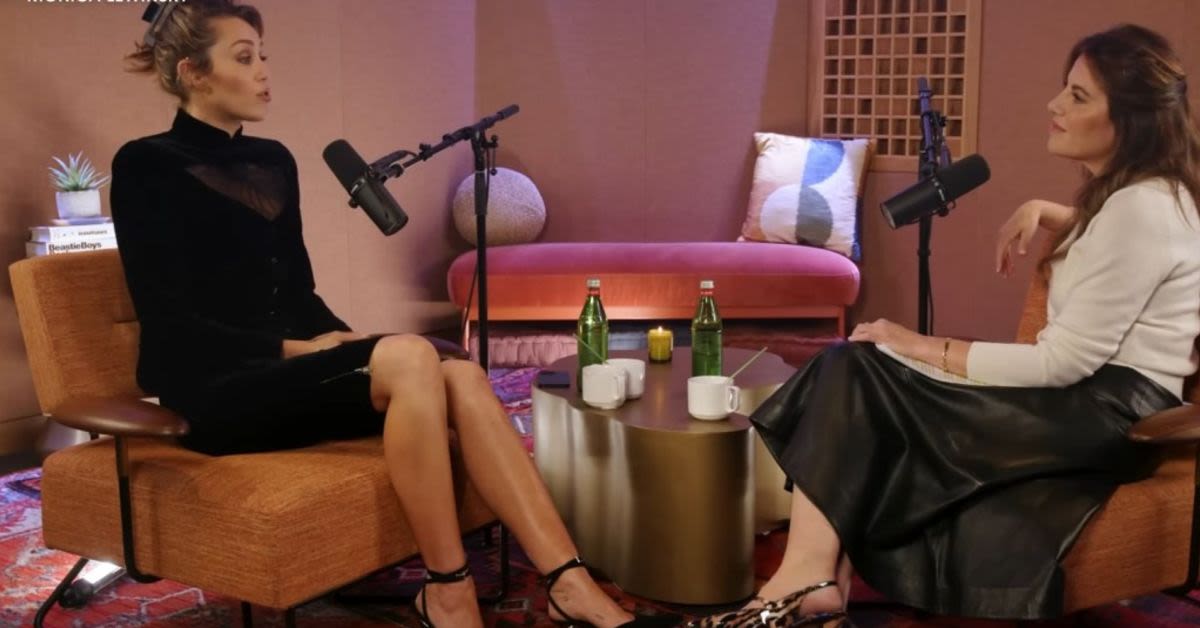
Pop star Miley Cyrus has opened up about the personal cost of her hyper-sexualized public image in a searching conversation with Monica Lewinsky, exposing the cultural contradictions that still surround female sexuality in an era that claims to celebrate liberation.
.
According to The Post Millennial, Cyrus joined Lewinsky on her podcast *Reclaiming* to reflect on how she broke away from her Disney Channel persona and attempted to reinvent herself as an adult artist, while Lewinskyonce the White House intern at the center of President Bill Clintons impeachment scandaldiscussed her own long struggle to rebuild a life and identity after becoming a global symbol of sexual scandal. The pairing is striking: one woman, a manufactured child star who chose to shock audiences with provocative performances; the other, a young staffer whose private affair with the most powerful man in the world was dragged into the harshest possible spotlight.
The two women explored how their public sexuality, though rooted in their own choices, ultimately produced deep feelings of shame, especially in relation to the men in their families. In Cyrus case, the shame came in the context of pop entertainment and deliberate image-making, while for Lewinsky it followed the publication of the Starr Report, which laid bare the intimate details of her relationship with Clinton.
Cyrus break from her squeaky-clean Disney image came in 2013, when she shed the Hannah Montana persona and released the single Wrecking Ball, accompanied by a now-infamous video that showcased her in overtly sexualized poses. That same year, she took to the stage in performances that flaunted her sexuality and aggressively rejected the wholesome image that millions of parents and children had associated with her for years.
"It was really hard for me in 2013," she told Lewinsky, "and I lost everything during that time in my personal life because of the choices I was making professionally. Y'know, if I kept dressing or acting a certain way, my relationships fell apart. No one wanted to date me because they didn't want to be with a woman, that sexual expression part was not for them, it was like shared with the world." Her comments underscore a reality that progressive culture often refuses to acknowledge: men may enjoy watching overt sexual display, but many do not want to build a life with the woman who makes herself a public spectacle.
Cyrus elaborated that her romantic relationships could not withstand the disconnect between what men wanted privately and what she was offering publicly. "So like, guys, when I would try to date when I was dating, or who I was engaged to at the time, that didn't work out because I was sharing a part of myself that men wanted saved for them only, and the fact that I would, you know, pose nude or dance in very little clothes, or show my body was making them feel like I was taking something away that was meant to be for them," she went on. In other words, the same culture that cheers empowerment on stage still operates on an instinctive understanding that intimacy loses its meaning when it is broadcast to the masses.
The emotional toll extended beyond romance and into her family life, where Cyrus felt a profound sense of embarrassment. "So I would have really hard times dating, and it was just, it was really hard. It was really hard for me to go home and see my dad and like look him in the eyes and not feel super embarrassed." That admission cuts against the feminist narrative that public sexual display is simply a matter of confidence and self-expression, suggesting instead that conscience and modesty are not so easily erased.
Lewinsky, for her part, described a similar burden of shame when the Starr Report exposed her sexual encounters with President Clinton in graphic detail. She recalled how difficult it was to face the men in her own family, saying "...my dad and my brother and my stepdad of you know just that all these things were out there, and my dad's a doctor, and he still went to work every day. My brother was in college." She said she still feels guilt over it, while Cyrus said she has largely worked through the guilt and shame that once weighed on her.
Beneath their stories lies something older and deeper than any modern media narrative: a primal instinct about sexual modesty, protection, and honor. For the most part, men want the women they are charged with protectingmothers, sisters, daughters, wivesto avoid appearing sexually available to the broader public, and women intuit this, which is why they often feel shame when they present themselves as sexually available to society at large.
One can argue that this is not merely a social construct but an instinctive human response tied to family, fidelity, and the preservation of trust. In some cultures, this instinct is taken to brutal extremes: in certain Islamic societies, the same impulse to guard female sexual honor has been twisted into the barbaric practice of honor killings, where a womans perceived sexual transgression can lead to her murder by male relatives.
In Western societies, and particularly in the United States, women have spent decades breaking down traditional norms governing how they present themselves in public. In practice, this has meant that behavior once considered scandalouslike Cyrus onstage antics or the open acknowledgment of affairs between subordinates and their powerful superiorshas become increasingly normalized, even glamorized, in entertainment and media.
Yet normalization does not erase the internal moral conflict that many women experience when their sexual behavior becomes public knowledge, especially in the eyes of the men they respect and love. The culture may preach liberation, but the heart often responds with guilt, and the mind scrambles to reconcile the desire for attention with the desire to be seen as worthy of respect.
Men, broadly speaking (with all the usual caveats), tend to want to see women in a particular light: as loyal, modest, and reserved in their sexuality, especially when it comes to the women they might marry or raise a family with. Women, despite decades of feminist rhetoric, often want to be seen in that same way, even as they are encouraged to behave in ways that undermine that image.
Popular culture has long hinted at this tension; as the Weezer song "No One Else" bluntly expresses, many men want a woman who is theirs alone, not a public commodity. Women, however, are told they should not want to be perceived as pure and unblemished, even though their own emotional reactionslike those described by Cyrus and Lewinskysuggest that this desire for purity in the eyes of loved ones is still very much alive.
It is precisely this tension that Cyrus and Lewinsky tapped into during their conversation, even if they might not describe it in those terms. Under the progressive, feminist model, the liberated American woman is not supposed to feel shame for publicly displaying her desires and sexualitybut as their stories show, she often does anyway.
The Me Too era further complicated this landscape by blurring the lines between consensual encounters and victimization. One thing that period revealed is that even when women willingly engage in sexual relationships, they may later feel ashamed of those choices, particularly when they conflict with how they want to see themselvesor be seen by others.
That shame can create a powerful incentive to reinterpret past events in a way that preserves a sense of innocence or purity. This is how consensual casual sex can, in some narratives, be mentally reimagined as coercion or even rape, especially when the man involved holds power or status that can be retroactively framed as inherently oppressive.
Lewinsky herself has embraced aspects of this reframing, praising the Me Too movement in 2018 and asserting that her relationship with Clinton "constituted a gross abuse of power" on his part. She was just 22 at the time of the affair, and in recent years she has tried to reinterpret the relationship through the lens of power imbalance and consent.
She has attempted to understand and reframe the experience, saying in 2018 that the relationship was "very, very complicated," and examining the definition of consent in light of "the power dynamics, his position, my age." She went on to say "He was my boss. He was the most powerful man on the planet. He was 27 years my senior, with enough life experience to know better. He was, at the time, at the pinnacle of his career, while I was in my first job out of college."
Yet even as she emphasizes the power imbalance, Lewinsky does not entirely absolve herself of responsibility. Still, she said that "none of the above excuses me for my responsibility for what happened. I meet regret every day." That acknowledgment stands in contrast to a broader cultural trend that often encourages women to see themselves exclusively as victims, rather than as moral agents capable of making wrong choices.
Cyrus, by contrast, appears less interested in recasting herself as a victim of patriarchy and more focused on the clash between public perception and personal growth. She understands the impact her public sexuality had on her relationships, but she sees it largely as a disconnect between who the world thought she wasDisneys Hannah Montanaand who she was becoming: an adult singer and musician, an artist trying to define herself apart from a corporate brand.
The broader cultural paradox is hard to miss: women are told they should be able to flaunt it and shake it without being labeled slutty, while men are encouraged to consume this display as entertainment without ever questioning what it does to their view of women as potential wives and mothers. Women want the freedom to perform sexuality without consequence, and men want the freedom to watch without feeling obligated to honor the woman behind the performance.
No matter how activists and academics insist things ought to be, the lived experiences of Cyrus and Lewinsky suggest that human nature has not changed nearly as much as the slogans have. Two outspoken women who have endured the full force of public scrutiny are now candidly acknowledging that shame, regret, and the desire for respect remain powerful forces, even in a culture that claims to have moved beyond such old-fashioned notions.
Their stories raise uncomfortable questions for a society that celebrates sexual exhibitionism while still quietly judging it, and for a feminist movement that promises liberation but often leaves women to grapple alone with the fallout of choices encouraged by that very ideology. As their conversation makes clear, the tension between public sexual freedom and private moral instinct is not going awayand no amount of progressive rhetoric has yet managed to erase the enduring human longing to be seen, especially by the men who matter most, as worthy of honor rather than as a spectacle.
Login