
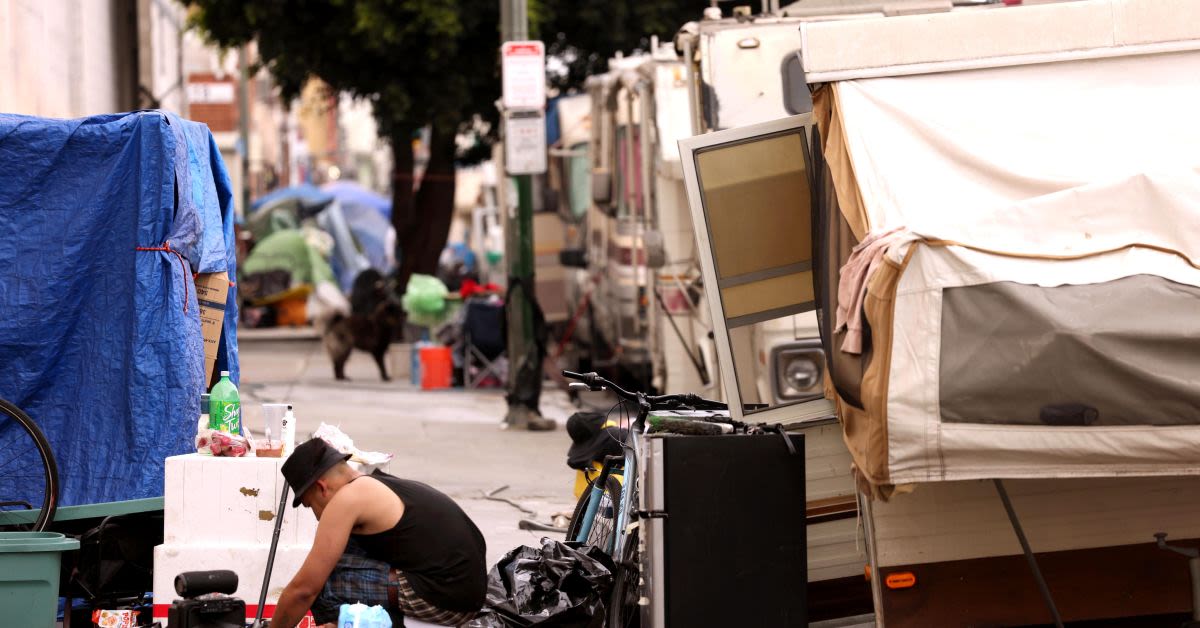
One of Californias most visible failures is playing out on the streets of Los Angeles, where a deepening homelessness crisis has become both a humanitarian disaster and a case study in what happens when progressive governance collides with activist obstruction.
According to RedState, the problem has been festering for decades and has only accelerated in recent years, even as Democrats at every level of government have promised action and delivered little more than press conferences and pilot programs. There is now a kind of grim resignation among residents, a sense that under one-party rule, no one seriously expects Governor Gavin Newsom, Los Angeles Mayor Karen Bass, or their allies to produce meaningful results on homelessness, despite years of lofty rhetoric and emergency declarations.
The situation has now deteriorated beyond mere political inaction, with evidence emerging that organized efforts are underway to block even modest attempts to restore order to public spaces. GOP gubernatorial candidate Steve Hilton recently walked through Los Angeles notorious Skid Row, and what he encountered went far beyond disturbing imagery of tents, trash, and human misery.
As Hilton navigated the debris-strewn sidewalks, stepping around addicts sprawled on the pavement, he was told that when police are dispatched to clear encampments, they are often legally barred from doing so. It is a surreal reality: officers tasked with maintaining public safety are effectively handcuffed, not by lack of authority, but by activist-driven court orders that prioritize encampment rights over community safety.
Homeless advocacy groups have repeatedly gone to court to stop law enforcement and city crews from removing drug users and other vagrants who have turned entire neighborhoods into open-air encampments. The result is a perverse system in which those illegally occupying public spaces and engaging in criminal behavior are shielded from basic enforcement under the guise of protecting civil liberties.
Hilton, clearly outraged by what he saw, shared his reaction bluntly. Ive been to Skid Row in Downtown LA many times. This was the most infuriating trip yet. Newsom, Becerra, Bass: How can you sleep at night knowing this is happening on your watch? he posted, underscoring the moral and political failure of the states top Democrats.
The legal theory driving much of this obstruction is that clearing encampments constitutes a violation of personal property rights, as if piles of belongings on public sidewalks were equivalent to a law-abiding citizens home. Under this logic, forcibly removing individuals who are illegally occupying public land and often committing crimes is framed as a civil rights abuse rather than a necessary step to protect the broader community.
At the center of this campaign is the Los Angeles Community Action Network (LA CAN), an activist nonprofit that has made a practice of using the courts to halt cleanup efforts. What has unfolded is a textbook example of California-style bureaucratic dysfunction: city and state officials drag their feet, activists sue to stop enforcement, and the crisis deepens while taxpayers foot an ever-growing bill.
Years ago, another group, the LA Alliance for Human Rights, sued the city to compel it to do what elected leaders had long refused to doenforce existing laws and implement a coherent plan to address encampments. Since 2020, this legal battle has raged, with courts ordering Los Angeles to devise a strategy to remove people from the streets and provide shelter, yet the citys response has been so inadequate that it has triggered additional lawsuits over noncompliance.
Los Angeles is now spending close to $1 billion a year on homelessness, an astonishing figure for a single city that has nonetheless failed even to slow the growth of the problem. The more money that is poured into the system, the more apparent it becomes that the issue is not a lack of funding, but a lack of political will, accountability, and a willingness to confront activist groups that profit from perpetual crisis.
Into this morass steps LA CAN, not as a partner in solutions, but as a legal roadblock to even incremental progress. What is emerging is the familiar paradox of many activist organizations: they are founded to address a social ill, but once the funding streams are established, their survival depends on the problem never being fully resolved.
Evidence suggests LA CAN is far more invested in litigation than in hands-on work that would actually reduce homelessness or improve conditions on the ground. During a court hearing last summer, the groups attorney argued against allowing an outside organization to conduct cleanup operations, a move that might have produced the one outcome activists seem most determined to avoidtangible results.
This is very complex, argued the LA CAN counsel, and no one has the answers. And certainly, its not up to all of us to decide these huge issues right here. Its up to local governments, elected officials and dedicated public servants ... not the alliance. Those local governments and dedicated public servants, of course, are the same Democrat officials who have presided over the explosion of encampments while spending staggering sums with little accountability.
As Hilton was told during his Skid Row tour, Mayor Karen Basss office works closely with LA CAN, even as the group continues to draw in donations and expand its influence. The relationship raises obvious questions about whether City Hall is more interested in appeasing activists than in enforcing laws and protecting residents who must live with the consequences of failed policy.
One critic described the arrangement starkly: The NGO LA CAN keeps LAPD away. With sub division STOP LAPD SPYING COALITION is under the LA CAN . They dont want the streets cleaned up. Their money comes from the people on the streets. This is the reported income for 2025. The implication is that LA CANs financial model is tied directly to the persistence of street encampments, giving it every incentive to resist meaningful cleanup.
What emerges is a picture of advocacy without accountability, activism without solutions. LA CANs efforts increasingly appear geared toward visibility and fundraising rather than measurable improvements in public safety or human dignity.
The organization even operates its own choral group, the Freedom Singers, a polished ensemble that has performed on America's Got Talent and The Kelly Clarkson Show. As expected, their performances are framed as efforts to raise awareness about homelessness in Los Angeles, a cause that plays well on national television and in donor appeals.
TRANSLATION: .
The Freedom Singers are composed of formerly unhoused individuals, people who have managed to leave the streets behind. Yet they now lend their voices to an organization that is actively fighting against efforts to move others off the sidewalks and into safer, more stable conditions, a contradiction that encapsulates the broader madness of Californias homelessness policy.
For residents and taxpayers, the unanswered question is how much longer this cycle of performative compassion and institutionalized failure will be allowed to continue. With nearly a billion dollars a year disappearing into programs that do not solve the problem, activist groups suing to block enforcement, and Democratic officials aligned with organizations that profit from ongoing chaos, Los Angeles has become a warning to the rest of the country about what happens when ideology and interest groups take precedence over order, responsibility, and genuine care for the vulnerable.
Login