
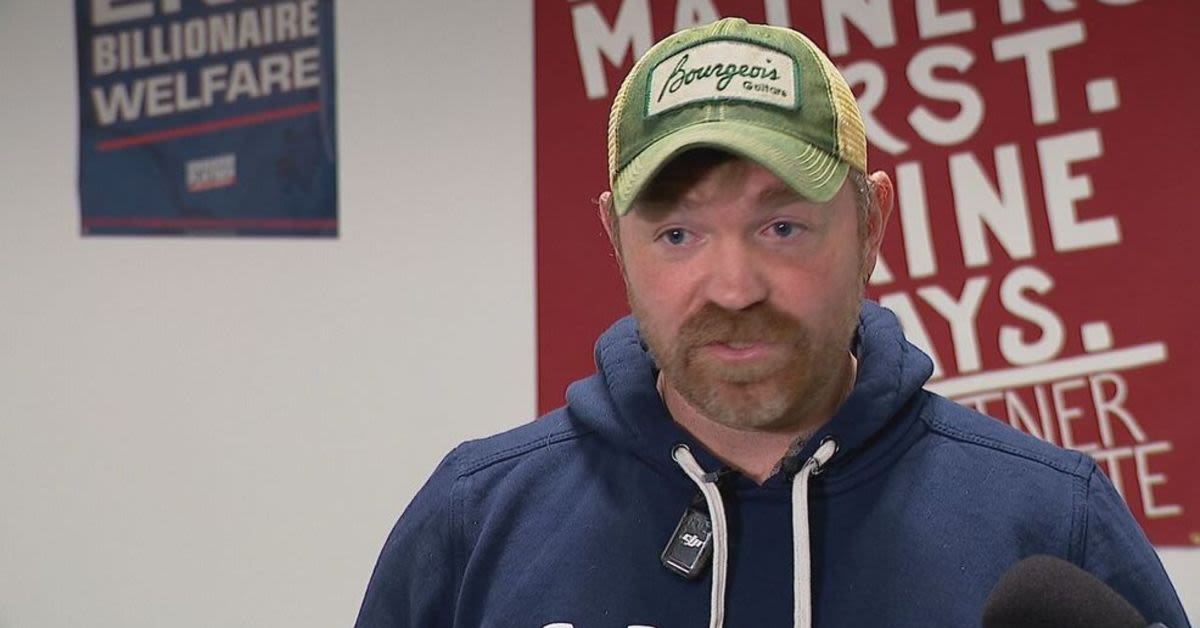
The political world was jolted this weekend as the death of Republican Sen.Lindsey Graham, 71, at his Capitol Hill home from sudden cardiac arrest collided with the ongoing fallout from the spectacular implosion of Democratic Maine Senate nominee Graham Platner.
According to Western Journal, the contrast between the two men could not be starker. Sen. Graham, a long-serving lawmaker and key figure in conservative politics, leaves behind a record of public service, foreign policy engagement and judicial confirmations that reshaped the federal courts. Platner, by contrast, exits the national stage as a disgraced, would-be senator who never made it to the ballot, withdrawing his candidacy after a former girlfriends rape allegations were published by Politico, detonating what remained of his already troubled campaign.
Platners collapse is not merely a story about one deeply flawed candidate but about the progressive ecosystem that elevated him. The Maine oysterman was transformed from a political nobody into a Democratic Senate nominee despite glaring red flags, including a Nazi tattoo and a documented history of instability and poor judgment. The episode exposes how the lefts activist and consultant class, obsessed with ideological purity and identity politics, can ignore basic character vetting until the scandal becomes too big to spin.
To understand how this debacle unfolded, it is necessary to revisit the timeline of the past week. A little after 3 p.m. on Monday, the rape allegations became public when Politico published the account of Platners former girlfriend, and within hours, the story had ricocheted across Washington and beyond.
By Monday afternoon and into Tuesday, the Democratic establishment that had once embraced Platner scrambled to distance itself. Virtually every elected Democrat and professional pundit who had previously defended or ignored his mounting disqualifying baggage suddenly denounced him, as the entire left-of-center political machine bolted for the exits.
The Maine Democratic Party, sensing a political catastrophe, announced late Tuesday that Platner was already trying to exert influence over who would replace him on the ballot. Even as they ran from the scandal, party officials made clear that Platner and his inner circle were attempting to leverage his withdrawal to shape the future of the race. The spectacle underscored how a man credibly accused of rape still believed he could dictate terms to a party that had foolishly elevated him in the first place.
Yet as Democrats fled, one figure moved in the opposite direction: Morris Katz. Whos Morris Katz, you may wonder? the original report asked, before answering its own question: He is the New York-based political adviser who helped engineer Platners rise from obscurity, and he did so not merely out of some misguided belief in Platners senatorial prospects.
For Katz, Platner was a vehicle for something much bigger. The 27-year-old consultant apparently saw in Platner a pathway to the White House, not just a Senate seat, and was already gaming out a presidential run in 2028 or 2032, depending on which account one believes. In Katzs telling, this was not just about flipping a Senate seat in Maine; it was about building a far-left national brand that could one day challenge for the presidency.
To many observers, Katzs ambitions sound delusional, the stuff of a political fantasist in need of a reality check. Yet his track record suggests he is not merely a crank shouting into the void. Katz has already demonstrated an ability to pluck obscure figures from the fringes and propel them into office as standard-bearers of the hard left, most notably some former New York State Assembly rando named Zohran Mamdani.
Mamdani, now a prominent socialist voice in New York politics, was born in Uganda and is therefore constitutionally barred from the presidency. For a consultant obsessed with building a national, presidential-level brand for the far left, that limitation posed a problem. Thus, Platner emerged as the next project an American-born, ideologically aligned vessel through whom Katz could attempt to scale his influence from local socialist politics to the national stage.
Even as Platners world was collapsing, Katz clung to that project. As late as Wednesday, the New York Post reported that Katz was still at the center of frantic maneuvering around Platners future. Mayor Zohran Mamdanis silver-spoon socialist adviser, Morris Katz, rushed over to beleaguered Graham Platners house Wednesday as they plotted how to remain a powerbroker in the Senate race enraging Democrats, the Post reported.
The gathering included Platners top campaign brass in addition to Katz, who is trying to hatch a plan for Platner to remain a voice in the Senate contest no matter what the accused rapist decides, a source familiar with deliberations told The Post. the outlet continued. His intransigence has left Maine Democrats livid and the Democratic Senatorial Campaign Committee (DSCC) in shock, according to the source. The same source added, The fact that the NYC mayors fixer is headed there to triage Maine has everyone fuming.
In other words, even as the Democratic Party apparatus was in full retreat, Katz was still trying to salvage influence from the wreckage. The self-styled fixer for Mamdani and other socialists was not prepared to relinquish his grip on a race he had helped shape, even if the candidate at the center of it was politically radioactive. Yet for all his maneuvering, the Mamdani teams fixer could not fix this.
After spending part of Wednesday hunkered down in what one account mockingly dubbed the Pltnerbnker, Platner and his advisers finally conceded that the campaign was unsalvageable. They decided he would release an 11-minute video announcing that he was suspending his campaign, a move that was supposed to calm the storm but instead raised new questions about timing and sincerity.
Before that video went public, Katz attempted to rewrite his own role in the saga. He took to X, the platform formerly known as Twitter, to declare that he was deeply disappointed in Platner and to insist that he had worked to wind down the campaign the moment the team became aware of the rape allegations. The post was clearly designed to portray Katz as a responsible actor who moved swiftly once the full gravity of the accusations became known.
The problem for Katz is that the public record does not neatly align with his self-exonerating narrative. The Readers added context note appended to his post highlighted the dubious nature of his timeline, pointing out that his actions did not match his claims of immediate disengagement. Moreover, Platners video itself did not constitute a formal withdrawal; he said he was suspending his campaign but did not file the necessary paperwork.
Axios later reported that Platner had told his team he would not officially withdraw until the day of the Monday, July 13 deadline, a delay that sent fresh waves of panic through Democratic circles. That delay made it appear that Platner and his advisers were still trying to extract concessions or maintain leverage, effectively holding the party hostage even as his candidacy was politically dead. Eventually, sanity prevailed and Platner formally withdrew on Friday, but not before days of needless drama.
That same Friday, the backlash against Katz intensified. The New York Times reported that [r]oughly 300 members of the Democratic Socialists of America have signed a letter asking that [Democratic Socialists of America] candidates and elected officials drop Morris Katz and Fight Agency, the consultant and firm closely associated with Graham Platners disgraced and abandoned Senate campaign in Maine. For a consultant whose brand was built within the DSA orbit, this was a significant rebuke.
Yet the letter was not solely about Platners alleged crimes. The letter comes after days of exasperated conversation among some members of the D.S.A. who feel the organizations reputation has been tarnished by its joint association with consultants who boosted Mr. Platner and Senator John Fetterman, who took a sharp rightward turn once in office, the Times reported. In other words, some on the far left were as angry about Fettermans refusal to toe the hardline socialist line particularly on Israel as they were about Platners alleged rape and Nazi tattoo.
The moral equivalence implied by that frustration is telling. On one hand, there is Platner, who reportedly raped a woman and had a Nazi tattoo and was a mentally ill sociopath who has repeatedly demonstrated excruciatingly (and/or illegally) poor judgment in his private life while in the midst of blackout alcoholism. On the other, there is Fetterman, whose chief offense in DSA eyes is that doesnt hate Israel. You can totally see how theyd make that equivalency, the original commentary noted with biting sarcasm.
Despite the DSA letter, Katzs influence has hardly evaporated, particularly in New York City. Morris Katz remains a top political adviser to Mayor Mamdani, the mayors office said in response to the letter, making clear that the socialist establishment in the city is not prepared to cut ties with its favored strategist. For all the hand-wringing among some DSA members, the power structure Katz helped build remains intact.
That persistence is troubling given what is now publicly known about Katz himself. He is not merely a cynical operative willing to prop up a deeply compromised candidate; he has his own disturbing history. Katz reportedly authored a book for boys as young as 10 titled Everything You Always Wanted to Know About Puberty ? and Shouldnt Be Googling: For Curious Boys, in which he allegedly wanted to include a picture of his own genitalia.
Such behavior would be disqualifying in any sane political movement, yet Katz has continued to thrive in the progressive ecosystem. Nor was he the only alleged predator orbiting Platners campaign. Daniel Moraff, one of the core trio that recruited the oysterman and pushed his candidacy forward, was reportedly dismissed from the 2022 campaign of now-Rep. Summer Lee of Pennsylvania after at least three complaints of sexual misconduct, as union-focused outlet Payday Report detailed in a Friday article.
Moraffs role in this fiasco is significant. He was among those who decided to proceed with Platners candidacy despite an expedited vetting process that had already unearthed some of the damaging information that would later explode into public view. That decision, driven by ideological zeal and the lure of a winnable Senate seat, ensured that the Democratic Party would be saddled with a nominee whose personal life was a ticking time bomb.
It is likely that Moraff will absorb much of the blame for this debacle, particularly among those eager to find a convenient scapegoat. Yet focusing solely on him would be a mistake. Katz, more than anyone else, was the marquee name attached to Platners operation, the consultant whose reputation and connections gave the campaign a veneer of credibility it never deserved.
Katzs insistence on keeping Platner in the game, even after the rape allegations surfaced, effectively held the Democratic Party hostage to the demands of a disgraced candidate and his inner circle. For days, he and his allies tried to negotiate from a position of moral and political bankruptcy, seeking to remain a voice in a race they had already poisoned. That posture revealed a consultant class more interested in power and leverage than in basic decency or accountability.
The broader lesson for conservatives is clear. This episode is not an isolated misstep but a symptom of a progressive movement that too often prioritizes ideological alignment and activist credentials over character, competence and moral clarity. When a man with a Nazi tattoo, a trail of personal chaos and a credible rape allegation can be elevated to a major-party Senate nomination, something is profoundly broken in the lefts vetting and value system.
As the nation reflects on the passing of a seasoned statesman like Sen. Lindsey Graham, it is worth contrasting his decades of public service with the chaos surrounding Graham Platner and the radical operatives who tried to ride his candidacy to greater power. Katz and his ilk are unlikely to disappear; well likely be dealing with the fixer and the candidates hes pushed for years to come. For voters who still care about integrity, constitutional norms and the character of those who seek high office, the Platner saga stands as a stark warning about what happens when ideology eclipses judgment and when the loudest voices on the left are allowed to define who is qualified to lead.
Login